The 25 Types of Executive Protection Agents – AKA Bodyguards

Fun Edition – A brutally honest field guide to many of the personalities you will find on any given  detail.

Let’s start with a disclaimer: This is all in good fun and mostly a light-hearted educational effort (…mostly). If you see yourself in one of these, take it as a chance to laugh, learn, and maybe reflect. Don’t worry, we’ve all been at least one of these at some point. Growth starts with self-awareness… and hopefully,  fewer mirror selfies.

1. The Tacticool Operator – Full MOLLE vest at a low-threat breakfast. Looks like he’s about to breach a compound to grab the client’s latte. Brings more gear than a Memorial Day sale at Palmetto State Armory.

2. The “I Know It All” – Claims he’s protected royalty, billionaires, and probably worked with a three letters agency. He/she won’t take ANY feedback but will gladly give you a TED Talk on unnecessary subjects you didn’t ask to know about.

3. The Shadow Ninja – Ghosts the second things get real, and s***t hits the fan. No one’s seen him since call time, but he swears he’s maintaining overwatch. Last seen ‘monitoring from a distance’, usually from the hotel buffet.

4. The Bully – Confuses intimidation with work competence. Yells at hotel staff. Threatens the valet. Bullies his teammates.

5. The Instructor – Treats every shift like a live seminar, whether you asked or not. Will gladly debrief you on your shoelace technique and critique your placement of your lapel pin.

6. The Gearhead – Shows up looking like a tactical vending machine. 19 gadgets, 4 flashlights with zero clue how to use anything. But hey, his gear costs more than your monthly rent. (Literally rattles as he walks down the quiet venue hallway with the principal.)

7. The Look-At-Me Suit – Carries himself like a runway model, impeccably tailored, hair shellacked to perfection, gleaming cufflinks, and a tie pin that’s seen more action than he has. Looks sharp, moves slow, and folds faster than a lawn chair at the first sign of trouble.

8. The Ghost of Contracts Past – Hasn’t worked a detail since flip phones were standard issue but claims to have protected everyone from the Pope to Elon Musk. No current gigs, just an endless loop of war stories, name-drops, and “you had to be there” moments.

9. The Quiet Pro – Calm, prepared, and drama-free. Doesn’t post, doesn’t brag, just shows up early, stays squared away, and handles business. He rarely speaks, but somehow always knows what’s coming. Never says a word, but you know he’s the one keeping things together. (Quite often has more experience than the whole team put together but sees no reason to bring it up or discuss it.)

10. The Client’s New Best Friend – More commonly known as the “BuddyGuard”. Desperate to be noticed by the client. Overshares personal stories. Laughs way too hard at the client’s jokes. Always standing just a little too close. Probably gets replaced after one trip. Always very quick to tell everyone how he and the principal have a “close knit relationship.”

11. The Rooftop Ninja Paranoid – Certain the next threat is coming from a rooftop sniper, a flower pot, or that sweet old lady with the purse. Scans every vent and pigeon like it’s housing a tactical assault team. Lives in a permanent state of Code Red, with zero chill. Pure cortisol, no calm whatsoever.

12. The LinkedIn Warrior – Online, he’s a tactical genius with elite leadership skills. On the ground? He panics when the elevator skips a floor. His resume’s impressive…too bad reality didn’t get the memo.

13. The Angry One – Everything was better “back in the day.” Finds fault with everything and everyone, especially if they’re breathing. Hates the client, the team, the hotel coffee, and probably the very concept of happiness and life itself.

14. The Philosopher – Talks more about ego death and quantum consciousness than safety zones and exits. Probably carries a worn-out copy of The Art of War and refers to threats as “energetic imbalances”.

15. The Codebook Guy – He is the human rulebook. Carries a laminated handbook like it’s a sacred text and quotes protocol like scripture. Has a meltdown if someone takes initiative without a written directive and a three-signature chain of command. Remember the yellow footprints in boot camp? This is the guy…

16. The Influencer – Formerly known as the Selfie Soldier 2.0. Every detail is a photo shoot and bragging opportunity. Can’t walk past a mirror without a tactical selfie. Hotel bathroom? Perfect for a photoshoot. Motorcade reflection? Even better. More focused on building their following than protecting the principal.

17. The Drama Queen – Complains about the hours, the post, the hotel pillow, and the client’s attitude, usually before their shift even starts, while they’re eating breakfast in a 3 Star Michelin restaurant. Thrives on tension and somehow turns every shift into a soap opera. If there’s peace on the team, give it 10 minutes… they’ll fix that.

18. The Certification Addict – Alphabet soup after their name and has more certificates than field hours. Proud graduate of every tactical, medical, and underwater knife-fighting course on the planet… but still can’t plan a basic advance or read a site map without getting lost.

19. The Gear Floater – Shows up empty-handed like it’s his first day…every day. No earpiece, no radio, no flashlight… somehow, no tie either. Treats the team like a mobile supply depot and still acts like he’s doing you a favor.

20. The Diplomat – He’s “Switzerland”, neutral, polite, and too nice to say no. Bends over backward to avoid conflict, says yes to everything, and somehow ends up overworked, overlooked, and underappreciated.

21. The Overcompensator – Short guy, big ego, bigger sunglasses. Talks like a tier-one operator, moves like a traffic cone. Folds the moment things get loud and real.

22. The Chronically Late Guy – Always “five minutes out”, even when the shift started an hour ago. Blames traffic, GPS, the rotation of the Earth, anything but himself. Shows up mid-shift with a coffee in hand and zero shame.

23. The Gym Bro – Lifts for three hours before call time, then passes out in the follow car. Protein shaker rattling like a maraca, sleeves one size too small hanging on for dear life, and zero clue where the principal is.

24. The One Assignment Wonder – Did one detail six years ago and hasn’t stopped talking about it since. Drops acronyms like candy, name drops vaguely. You’d think he ran a presidential motorcade, but it turns out it was a mall opening.

25. The One with “No Filter” – Says the quiet part out loud… and plenty no one ever wanted to hear. Awkward jokes, offhand comments, and zero reading of the room. Has made at least one client, staff member, and hotel manager deeply uncomfortable…before lunch.

BONUS TYPE: The Self-Promoter – Wears branded merch on every detail. Business cards in the glove box. Turns casual conversation into a sales pitch.

At the end of the day, this list is a humorous take on real-world behaviors we all encounter in the field. Recognizing these behaviors, whether in ourselves or in others, is not about assigning blame, but about promoting self-awareness and professional growth. Executive protection is a high-stakes environment where attitude, adaptability, and accountability matter as much as any other kind of skill. The goal isn’t perfection, it’s progress. Let’s all of us aim to be the type of professional others want on their team. And remember… A little humor along the way doesn’t hurt.

Did we miss a type? Share your experiences in the comments, and let’s be honest, we’ve all played one of these roles at some point in our careers.

#ExecutiveProtection #CloseProtection #SecurityProfessionals #BodyguardLife #ProtectiveDetails #EPCommunity #SecurityTraining #SecurityIndustryHumor #FieldNotesFromTheDetail #RealEPStories

Bodyguards for Kids are Back!

Founded in 2023 Bodyguards for Kids unites the security industry to raise donations for St. Jude. This is a unique opportunity to connect with others in the field while supporting a meaningful cause. When you donate through our event page on St. Jude’s website, 100% of your contributions go directly to the children of St. Jude, ensuring they and their families receive life-saving care and access to cutting-edge research at no cost.


Over the past two events, we’ve raised $35,779 and hosted 30 international subject matter experts, all thanks to the our incredible sponsors, speakers, and attendees!

Through this event, our community has:
♦️ Learned from international subject matter experts.
♦️ Won scholarships, books, and other exciting raffle prizes.
♦️ Contributed donations that make a difference for these little heroes.

This year, we’re aiming even higher, and we need your help to make an even bigger impact!

Bodyguards for Kids 2025 will take place on March 29-30 (Saturday & Sunday), starting at 9:30 AM PST. The best part? The event is virtual, so you can join from anywhere!

How to Participate?
Simply make a donation on the Bodyguards for Kids 2025 event page on St. Jude’s website. Your donation serves as your ticket to the event and your entry into our raffle. For the direct donation link CLICK HERE.

The minimum donation to attend our virtual educational event is $50.
And while we welcome all participants and all donations of any amount you wish to give, we offer additional recognition to those individuals or corporations who donate at or above the minimums listed below.

Event Sponsorship
If you own a security company, or even as a private person, you can make a donation in your or your company’s name to our cause and be publicly listed as an individual or company donor with your name or company name and logo shown on our event page.
-The minimum donation for individuals to be listed as event donors is $250
-The minimum donation for companies to be listed as event donors is $500

How Else Can You Support Our Event
You can contribute by donating security-related books, training scholarships, or products. Don’t forget to share our event on your social media! Spread the word and help us make a difference for children in need. Whether you’re a security professional, a business owner, or simply someone who wants to make a difference, this is your chance to give back. Don’t Miss Out!

Join us today and help shape a brighter future for children in need. Together, we can make an incredible impact.

For more information visit Bodyguards for Kids 2025

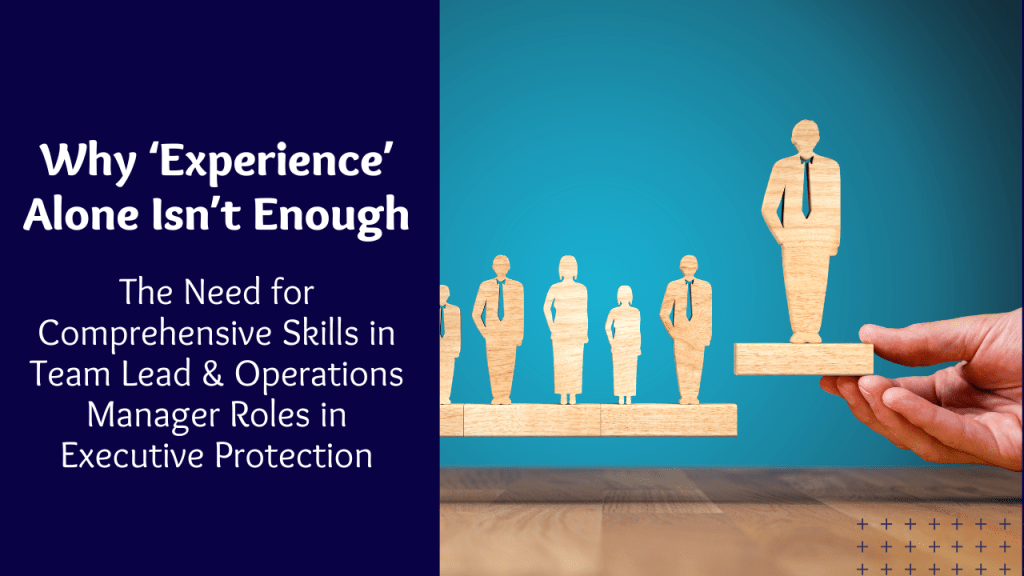
Why ‘Experience’ Alone Isn’t Enough

The Need for Comprehensive Skills in Team Lead & Operations Manager Roles in Executive Protection

We see a lot of articles and posts that address the issues with executive protection agents or what skills are needed and how one should perform as a member of the team. But we rarely see an article that clearly addresses the issues concerning those in positions such as a team leader, security manager or operational director. While its always easy to blame the boots on the ground, it’s important to see and address the issues concerning those who are managing them.

Primarily, we see leadership positions held by people who have just left (Yes, that’s correct, just left) the employ of the ‘Three-letter’ agencies, military, or in some cases, people who have been heavily involved in the industry as EP agents for a number of years. As you can understand, there’s every reason why the first group are, quite often, the best choice for such roles. So today we will discuss the second group, and why the EP industry today, demands more from its leaders than just experience in the field.

We all know that positions like Team Leaders (TLs), Security Managers, or Operations Managers play an important role in ensuring the success of protection teams and client satisfaction, and why holding  one of these positions is not just about having a “higher role” (and payrate). However, a recurring issue in the industry is that many individuals ascend to these roles solely based on time served as EP agents, security guards, military service, law enforcement, or other security-related positions. While such backgrounds may seem at first to provide a strong foundation, they are insufficient on their own to support the multifaceted challenges a leadership position entails. Being a good soldier, having a great arrest record as a police officer or K9 handler, or having been an EP agent for ‘X’  amount of time, doesn’t automatically translate that you are a great fit for a leadership position.

Leadership roles have critical needs that go beyond their past experience, and they require additional skills and training in diverse domains. The consequences of neglecting professional growth in these areas can result in complications such as poor hiring decisions, misaligned role assignments, and inadequate team management. You will be amazed to realize how many times a failure wasn’t so much the fault of the lowly agent, but primarily due to the people in those leadership positions above them.

The Problem with Experience-Only Leadership

Experience in the military, law enforcement or other security related roles, often instill discipline, situational awareness, and tactical skills, qualities that are valuable in executive protection. However, these experiences (or the time you spent in the career) may not translate to effective leadership or operational management in a corporate or private security setting. Here’s why:

  • Inability to Define the Right Candidate for the Job

Many TLs, Security Managers, and Operations Managers lack the skills to create detailed job profiles for hiring. Instead of matching the best candidate to the job’s requirements, they often try to tailor the job to fit the skills of candidates they personally favor. They often default to selecting individuals with similar backgrounds as theirs or their generalized security experience. They overlook key factors such as soft skills, specialized training, and the ability to adapt to the diverse requirements that the client needs or wants. And even more detrimental, there are many cases of managers and detail leaders who find the resume or background of a highly qualified candidate to be intimidating and/or feel challenged by their respective experience and remove them from the list of qualified applicants. While the industry seems to always be complaining about the “quality” of agents, no one appears to be complaining about who did or didn’t hire them for the client in the first place! The best ‘fit’ for the task is not always on the task…

  • Challenges in Role Assignment

Even after hiring, many leaders fail to continue to assess their team members’ individual strengths and weaknesses. Each agent brings specific skills to the table, yet instead of assigning them to roles that align with their expertise, such as surveillance detection, client interactions, or working with children, they often assign tasks indiscriminately. This approach leads to inefficiency, mistakes and decreased team morale. While it can sometimes be challenging to identify the best role for an individual, leaders should be open to reassigning team members. If a placement doesn’t work, avoid forcing it and instead, reassign them to a different position. Leaders must be willing to experiment and refine roles until each team member is in a position that maximizes their value within the team. Try to maintain a long-term mindset. Role assignments are not static; they should evolve as agents grow in their careers and as team needs change.

It is also important to create a culture where team members feel comfortable discussing their strengths, preferences, and areas where they excel. This insight can be invaluable when deciding role assignments. In addition, when assigning roles, think beyond individual skills and consider how team members will interact. The right mix of personalities and expertise can significantly enhance overall team effectiveness…And the wrong combination can be its downfall.

  • Lack of Professional Empathy

Good and effective leaders must be able to balance operational demands with the well-being of their team. Unfortunately, history has shown us that 9 out of 10 in leadership positions don’t particularly care about their team. This can come about  because they are not aware of what it takes to be the agent on the ground, or because of their own past experiences in very much different environments. They expect their agents to work overtime (mostly without being paid for it) or handle unreasonable workloads without considering the impact on their wellbeing and operational performance. It still baffles us that many do not seem to grasp the fact that if you overwork your agents, their attention to detail and their reaction time to incidents will suffer significantly. And we all know how important these two areas are for a protective detail!

Some will even go to extra lengths to ask the agents to do duties that are outside their scope of work, because they do not want to “inconvenience” their clients by making proper demands. And we have found out, instead of standing up for their teams, they are terrified to speak to their clients. They allow their ‘Boots on the Ground’ (who are the most important part of any security detail) to be abused and mistreated, instead of doing what their job calls for, which is to be the go-between and make sure the team has what is needed and that they are all being taken care of.

And for those reasons, this is the type of additional training, skills, and mindset critical for such roles:

Leadership and Management Training: Leadership courses can teach skills like conflict resolution, team building, and emotional intelligence. Leaders who can inspire trust and foster a positive team culture are more likely to achieve long-term success.

-Human Resource Management: Training in hiring practices and personnel management is crucial for selecting the right candidates and building a well-rounded team. Leaders should learn how to conduct behavioral interviews, assess qualifications, and identify red flags during the recruitment process.

-Operational Planning and Logistics: Advanced training in operational planning can help leaders create efficient schedules, optimize resources, and assign roles based on individual expertise. This ensures that every team member contributes their best to the mission.

-Empathy and Emotional Intelligence: Leaders must cultivate professional empathy—understanding their team’s needs, limitations, and aspirations. This includes setting reasonable work hours, recognizing accomplishments, and providing support during challenging assignments.

When TLs and Operations Managers possess well-rounded skill sets, the entire team and client benefits.

A leader with HR skills can build a diverse and competent team, ensuring that each member contributes unique strengths to the operation. By aligning team members with tasks that match their expertise, leaders can enhance efficiency and job satisfaction.

A leader who shows empathy and prioritizes work-life balance, fosters loyalty and motivation, leading to better performance and lower turnover. When the team operates seamlessly under skilled leadership, clients receive a higher level of service, strengthening the organization’s reputation.

The roles of TLs, Security Managers, and Operations Managers in executive protection are too critical to be entrusted to someone whose value is solely based on some specific skillset unrelated to the role. While some backgrounds can be valuable, they must be complemented by additional training and skills in leadership, human resources, operational planning, and empathy. Only then can these leaders effectively hire, manage, and deploy their teams, ensuring operational success and client satisfaction.

For the EP industry to continue evolving, it’s time to prioritize comprehensive development for those in leadership positions. This is not just a recommendation—it’s a necessity for the future of executive protection.

#ExecutiveProtection #LeadershipDevelopment #SecurityManagement #SecurityOperations #RiskManagement #TeamLeadership #CorporateSecurity #SecurityTraining #TeamLeader #ProtectionSpecialist #CrisisManagement

The Importance of Effective Communication Between Protectee and The Executive Protection Team

The last few days have produced a video of the meeting between Vladimir Putin and Justin Trudeau and has been making the news within the executive protection industry circles as it shows the great communication levels between Putin and his EP agents. This is highlighting once again the importance of communication between the protective team and the principal. Although it is a subject rarely mentioned in EP training schools, communication is vital, especially in an industry where safety is the prime objective and split-second decisions can make all the difference, sometimes even between life and death.

Photo by August de Richelieu on Pexels.com

Long gone are the days of an EP agent being considered just a body or a gun for hire. The industry has changed, and with that has changed what the definition of an EP agent is and what responsibilities fall under their roles. Being able to communicate effectively with your team members, your client, and anyone else around the client is vital for a successful operation. Consider the scenario where you are on a detail and you have to communicate with your client in a covert way, because something changed, and you have to move. Or your client is meeting with fans or has a personal meeting and someone is making him feel threatened, scared, or insulted. You need to be able to know when to act and your client must be able to understand your directions and most importantly be able to follow them up.

Now, the simplest definition of communication is defined as a process that involves sending and receiving messages through the verbal and non-verbal methods. And as with many other forms of communication, it needs two sides to function properly. For the sender, and the receiver, when we talk about communication between an EP agent and the protectee, it is important to have both sides invested in effective communication, otherwise it won’t work effectively. In high-pressure situations, split-second decisions can mean the difference between safety and peril. Effective communication enables the protection team to relay vital information promptly, allowing them  to make informed decisions in the blink of an eye. Whether it’s identifying an exit strategy, assessing the credibility of a potential threat, or removing themselves from a potential dangerous or embarrassing situation, clear and concise communication between EP teams and their clients is paramount.

Mutual Understanding Between Protectee and EP agent

Mutual understanding is important for effective communication and goes beyond mere verbal exchanges; it includes a deep comprehension of the protectee’s habits, preferences, emotional state, body language, current situation/environment, and potential vulnerabilities. It also means that the protectee has a good understanding of what his/her protective team can do and trusts their abilities, judgment, and they themselves as professionals.

Building Effective Communication

Many will tell you that clients have to go through training classes with them. The reality is, it is very rare, if not impossible, for a client to be willing to attend a class with his EP agents, they feel it is our job, they have much more important things to attend to. In our 56 years of combined experience, we only saw one client, ONE, who took a four-day class with his protective team. And the reason he did it was because the client himself was quite interested in anything “tactical”. The majority of your clients either hate guns, value their time more, or do not have the slightest interest to learn anything about safety, “Better things to do”. Don’t forget, that is what they hired YOU for…

However, there are ways to build effective communication with your clients.  

  1. Learn your client well. This is probably one of the most important steps for building effective communication. Take your time to learn about the people you will be protecting, know if they have any physical or psychological issues (it can affect how they express themselves). Learn how to “read” their body language, like when they feel discomfort, are scared, embarrassed, angry, and even what they like or dislike. Although this is hard when you are hired for short gigs, because you don’t have the luxury of time, try to learn some information from their PA’s or previous EP agents who may have worked before you.
  2. Be situationally aware. In our industry, real-time awareness and dynamic risk assessment are non-negotiable. Make sure that you know well what is going around your client and how specific people or behaviors make them feel, as well as be aware of any potential suspicious people or threats toward them.
  3. “Read the room”. ‘Reading the room’ involves grasping the nuances of the environment, the people present, and the emotions prevailing within the space. It requires constant vigilance and adaptability to ensure proper communication, positive cooperation with the client, and everyone else surrounding them, as well as the client’s safety and well-being at all times. “Reading the room” helps executive protection agents detect emotions and adapt their approach, conversational tone, or, in many cases, just remain quiet. By closely observing body language, facial expressions, and interactions among attendees, staff, corporate members, and even family members, agents can identify not only “moods” but also individuals who may pose a risk to the client’s safety.
  4. Act accordingly. Many colleagues fail to act accordingly to the threat/situation/environment because they are so programmed to ‘’impress’’ the protectee, leading them to over abuse their roles and their use of power/authority and ending up either embarrassing the client or disrupting their moment/meeting. If you overreact once or twice the client will stop following your directions when there is actually a need and time to do so. Bottom line: Don’t over react unless there is a reason to.
  5. Keep Protectee Informed.  Consider making sure that the protectee remains informed about any potential threats or changes in the security environment. Whether it’s a BOLO on a specific person, shift in the itinerary, a sudden change in the protectee’s schedule, or an unexpected development, open lines of communication empower both parties to respond proactively, mitigating risks and ensuring a seamless flow of operations. It also helps with building trust with the person you protect. They feel involved, valued and understood, and they are more likely to follow-up with your directions in the case of an emergency. By actively listening to your protectee’s concerns, addressing their needs, and keeping them informed every step of the way, you can create a sense of mutual trust that forms the cornerstone of an effective protective operation. Something to consider though, do not overdo it! Use simple language (avoid professional terminology) and keep it simple and to the point.

Effective communication, as in the example of the video with Putin and his EP agent, may seem impressive. It is, but what you should know is that there is a lot of time invested by both parties to reach that level. As you become able to read your clients, they will also begin to read you as well. If you have a good relationship, they will be able to read into your body language as well and know what is coming so they can prepare themselves and follow your directions quickly. A protective detail is like a good watch mechanism. Everyone involved is a piece of it and plays a big part in making it work…Like a clock…

The Protector’s Resource Hub is here! and, is free!

Welcome to the official resource hub for Executive Protection Agents, offered by LeMareschal Protection & Intelligence Solutions. Understanding the unique challenges and dynamic environments faced by agents daily, our goal is to equip you with an arsenal of essential tools and links. From links with free educational courses, real-time threat intelligence sources to advanced protection methodologies and free templates, this page is designed to enhance your operational efficiency and situational awareness. As leaders in the protective and intelligence industry, we believe in empowering our community with the best resources, ensuring seamless protection for all.

Photo by Armin Rimoldi on Pexels.com

Disclaimer: This page serves as a resource of links directing you to external, third-party websites. We are not responsible for the accuracy or content of information presented on these external sites. Please do your due diligence and use these suggestions as you see fit.

FREE Educational Courses

  1. Council of Europe https://help.elearning.ext.coe.int/
  2. FEMA https://training.fema.gov/is/crslist.aspx?page=2&lang=en
  3. TRIPwire https://tripwire.dhs.gov/training-education/counter-ied-training-0#faq-question
  4. Center for Development of Security Excellence- Defense Counterintelligence and Security Agency https://www.cdse.edu/Training/eLearning/
  5. ESRI academy https://www.esri.com/training/catalog/search/
  6. MSG https://www.managementstudyguide.com/corporate-etiquettes.htm
  7. NWC https://usnwc.libguides.com/c.php?g=494120&p=3381401
  8. Disaster Ready Org https://www.disasterready.org/
  9. Basel Institute of Governance https://baselgovernance.org/basel-learn
  10. My Languages Org https://mylanguages.org/
  11. UNODC https://www.unodc.org/e4j/en/tertiary/counter-terrorism.html
  12. UNODC Global E-Learning https://www.unodc.org/elearning/en/courses/course-catalogue.html
  13. United States Institute of Peace https://www.usip.org/academy/catalog-global-campus-courses
  14. Counter-Terrorism Training Suite https://ct.protectuk.police.uk/
  15. United Nations Department of Safety & Security https://training.dss.un.org/
  16. UNICEF https://agora.unicef.org/
  17. TEEX https://teex.org/class/AWR375/
  18. Geneva Centre for Security Sector Governance https://www.dcaf.ch/resources?type=elearnings
  19. SANS Institute https://www.sans.org/cyberaces/
  20. NIST https://www.nist.gov/itl/applied-cybersecurity/nice/resources/online-learning-content
Photo by Lisa Fotios on Pexels.com

FREE Resources/Tools

  1. Counter Terrorism Guide https://www.dni.gov/nctc/index.html
  2. Centre For Research and Evidence on Security Threats https://crestresearch.ac.uk/resources/
  3. Health and Safety Executive https://www.hse.gov.uk/simple-health-safety/risk/risk-assessment-template-and-examples.htm
  4. Human Security Collective https://www.hscollective.org/our-resources/our-resources/?acceptCookies=65c2c526e98d0
  5. National Sex Offenders Public Website (USA) https://www.nsopw.gov/search-public-sex-offender-registries
  6. Counter Extremism Project https://www.counterextremism.com/about
  7. SPLC https://www.splcenter.org/hate-map
  8. Stanford Center for International Security and Cooperation     https://cisac.fsi.stanford.edu/mappingmilitants
  9. Global Network of Extremism and Technology https://gnet-research.org/
  10. Bellingcat https://www.bellingcat.com/category/news/?fwp_categories=news
  11. Media Bias Fact Check https://mediabiasfactcheck.com/center/
  12. 2023 Index of Economic Freedom https://www.heritage.org/index/about
  13. ESRI real-time mapping NYC https://coolmaps.esri.com/#12
  14. FBI Study of Pre-Attack Behaviors of Active Shooters in the United States Between 2000 and 2013 https://www.fbi.gov/file-repository/pre-attack-behaviors-of-active-shooters-in-us-2000-2013.pdf/view

The Role of Counter-Surveillance in Executive Protection Operations

One of the most underestimated skills of an executive protection agent is counter-surveillance tactics. This specific topic is either being touched on for a brief time during EP courses or not covered at all. Within the functions of protective operations, counter-surveillance plays a pivotal role in mitigating risks and ensuring the effectiveness of protection strategies.

When most people think about bodyguards, they think about the people who are around a celebrity or an important public figure. They do not know that executive protection is more than just protective agents surrounding a VIP. It involves a comprehensive approach to security, involving thorough planning, risk and threat assessments, intelligence gathering, comprehensive advance work, and strategic responses. While visible security measures (such as bodyguards) are important, the covert and preemptive aspects are equally critical to a successful protection operation. Counter-surveillance is the art and science of identifying and countering threats before they manifest, making it an indispensable tool in the executive protection toolbox. It is such an important area that it needs to be properly studied.

Photo by Burak The Weekender on Pexels.com

Why are specific people at risk for surveillance? The objective of surveillance is to monitor, record, and analyze the movements and activities of individuals or groups to gather information. Criminals use surveillance to discover what your weaknesses are to do you harm (especially terrorist organizations), and paparazzi use it to find your patterns so they can predict your next move and where to find you next. Some other reasons individuals or entities may be surveilled is to gather business intelligence or other personal motives such as private investigations, often relating to legal matters or personal disputes. An all-new group of people who use surveillance against their victims are sex predators and stalkers. The intention of these individuals is obviously for kidnapping, trafficking, and harm to their victims.

Understandably, there are many risks associated with being followed or monitored, such as:

  • Compromised Personal Safety: Surveillance can be a precursor to more direct threats such as physical attacks, kidnapping, or ambushes.
  • Privacy Invasion: Persistent surveillance can lead to significant invasions of privacy, affecting the mental well-being and sense of security of the clients and their family members.
  • Information Leakage: Surveillance can result in sensitive or confidential information being intercepted, posing risks to both personal and corporate security.
  • Behavioral Alteration: Knowing one is being watched can lead to altered behavior, which can impact the client’s performance and decision-making.

What is Counter-Surveillance? Counter-surveillance is the proactive practice of monitoring and countering potential threats, hostile surveillance, or intelligence-gathering activities aimed at the protected individual or group. It involves the use of advanced techniques, technology, and trained personnel to detect, deter, and neutralize potential threats while avoiding confrontation.

And it can be crucial for the following reasons:

  • Early Threat Detection: One of the primary advantages of counter surveillance is the ability to detect threats in their early stages. Hostile individuals or groups often conduct surveillance to gather information, assess vulnerabilities, and plan attacks. In his book “I was Born on November 17”, Dimitris Koufontinas, one of the most notorious domestic terrorists in Greece and the leader of the infamous November 17 terrorist organization, (responsible for the assassination of CIA Chief of Station Richard Welch and 4 other Americans as well as the killing of at least 19 other individuals), explained in detail the tactics of how the terrorist organization would conduct surveillance on their targets. A very educational read for those interested in learning from the adversary. In such events, effective counter-surveillance can intercept early surveillance attempts by raising awareness and allowing security teams to intervene before a threat materializes.
  • Reducing Vulnerabilities: Counter surveillance helps protect individuals by identifying weaknesses in their security protocols. By pinpointing potential vulnerabilities or patterns that could be exploited by malicious actors, protective measures can be adjusted or strengthened to minimize risk. Weaknesses can be found in the biggest and most sophisticated protective operation, no one is immune.
  • Preventing Ambushes or Attacks: Surveillance is often a precursor to ambushes or attacks. Counter surveillance can identify suspicious individuals or activities that may indicate imminent danger, allowing security teams to take proactive measures to prevent an attack.
  • Enhanced Situational Awareness: Counter surveillance teams provide real-time intelligence, which enhances the situational awareness of executive protection personnel. This enables them to make informed decisions, adjust routes, and respond effectively to changing circumstances.
  • Protecting Privacy: Counter surveillance also plays a role in protecting the privacy of high-profile individuals. By identifying and deterring paparazzi or overzealous fans, it allows clients to maintain a degree of personal space and control over their lives. In one of our previous podcasts with a retired famous paparazzi, he admitted that he knew where to find celebrities because they had a routine life and used the same restaurants or bars over and over again.
Photo by Aleksandar Pasaric on Pexels.com

Things to consider during counter-surveillance operations. A good counter-surveillance agent is the one who understands the tactics of surveillance practices. As we mentioned earlier, surveillance and counter-surveillance are a very specialized area within protective operations and one needs to dedicate a good amount of specialized training to it. Something to consider for those EP agents who want to learn more.

Before diving into counter-surveillance, it’s essential to grasp the concept of surveillance itself. Learn from your adversary. In order to be able to counter an act, you must know how to perform the act. Previously, we explained who may be conducting surveillance on you or your client and why. Below, we will analyze the methods of surveillance, the various methods used, different forms a surveillance can take, and commonly used techniques. If you know how your adversary operates, you will be more skilled in anticipating their moves, identifying surveillance, and mitigate risks.

Methods of Surveillance: Surveillance methods vary greatly depending on the objectives and the technology available. Common methods include:

  • Physical Surveillance: Involves the physical observation of a person or place. It can be either stationery (watching from a fixed position) or mobile (following the target).
  • Technical Surveillance: Utilizes electronic devices like cameras, microphones, GPS trackers, and wiretapping equipment to monitor and record activities.
  • Cyber Surveillance: Involves monitoring online activities, including email communications, social media interactions, and browsing history.
  • Aerial Surveillance: Uses drones or other aircraft to observe from above.
  • Agent-Based Surveillance: Involves human intelligence where individuals gather information through personal interaction or infiltration into a group.

Tools Used in Surveillance: Surveillance tools range from simple binoculars to sophisticated electronic equipment:

  • Optical Surveillance Tools: Binoculars, telescopes, and cameras.
  • Audio Surveillance Tools: Listening devices, voice recorders, and wiretaps.
  • Electronic Surveillance Tools: GPS trackers, motion sensors, and digital monitoring software.
  • Data Surveillance Tools: Software for monitoring internet activity, including email interception and network monitoring.

Forms Surveillance Can Take: Surveillance can take several forms, including:

  • Covert Surveillance: Conducted without knowledge of the subject.
  • Overt Surveillance: Visible and obvious monitoring, often used as a deterrent.
  • Personal Surveillance: Focused on individuals or small groups.
  • Mass Surveillance: Broad monitoring, often of large populations or areas.

Common Techniques Used in Surveillance: Surveillance techniques will depend on the purpose and context.

  • Tail Surveillance or “Tailing”: Following a subject discreetly.
  • Stationary Surveillance: Observing from a fixed point.
  • Electronic Eavesdropping: Listening in on conversations or communications.
  • Cyber Monitoring: Tracking online activities and digital footprints.
  • Pattern Analysis: Studying routines and behaviors for anomalies.

Counter-surveillance 101

Counter-surveillance tactics are critical for executive protection teams to ensure the safety and security of high-profile individuals. These tactics help identify and mitigate potential threats and hostile surveillance. One of the most important aspects of counter-surveillance is being able to identify suspicious people/behaviors. For this, we will use the U.S. government acronym TEDD which illustrates the principles one can use to identify surveillance. TEDD stands for Time – Environment – Distance – Demeanor. In other words, if a person sees someone repeatedly over a particular timeframe, in different environments and/or at distances not proximal to each other, or one who displays a poor demeanor, then it can be assumed he or she is under surveillance.

When an individual becomes the specific target of a planned attack, they may find themselves subjected to various elements of surveillance, including time, environment, and distance (TEDD). However, if the focus of the threat is directed towards a location, such as a subway or a government facility where the individual works, the primary element to be aware of is demeanor. Demeanor, in this context, refers to a person’s behavior that appears unusual or unnatural, or his presence is unjustified. This behavior can range from overtly suspicious actions, such as loitering without a clear purpose or reason for being in a particular place, to more subtle signs that are almost undetectable to an observer. Sometimes, it’s a gut feeling or a sense that something isn’t right, rather than something visibly obvious.

Signs of poor demeanor may include:

  • Mirroring: Acting in sync with the target’s movements, indicating a potential attempt to monitor or follow them.
  • Communication: Making efforts to communicate or coordinate with others when the target moves, possibly signaling collaboration within a surveillance team.
  • Avoiding Eye Contact: Refraining from making eye contact with the target, potentially to avoid drawing attention or revealing intent.
  • Unnatural Behavior: Signs of emotional stress, such as nervousness, excessive enthusiasm, or noticeable sweating.
  • Abrupt Movements: Making sudden turns, stops, or changes in direction that seem out of place or unnatural.
  • Extended Presence: A person who remains in a specific area for an unusually long period without an apparent reason.
  • Unjustified Contact: Repeated or unplanned interactions with a specific person without a clear explanation.
  • Unjustified Presence: A person whose presence in a particular location or at a specific time is not easily justified or explained.
  • Pattern Repetition: Multiple individuals displaying similar behaviors or signs.
  • Standing Out: Someone who noticeably differs from the surrounding crowd in some way.
  • Intuition: Trusting your instincts when you get a bad feeling or sense that something is amiss.
  • Observing Hands: Pay attention to whether individuals are holding anything that could be used as a weapon or a tool for kidnapping.
  • Covert Communication: Monitoring for signs of communication, such as texting, hand signals, nods, repeated eye contact, or any unusual interactions when you move.


In the context of terrorism, displaying a poor demeanor can also involve:

  • Inappropriate Attire: Wearing clothing that is unsuitable for the weather, like donning heavy coats in the summertime, or exhibiting unusual bulges or wires under clothing that might suggest concealed weapons or devices.
  • Physical Discomfort: Showing signs of nervousness, such as excessive sweating, mumbling, or fidgeting.
  • Avoiding Security: Deliberately attempting to evade security personnel or behaving in a manner that raises suspicions when encountering security measures.
  • Unusual Baggage: A person carrying bags, suitcases, or luggage that appears out of place or disproportionate to the situation.
  • In addition, according to some reports, suicide bombers often exhibit an intense stare as they approach the final stages of their mission. They seem to have tunnel vision, being able to focus only on their intended purpose or target. They may also be under the influence of drugs.


We have to highlight that poor demeanor encompasses a wide range of behaviors and signs, from the overtly conspicuous to the subtly unusual. Being vigilant and aware of these indicators can help individuals recognize potential threats and take appropriate actions to ensure their safety in various situations, especially in environments where security risks are a concern.

Photo by Kaique Rocha on Pexels.com

Recognizing signs of being followed is critical for executive protection teams. One should be on the lookout for:

  • Repetition in Appearances: Notice repeated appearances of the same vehicle or person(s) in different locations or over time.
  • Unusual Patterns: Highlighting patterns such as a person on foot or in a vehicle making the same turns, stopping when you stop, or lingering in the same areas.

-Using your peripheral vision, mirrors, and other reflective surfaces (like shop windows or parked cars) for better observation.

-Enter buildings or make sudden, unexpected turns to test if a follower is maintaining their pursuit.

-While driving, change speeds, make sudden, unexpected turns to test if a follower is maintaining their pursuit. Make a stop at a safe location to observe if any vehicle stops nearby or behaves suspiciously. When you can, perform a legal and safe U-turn to see if the following vehicle replicates the maneuver. Drive a route in reverse or returning to a previous location to check for surveillance.


Counter-surveillance tactics for executive protection teams:

  • Behavior Analysis: EP team members have to learn how to observe the behavior of people in the vicinity of the protected individual. Look for signs of unusual or suspicious conduct, such as individuals who appear to be loitering, repeatedly changing their positions, taking a keen interest in the protected person, or other signs we mentioned earlier.
  • Varying Routes and Schedules: In our world, we say routine can be as deadly as a bullet, and there is a truth to it. EP teams must avoid predictable patterns by varying the routes and schedules of the protected individual. This makes it more challenging for potential threats to plan and execute an attack. And an additional challenge is that many clients become quite used to their patterns and it takes patience and understanding to slowly convince them that the day-to-day changes in routes or patterns are a good thing and not a bother or a hinderance.
  • Discreet and Safe Communication: It is disappointing to say that we have many examples of EP agents who do not practice secure and discreet communication methods, adding more risks to their client’s safety. Always maintain OPSEC, use secure communication apps (Sorry, but WhatsApp is NOT one of them), and be careful what you post on social media.
  • Counter-Observation: The majority of EP operations are done by small teams. Not all clients or teams have those extra bodies to deploy for their own counter-surveillance team. That is why it is important for the team members to be extra vigilant and keep an eye on individuals who may be surveilling the protected individual.
  • Technical Surveillance Detection: Use specialized equipment to detect electronic surveillance devices, such as hidden cameras, bugs, or GPS trackers. In addition, educate yourself and seek extra training in how to sweep vehicles, accommodations, and meeting locations for listening devices or threats.
  • Situational Awareness: Promote constant situational awareness among team members. Encourage them to be vigilant and observant of their surroundings, including people, vehicles, and anomalies.
  • Route Reconnaissance: Conduct advance reconnaissance of routes and locations where the protected individual will visit. Identify potential chokepoints, escape routes, and secure areas.
  • Spotting Surveillance Teams: Train team members to recognize signs of hostile surveillance teams. Look for vehicles or individuals that appear out of place, conduct frequent U-turns, or employ evasive driving tactics.
  • Emergency Response Protocols: Develop and rehearse with your team emergency response protocols to address situations where hostile surveillance is identified. These protocols should include contacting law enforcement, documentation, team briefings, and taking appropriate actions to ensure the principal’s safety.
  • Counter-Intelligence Measures: Be aware of potential leaks of sensitive information within the team, household personnel, or from external sources. Implement counter-intelligence measures to protect operational details.
  • Adaptive Tactics: Be always flexible and adapt tactics based on the specific circumstances and threat environment. Threats may change, so the counter-surveillance approach should evolve accordingly.

Do not forget the Human Element!

The human element is irreplaceable in counter-surveillance operations. Skilled and trained personnel with a deep understanding of human behavior and surveillance techniques are the linchpin of a successful counter-surveillance program. Their ability to blend in, remain discreet, and adapt to evolving threats is invaluable. Nothing can replace real-time-on-the ground intelligence.

For executive protection teams, counter surveillance is not really an option, it is an important component for protecting high-profile individuals, security team members and mitigating potential risks. By providing early threat detection, reducing vulnerabilities, preventing ambushes, enhancing situational awareness, and protecting privacy, counter surveillance serves as a vital pillar of executive protection operations.

#ExecutiveProtection #CounterSurveillance #SecurityTactics #RiskManagement

#ProtectiveOperations #SurveillanceCountermeasures #PersonalSafety #ThreatDetection

#VIPSecurity #ProtectionStrategies

Event Security for High Profile Individuals

In the last months, we have seen many videos from what one may label a ‘failed’ security operation where public figures were attacked or embarrassed during their public appearance at an event. Protecting high-profile individuals during an event or public speech requires very careful and detailed planning. Despite the big challenges for the security team, public events are essential for high-profile individuals, especially for politicians, celebrities, or business leaders who need to engage with their fans, audience, or electorate.

Event Security is a uniquely separate topic, and one needs to spend quite some time studying it and implementing all the necessary steps. Unfortunately, most EP schools do not teach it, and some invest very little time in it considering the fact that the key to Event Security is to manage and mitigate the risks with thorough planning, intelligence, and coordination of multiple parties involved.

The protective measures for any event will depend on the event size (private, public, big, small), event purpose (political, cultural, educational, etc.), threat levels, speakers’ public visibility, and value to their organization. (what is the value of each speaker if they get harmed or embarrassed?)

Understanding the complexities involved in securing high-profile individuals during public events and why such events can pose several inherent risks for high-profile individuals.

Visibility: Public events mean the high-profile person is largely exposed, making it easier for potential attackers to locate, approach, or target them. When your clients are on the platform (Behind the podium) or anywhere on the stage, they are vulnerable targets.

Predictability: Public events are almost always scheduled and provide potential attackers with the time to plan their actions. Even with meticulous security planning, knowing the timing and location of an event in advance gives adversaries a significant advantage.

Crowd Control and Media Challenges: Large gatherings are inherently harder to control. Even with barriers and security personnel, managing a crowd can be unpredictable. Someone with malicious intent could potentially blend in or infiltrate as the event support help or basic crowd control, making detection harder and giving them very proximal access. The media coverage that accompanies many public events involving high-profile individuals can be a double-edged sword. While it spreads the message of the event from a marketing aspect, it also broadcasts the vulnerabilities and security arrangements in real time.

Multiple Access Points: Venues for public events often have multiple entry and exit points, which can be difficult to secure completely.

Multiple Parties Involved: Event organization involves the coordination of multiple parties, vendors, venue management, event organizers, and even different security entities. Your client is not the only one with a security detail, most of the time you will find the presence of law enforcement, uniformed guards, and Executive Protection teams for multiple public figures who are present. More involved parties make the coordination harder as communication or logistical breakdowns among these parties can create security vulnerabilities and confusion.

Sniper and Active Shooter Threats: Open-air events or events with vast, unobscured perimeters can pose sniper threats, especially if there are high vantage points nearby. An active shooter can be another threat for events since one can find many people who share the same ideas, and goals (political, social, etc.) gathered in the same place.

Terrorist Attack and Bomb Threats: Crowded areas are high-impact targets for those wanting to cause mass harm. This makes guests and staff screening, detection of explosives (K9 is best), and managing evacuation protocols critically important.

Public Sentiment: High-profile individuals, especially politicians or controversial figures, can evoke strong emotions. Public events can attract not just fans and supporters, but also protestors or individuals with negative or hostile intentions.

Reliance on Local Infrastructure: High-profile individuals and their security teams often have to rely on local infrastructure, which they might not be familiar with. This includes clearly understanding local threats, coordination and relying on local law enforcement, and navigating unknown, or lesser-known, venues. How many times have you found yourself in an event where if it was for you, you would have never chosen that place from a security standpoint? The thing to always remember is that security teams, for the most part, have very little or no say in the venues and must work with and do their best to function with and plan around, the circumstances, locations, and other plans made by individuals who do not have security protocols in mind.

Basic Considerations for Securing Your Client during Public Events:

Photo by Werner Pfennig on Pexels.com

Advance Planning & Risk Assessment: Conduct a thorough risk assessment of the venue, identifying potential threats and vulnerabilities. Scout the location beforehand. Look for multiple entry and exit points, chokepoints, and rooms that can be used as safe rooms. Assess local threat intelligence and political climate.

Physical Security: If you are responsible for the event security, establish a secure perimeter around the venue with barricades or barriers. Control access points with security personnel, metal detectors, and possibly explosive-detection canine units. Inspect the stage/platform and immediate surroundings for potential threats and listening devices. Ensure that there’s an emergency evacuation route and a safe room or fallback position. If you have no control over the event security planning and your client is invited as a speaker/guest then consider gathering as much information you can for the established security measures, evacuation plans, and other speakers/guests (your client may be at risk because he is present in an event where another speaker who is targeted is present). Now is your chance to put your soft skills into action and make friends with event organizers, event security, and law enforcement.

The Podium: In public speeches, when your client is on the podium, he is the perfect target, all lights and attention are on him. The podiums are usually lightweight and small. If the threat level is high, you should consider placing armored plates for better ballistic protection. Consult your client to avoid unnecessary movements from the podium. Consider placing your own protective agents as close as possible to the podium and in crucial spots where they can react if needed be. Establish a plan for reaction and evacuation, rehearse it with your team, and make sure your client is briefed on it as well.

Seating Arrangements: If possible, consider having the client seating in a location that is lower than the security team so that he is less visible. Bear in mind that depending on how many high-profile speakers/guests will be present, the number of seats for the security team will be very limited. On many occasions, you won’t be able to sit next to or close to your client. As all the spots are reserved for guests only. The ideal seating plan would be half-moon (semicircular) shaped with the front row being lower than the back. When the threat level is high, serious consideration should be given to armoring the chair and the speaking podium with armored plates. If possible, arrange to have known personnel, to you and your client, seated next to or close to him.

The Stage: If you are the one responsible for the event security, consider keeping a good distance from the stage to the first row of seats of at least 7-8 meters. In this area, only security personnel or individuals accompanied by security team members should move. The first row of seats should be empty to act as a barrier to anyone from the crowd wanting to approach the stage. The second row should be for individuals who are speakers. When these individuals would need to go on stage, only half of the seats should be reserved so that they approach from one side and return to their row from the other. This way, the front of the stage will never be filled with people which someone could use as cover for an attack. The security team members should be positioned around the guests to have a full visual check of the audience. They should be able to intervene anywhere throughout, and no one should be able to get near the stage unaccompanied.

Personnel: If you are responsible for the event’s security, deploy both uniformed and plainclothes security personnel who can blend in with your guests. Screen all the vendors, catering, and anyone who has access and a presence at the event. Consider having an emergency medical team on standby.

Communication: Establish a clear communication plan among all security teams. Designate codewords for specific emergencies, code names, use encrypted radios, and have a backup communication method.

Surveillance & Counter-surveillance: Use CCTV to monitor the crowd and surroundings. Deploy undercover agents in the crowd for counter-surveillance and to identify suspicious behavior. Each report should be immediately evaluated for relevance and threat level.

Vehicle Security: The driver always stays in the vehicle. Plan multiple egress routes from the location to account for different scenarios.

Screening & Access Control: Ensure that everyone entering the venue undergoes thorough screening. Control VIP areas and ensure only authorized personnel have access. Use a guest list or invitation-only system if possible.

Public Interaction: If your client plans to interact with the audience or media, pre-plan your team’s positions and manage the crowd accordingly. Watch out for anything/anyone that stands out as unusual and always watch the hands of those close to your client. Are they holding something that can harm or embarrass him? Be prepared to extract your client swiftly in the event of a disturbance. Hands, hands, hands…And scan your zone of responsibility and scan again.

Intelligence & Coordination: Do your intelligence gathering and evaluation. Monitor social media for any potential threats or discussions that might indicate planned disruptions. Digital forensics can also play a role in pre-event threat assessment. Liaise with local law enforcement and potentially federal agencies (depending on who your client is, on the country and threat level). Gather intelligence on any known threats or groups that may target your client, or other speakers at the event.

Case Studies: Highlight previous incidents involving security breaches or attacks on high-profile individuals during public events. Discuss what went wrong and the lessons learned from each incident.

Utilize Technology: This includes surveillance drones, facial recognition systems, biometric access controls, and AI-driven threat detection systems.

Liaison with Other Entities: Collaboration with other guests’ security teams, agencies, and private security firms can provide additional resources and intelligence. Highlight the importance of sharing information and working in tandem.

Psychological Profiling: Make sure your team has a good understanding of crowd psychology and potential attacker profiles. This can help in preempting potential threats. Using COVPRO agents in the crowd will always give a significant advantage when providing a proactive response.

After-Action Reviews: After every event, conduct a debriefing session. Discuss what went well, what could be improved, and any potential threats that were identified. This helps in refining strategies for future events.

Legal and Ethical Considerations: Discuss the balance between ensuring security and respecting individual rights. In many jurisdictions, there are legal limitations on what security personnel can do, especially concerning personal searches, data collection, and surveillance.

Remember, during events, the goal is to have multiple layers of security so that if any one layer fails, another can immediately respond. The most effective protection details work quietly in the background, providing a safe environment while being as unobtrusive as possible.

Do you want to learn more about Event Security and our specialized courses? Contact Us Today!

#eventsecurity #EventSecurityTips #HighProfileProtection #PublicAppearanceSafety #CelebritySecurityTips #PublicEventsProtectionStrategies #BusinessLeaderSafety #SecurePublicEngagements #EventRiskManagement #PublicEventsSecurityRisks #ProtectiveLayersForVIPs #LeMareschalSecurity #EventSecurityTraining #SecurityMasterclasses

Conflict Management In Protective Operations

One of the most underestimated qualifications for executive protection professionals is their ability to deal with #conflict as it pertains to incidents that occur while on duty, as well as off duty. Every #security professional, regardless of their role, will inevitably encounter disagreements and confrontations. These conflicts can arise from differing opinions, expectations, or agendas. However, the way these conflicts are dealt with can be the difference between a safe resolution and a potentially uncontrolled, threatening situation. The ability to manage conflict effectively is, therefore, a non-negotiable skill set for any security professional. How you deal with a tense situation and how fast you resolve it can be crucial for everyone, particularly for the safety of your client, your team’s, and yours.

If conflict remains unsolved or mismanaged, it may lead to a dangerous environment. A disgruntled fan, for instance, who is denied a photo opportunity with their idol, may react unpredictably if their emotions are not appropriately managed. Conflicts, in this context, arise from disagreements or clashes of interest between two or more parties. This could be an irate client, an aggressive member of the paparazzi, a restless fan, or even a stressed family member of the client.

Conflict situations often rise up quickly and can be potentially triggered by strong emotions, such as anger, sadness, insult, or embarrassment. An effective conflict manager must also possess emotional intelligence to control their own emotions, remain calm, use clear and polite language, and maintain a positive attitude. This is as much, or more, about managing yourself as it is about managing the overall conflict.

Understanding Conflict in Protective Operations

Conflict is a natural part of human interaction. It arises when individuals have differing viewpoints or when their expectations aren’t met or are misunderstood. While it’s impossible to agree with everyone on every issue, how one manages these disagreements is crucial, especially in the executive protection sector. For instance, an agitated fan waiting in line for hours might react unpredictably if their emotions, driven by a need to be recognized, aren’t addressed appropriately. The way you approach a conflict situation can change during the course of the situation, but it can also change the result of it.

Why is it important for executive protection agents to be trained in conflict management?

It is important for executive protection agents to be trained in #conflictmanagement for several reasons:

1. Prevention of Violence/De-escalation: EP agents often work in high-stress environments where conflicts can escalate quickly, leading to #violence or other security #risks. By having the skills to manage and resolve conflicts effectively, EP agents can prevent situations from getting out of control and reduce the risk of harm to their clients, themselves, their colleagues, and/or the public.

2. Maintaining Safe and Secure Environments: Conflict can disrupt the normal functioning of an organization or community, and it can have negative impacts on #safety and security. EP agents who are trained in conflict management can help to maintain safe and #secure environments by quickly identifying and resolving conflicts before they escalate.

3. Enhancing Communication Skills: Conflict management training can enhance the communication skills of EP agents, which are essential for effective conflict resolution. Effective communication skills can help to de-escalate conflicts and foster positive relationships with the client, household personnel, the public, colleagues, and other stakeholders.

4. Better Decision-Making: Conflict management training can also improve the decision-making skills of EP agents. When faced with a conflict, these professionals must make quick and effective decisions that are in the best interest of public safety and their client’s safety. Conflict management training can help security professionals to make informed and rational decisions in high-pressure situations.

5. Operational Excellence: Conflicts can also arise in the context of security #operations, such as during #event security or protective operations. Effective conflict management techniques can help ensure that these activities are carried out in a way that minimizes harm to anyone involved and maintains the security of the operation.

Different types of conflict

There are several types of conflict, including Interpersonal conflict, Organizational conflict, Economic conflict, Intergroup conflict, Societal conflict, Internal conflict, External conflict, and Intra-personal conflict. Each type has its own unique characteristics, causes, and potential solutions. Effective conflict resolution strategies often depend on accurately identifying the type of conflict and tailoring the approach to the specific situation.

What kind of conflicts are more common for Executive Protection agents to encounter in their work?

  • Interpersonal Conflicts: EP agents may encounter conflicts between individuals, such as disagreements between co-workers, customers, the public, clients, and their family members.
  • Organizational Conflicts: EP agents may encounter conflicts within their organization, such as disputes between management and employees or conflicts over policies and procedures.
  • Legal Conflicts: EP agents may encounter conflicts related to legal issues, such as disputes over contracts, liability, payment, or work conditions.
  • Cultural Conflicts: EP agents may encounter conflicts related to cultural differences, such as conflicts related to language barriers, customs, or religious practices.
  • Conflict with law enforcement or regulatory authorities: EP agents may need to deal with conflicts that arise between their organization and law enforcement or regulatory authorities, such as disputes over compliance or licensing requirements.
  • Conflict with external groups or individuals: EP agents may need to manage conflicts that arise between their organization and external groups or individuals, such as protesters or activists who disagree with the organization’s policies or actions.
  • Conflict related to security risks: EP agents may need to manage conflicts related to security risks, such as disagreements over the best approach to mitigating a security threat or managing the consequences of a security breach.
  • Conflict related to resource allocation: EP agents may need to manage conflicts related to resource allocation, such as disputes over budget allocations or competing priorities for security resources.

What causes conflict?

It is important to understand the underlying causes of conflict to effectively manage and resolve conflicts. As we will see there are many causes and sources of conflict, which can vary depending on the context and the parties involved.

Most common causes and sources of conflict:

  • Bad Communication
  • Differences in values and beliefs
  • Competition for resources
  • Power imbalances.
  • Personality clashes
  • External factors
  • Historical Grievances

What are the consequences of conflict mismanagement in protective operations?

Mismanaging conflict in protective operations can have serious consequences, including:

  • Escalation of violence: If conflicts are not managed effectively, they can quickly escalate and turn violent, posing a risk to the safety of the EP agent, the client, and the public.
  • Compromised security: Conflict can distract the EP agents from their primary duties, leaving vulnerabilities that can be exploited by #criminals or other #hostile actors.
  • Damage to reputation: Mismanagement of conflict can damage the #reputation of security organizations and reduce public trust in their ability to maintain safety and security.
  • Legal consequences: If conflicts are mishandled, EP agents and their organizations may face legal action or #liability, which can be costly and damaging to their reputation.
  • Employee turnover: Unresolved conflicts can lead to high levels of #stress and dissatisfaction among executive protection personnel, leading to higher turnover rates and reduced productivity.
  • Reduced effectiveness: Mismanaged conflicts can reduce the effectiveness of protective operations, as personnel may be distracted by ongoing conflicts and unable to focus on their primary responsibilities.

Managing Conflict Situations

***Conflict resolution starts with understanding what is happening and why is happening***

Effective conflict management in executive protection settings involves several key principles, including active listening, clear communication, respect for different perspectives, and a focus on finding mutually beneficial solutions. By using these principles to manage conflicts, EP agents can build trust and maintain positive relationships with the public, while also preventing or de-escalating potential security threats.

The key to successful conflict management lies in communication. A good understanding of both verbal and non-verbal communication can help defuse tensions, as can empathizing with the aggrieved party and acknowledging the problem. Overarching all of these is the respect we must have for differences, be it cultural, professional, religious, or economically driven.

Photo by Andrea Piacquadio on Pexels.com

Essential Conflict Management Skills

  • Professionalism and Positivity: Always maintain a professional demeanor. Use clear, polite language and remain calm. Having a positive and peaceful approach will begin to lower any tension.
  • Effective Communication: Vital for defusing potential conflicts. Listening actively and speaking clearly can prevent misunderstandings.
  • Stress Management: Stay alert and calm, even under pressure. A calm demeanor aids in understanding both verbal and non-verbal cues. Be able to manage your own stress levels, when you are calm, you can have a better understanding of both verbal and nonverbal communication.
  • Emotional Regulation: Emotions can be contagious, especially emotions like fear, anger, and anxiety. Another person’s emotion may affect your actions, thoughts, feelings, and vice versa. By controlling your own, you can prevent escalating the situation. Remember that in most cases you may be called names, be insulted, or accused of things that are not true. If you can control your own emotions, you will be able to use a calmer voice, proper words, and use positive body language therefore the other person won’t feel, threatened, insulted, challenged, or frightened of you.
  • Empathy and Respect: Recognize the importance of others’ feelings and always be respectful of differences, whether cultural, religious, or otherwise. No matter how unimportant to you a matter may seem, to that person, it is very important and apparently has made them feel that way (angry, sad, disappointed, insulted, etc.). Always be mindful and respect the diversity of cultural, professional, religious, economical, etc. backgrounds. Avoid any word or gesture that may be disrespectful or be seen, or misunderstood, as a slur or stereotypical judgment.

Identify, Assess, and Mitigate Risks in Conflict Situations

Recognizing potential #threats, assessing the situation and the people involved, and adjusting responses accordingly, are essential steps in conflict #mitigation. It may also be necessary to take a step back and/or call for help or assign someone else to deal with the situation. If you have gotten too close to the situation, having someone new handle the de-escalation can bring about a more peaceful conclusion to the conflict. In many cases, adopting an assertive behavior rather than an aggressive one, maintaining personal space, and calmly building rapport with the aggrieved party can also significantly decrease the tempo and reduce risks associated with the conflict.

Risk Mitigation in Conflict Situations:

  • Understand the Individual: Listen honestly and actively to their concerns and emotions.
  • Empathy and Apology: Even if not directly at fault, acknowledging their feelings can de-escalate tensions.
  • Acknowledge the Problem: Reassure them of your intent to help and provide solutions.

Conflict Management Strategies to Reduce Risk

  • Recognize potential threats.
  • Assess the situation and environment.
  • Adjust your response based on the assessment.
  • Maintain personal space and adopt a non-aggressive stance.
  • Remain calm, remember that your demeanor can influence the other person’s behavior.
  • Avoid physical contact.
  • If necessary, relocate the conversation to a more suitable location.
  • Listen actively and be aware of your own biases and assumptions.
  • Clearly communicate your role and intent.
  • Adopt assertive, not aggressive, behavior.
  • Try to view the situation from their perspective.
  • Show empathy.
  • Explore options.
  • Be respectful and avoid blaming or shaming.
  • Ask open-ended questions.
  • Be proactive.
  • Avoid arguing, being defensive, making threats and ultimatums.
  • Use “I” statements.
  • Be firm but fair.
  • Know your limits. If the situation doesn’t improve, consider switching with a colleague for improved communication.
  • Document the incident.

Never forget that conflict management in security operations is not about winning or losing, it’s about #mitigating #risks, maintaining #safety, ensuring respect, and fostering understanding. With the right approach, conflict can transform from a potentially explosive threat into an opportunity for growth, understanding, and learning.

If this interests you, or you would like to have your employees trained in Conflict Management please reach out to us!

#ExecutiveProtection #ConflictManagement #SecurityProfessionals #Bodyguards

#FemaleBodyguards #DeescalationTechniques #ProtectiveOperations #RiskMitigation

#EPTraining #SecurityRisks #EffectiveCommunication #EmotionalIntelligence

#SafetyFirst #ProfessionalConflictResolution #SecurityOperations #AggressionManagement

#CrisisManagement #ProtectiveAgents #ConflictResolutionSkills #SecurityThreats

#SecurityBestPractices #CorporateSecurity #EventSecurity

Intelligence On the Go for All-Anytime You Need It

In today’s fast-paced world, intelligence is not just a luxury — it’s a necessity. But who said it has to be unattainable or break the bank? At LeMareschal, we believe that every business, regardless of its size, deserves access to top-notch intelligence services.

We provide Customized Intelligence Reports:

  • Up-to-date information on security threats.
  • Risk management strategies.
  • Insights into global events.
  • Social Media Monitoring.

Tailored for Every Business: Whether you’re a budding startup or an established enterprise, LeMareschal is here to ensure you’re always informed. Our dedicated team of intel analysts is committed to providing bespoke Intelligence Reports tailored just for you.

Global Reach, Local Impact: Leveraging our global network, we offer real-time, relevant intelligence that empowers you to stay ahead of the curve. Our easy-to-read reports are designed to equip you with the information you need to make confident and secure decisions.

Expertise You Can Trust: Our diverse team comprises seasoned security and intelligence professionals. Trained to the highest standards and with the latest intelligence platforms and tools, they are adept at delivering exceptional report products that stand out in clarity and precision.

Comprehensive Intelligence Reports: Stay updated with our easy-to-read reports that cover a wide spectrum—from security threats and risk management strategies to global events. Our global network ensures you receive timely, accurate, and detailed insights, empowering you to stay a step ahead.

Intelligence isn’t just data – it’s a tool. A tool that equips you to make confident, secure decisions. With our risk briefings, you’re not just informed, you’re prepared. In a world where information is power, don’t let your business be left in the dark. Intelligence reporting isn’t just an add-on, it’s an integral component of a robust security plan.

What Makes Our Intelligence Division Unique? It’s not just about intelligence— it’s about understanding its application. Our analysts are not only skilled in intelligence analysis but also have hands-on experience in protective operations and security services. They know what’s crucial for protective and security teams, ensuring you get actionable insights.

Partnering with LeMareschal for your Intelligence needs you receive:

✔ Dedicated Intel Analysts: A team of intel analysts assigned just for you.

✔ Multi-Disciplinary Expertise: Our analysts are trained in both intelligence and protective services.

✔ Affordable Packages: Intelligence shouldn’t be a luxury, it’s a necessity we make affordable for all security companies.

Intelligence is The Cornerstone of Your Security Plan. Reach out to us to discover how LeMareschal can elevate your security and intelligence game.

Intelligence is valuable, and with LeMareschal, it’s within your reach!

#IntelligenceForAll #GlobalIntelligenceReports #SecurityThreatsInsights

#BespokeIntelligence #RiskManagementStrategies #SocialMediaMonitoring

#LeMareschalIntel #IntelAnalystsExpertise #ProtectiveServicesInsights

#AffordableIntelligence #ProtectiveIntelligence #ThreatIntelligence

How prepared and trained are you to deal with a “crisis situation” as an executive protection agent? Erdogan’s case

We have always supported the need for a continuum of training, qualification, and evaluation for people who work throughout the security industry. Our type of profession requires operatives to perform, at the top of their skill set and ability, in any number of situations that may require hard physical activities, training in various disciplines, possession of comprehensive knowledge when it comes to security measures, and, most crucially, a sharp mind and the ability to take actions and react fast in a crisis situation. It is we who are required to act calmly and with steadfast resolve when all others have lost all sense of control. But bear in mind, while we all strive to train in some of the “sexier” skills in EP, sometimes the very basic abilities and adherence to fundamental policies will make all the difference in the world.

        For example, we would like to bring to your attention an incident that took place in Turkey some years ago involving Turkey’s Prime Minister Recep Tayyip Erdogan, an incident that was riddled with many mistakes made, one after another, by his Executive Protection Team. It was this particular security failure that was one of the primary reasons that lead to major changes in the security detail protocols in Turkey.

Photo by geralt via Pixabay

According to sources, Mr. Erdogan, a few minutes after leaving the Turkish Parliament and entering his vehicle, started feeling unwell and lost consciousness. His chauffeur and his executive protection agent panicked. And from that moment forward, a series of significant errors began to unfold.

Neither the chauffeur nor the executive protection agent seemed to have any background or training in First Aid. When they saw their client in the back of the car lose consciousness, they immediately drove the car, in a reckless manner and at excessive speeds, to get to the hospital which was on the other side of town. In hindsight, they should have driven to the Parliament Health Center, which was quite close to them. And, while speeding enroute to the hospital, they managed to lose the rest of their security convoy and found themselves all alone racing through the streets.

When they finally arrived at the hospital, both driver and executive protection agent got out of the vehicle at the same time, thus putting themselves in yet another embarrassing circumstance and their client in a potentially dangerous situation, according to the Hurriyet Press.

     “Erdogan’s chauffeur, found himself in a panic as he rushed from the Mercedes Tuesday morning in front of Ankara’s Guven Hospital, inadvertently leaving the keys to the car in the ignition, which meant the locks on all of the doors, which had proceeded to shut automatically, could not be opened. It took security detail members 10 minutes to break open the window of the armored Mercedes. Critically valuable time, added doctors, who note that had Erdogan experienced any health problems more serious than a hypoglycemic faint, he could have died during that period.”

Although this specific incident might serve well as a valuable advertisement for Mercedes armored cars in regard to how difficult it is to break their windows, it certainly placed Mr. Erdogan in a precarious situation and his security team in an even more awkward and quite embarrassing position. As their client lay unconscious inside the car, his security team struggled for about 10 minutes to break the thick window of the armored car, aided by workers at a construction site near the hospital who brought a sledgehammer and a chisel. 

According to the New York Times, the newspaper Hurriyet called it “a security scandal,” while another paper, Sabah, asked, “What if the prime minister was having a heart attack?” 

While we all may offer up a number of solutions for this incident, there are a couple of basic truths that, if followed, would have alleviated most of these issues. One, possessing a second set of keys for our client’s sedans is a godsend in a moment like this. We all have seen several incidents recently where the security team couldn’t seem to locate the keys for the limo, leaving the client standing exposed to the crowds nearby, the paparazzi, and who knows what other risks or threats. In this particular circumstance, the result could have been fatal. Secondly, as we are all clearly aware, the driver should NEVER leave the vehicle. If this basic truth had been adhered to, there would not have been the excruciatingly long moments trying to break into the sedan. There are a number of reasons that the security driver stays behind the wheel at all times and while this is not the first example that comes to mind, this certainly made the point quite clear. And lastly, had the driver kept the convoy together as a unit, there is a good chance that several of the mishaps could have been minimized or avoided altogether. This event exemplifies the prime reason for SOP’s that would address many of these issues, and with continued training, could eradicate mistakes that have potentially serious consequences.

Photo by Joel Gundi on Pexels.com

Following that incident, some of the crucial changes to Erdogan’s security detail were that a doctor will accompany the Prime Minister on both domestic and international trips, an ambulance will also be included as a part of Erdogan’s normal convoy package, and last, but very importantly, all security Ankara officials agreed that chauffeurs, driving the official vehicles used by the Prime Minister, must go through special “crisis situation” training.

A real-life incident such as this combined with circumstances that anyone of us could be called to deal with illustrates the imperative need to make certain you are properly prepared and thoroughly trained to respond in a professional and effective manner to whatever life may throw in your path. It is always wisest to have skills and training and not need it than to need a particular skill(s) or skillset and not have it or be trained properly in it. We in our Craft always make the humorous comment that your client will, most likely, never suffer an ill moment or awkward circumstance unless you are unprepared for it. We have no idea what the future holds. Plan as though everything is real…Train as though the weight of the entire issue rests in your hands… It’s all up to you.

#SecurityTraining #ExecutiveProtection #CrisisResponse #ErdoganSecurityIncident

#ProtectionProtocols #SecurityMishaps #ProfessionalSecurity #EventSafety

#SecurityPreparedness #CrisisManagement #SecurityDetailFailures

#ArmoredVehicleSafety #SecurityBestPractices #ProtectionStandards

#SecurityIndustryInsights #bodyguards #femalebodyguards #SecurityIncident #TravelSafety