CEOs Under Attack – The Growing Risks for Corporate Leaders

This article was first published in Chief Executive Officer


The recent assassination of UnitedHealthcare CEO Brian Thompson has cast a spotlight on the vulnerabilities faced by many corporate leaders and is a great example of how C-Suite executive’s safety can affect not only their personal wellbeing, but also can drastically affect a company’s reputation and stock. According to News Nation, UnitedHealth Group shares are down more than 14% since Thompson was shot and the company is counting its losses in billions.

While many corporations see security as an unnecessary financial loss and many won’t consider it in their budget, history has shown us that failing to protect their executives can cause an enormous financial loss. As we have seen, there have been many reported incidents surrounding violence towards C-suite executives. Some of the most well-known cases, the kidnappings of the Toronto crypto company CEO who got kidnapped last November and was held for $1M ransom before being released, the murder of the tech executive Bob Lee, founder of Cash App in San Francisco, in 2023, and the death of another tech executive Vivek Taneja, who was assaulted in downtown D.C. on February of the same year and succumbed to his injuries a day later. These incidents, along with many others, bring again to light potential dangers that corporate leaders face today.

Photo by Tima Miroshnichenko on Pexels.com

Reality Check

While the general public assumes that all high-profile individuals, including celebrities, have security, the reality is that many C-suite executives operate day-to-day without any security presence. Whether they are traveling for business, attending meetings and conferences, or simply going about their daily routines, these individuals often find themselves exposed to various threats without the support of a dedicated security team.

The reasons for this vary. In some cases, the cost of executive protection is not prioritized within the company’s budget. In others, reductions in force (RIF) have affected the security team. Additionally, even when security is provided, many executives resist it, preferring to avoid the perceived inconvenience of having protection around them. One of the biggest challenges when assigning security to specific individuals is their non-compliance, as they believe they will lose their privacy and be forced to change how they live their lives.

Significant Incidents Involving CEOs:

Brian Thompson was the latest victim, but not the only one by far:

  • Pava LaPere, a 26-year-old tech entrepreneur, was found dead on the roof of her building, half-naked, strangled, and brutally beaten.
  • 51-year-old Forrest Hayes, the former senior director of Apple’s worldwide operations, was killed by a high-priced prostitute who injected him with a lethal dose of heroin and then left him to die on his luxury yacht.
  • In 2019, Tushar Atre a tech executive and founder of a Santa Cruz-based web design company, was kidnapped from his home on October 1, 2019. He was later found dead in his girlfriend’s BMW SUV. Several suspects, including former employees, were arrested in connection with his death.
  • In 2022, Artemis Seaford, a high-level executive at Meta and dual U.S. – Greek national, was found to be surveilled by surveillance-for-hire software for around one year.
  • In 2015, Tadas Kasputis, one of the founders of CoinStruction and the ExMarkets crypto-exchange was kidnapped in his hometown Kaunas city in Lithuania by criminals who wanted to gain access to his crypto wallet.
  • In 1998, Bill Gates, was hit in the face with a cream pie as he was about to enter a building for a meeting in Brussels.
  • In 2018, Jeff Bezos had his mobile phone “hacked” after receiving a WhatsApp message.

As we can see from multiple cases, threats towards these individuals can come from any direction and at any given opportunity. Those of wealth or stature in society find themselves becoming a target or being “condemned” by groups who feel that they somehow deserve more and that their goal is best obtained through violence of some sort.

We all saw how executives and personnel from pharmaceutical companies were targeted during the Covid lockdowns and how specific minorities (Asian) have been singled out for harassment recently due to stories surrounding the supposed origins of Covid as well as the tedious political arena of U.S/Chinese relations. Russian businessmen/women have become victims of various crimes against themselves, their families, assets, and companies.

The Need to Protect the Brand

One thing that often escapes the attention of many corporate boards is that CEOs and other high-level C-suite executives are not just leaders of their organizations, they are the face of the company, the human embodiment of the Brand. Protecting these individuals extends far beyond safeguarding their lives; it is also about safeguarding the brand’s reputation, market value, and future stability.

The visibility of executives today has grown exponentially. Shareholders, clients, and the media closely associate a company’s identity and trustworthiness with its leadership team. When a CEO or prominent executive is harmed, whether through assassination, kidnapping or any other physical harm, the ripple effects can be catastrophic for their organizations. Such events can erode stakeholder confidence, shake public perception, and cause financial volatility.

For example, and as we mentioned earlier, following the tragic assassination of UnitedHealthcare CEO Brian Thompson, the company’s stock value reportedly dropped over 14%, resulting in billions of dollars in losses. This kind of damage is not limited to financial metrics alone; it can also impact on employee morale, customer trust, and the company’s ability to attract new business.

The brand-equity connection is further amplified in industries like technology, finance, crypto and healthcare, where executives are often seen as visionaries or cultural icons. Consider figures like Bob Lee, founder of Cash App, whose untimely death not only shocked the tech world, but raised concerns about safety for executives in high-risk urban environments. In these scenarios, the absence of robust protection not only puts lives at risk but also undermines the strength of the brand narrative and leadership continuity.

Corporate boards must understand that executive security is not just some numbers in your budget as an expense, but a proactive and strategic investment in their brand protection. While the first thing that comes to mind is the importance of preserving human lives, organizations have to also realize that any harm done to their executives and employees will have a tremendous impact on their business.

The loss of the leaders in their business (the brains behind their products), the loss of their intellectual property, and the disturbance of their daily operations will cause the employees, customers and investors to lose faith in them. Failing to protect their own executives leaves companies vulnerable, not just to physical threats but to reputational damage that can take years to repair.

Photo by Pavel Danilyuk on Pexels.com

The Giant With Feet made of Clay

One thing that has become increasingly apparent in light of these recent incidents is how surprisingly easy it can be for individuals, often with limited resources, minimal planning, and very little experience, to approach, harm or embarrass high-profile public figures, including CEOs and other C-suite executives. These events expose a concerning vulnerability: corporate leaders, who represent power and authority can still be physically or reputationally damaged with alarming ease.

The very perception of strength that many companies project, be it through financial dominance, market influence, or industry leadership, can quickly crumble when their most visible representatives are attacked or harmed. It reveals the “giant with feet made of clay”: an entity that appears powerful and unstoppable on the surface but, in reality, cannot adequately support or protect its executives, leaving them exposed to danger.

This illusion of invincibility creates a dangerous dichotomy. While corporations may excel at presenting their resilience in business operations, their failure to ensure the security of their leadership undermines their credibility. Each time a CEO or executive is harmed (whether through kidnapping, physical assault, or character assassination) it sends a message to stakeholders, employees, and even competitors that the “giant” is vulnerable. The company’s façade of stability cracks, and the repercussions can be severe:

  • Financial Fallout: Attacks on executives often trigger stock price drops, erode investor confidence, and cause millions, if not billions, in losses.
  • Reputational Damage: If a company cannot protect its leadership, what message does that send to clients, employees, and the public?
  • Operational Disruption: The absence or incapacitation of key executives can destabilize decision-making and hinder long-term strategic goals.

High-profile incidents, like the assassination of UnitedHealthcare CEO Brian Thompson or the kidnapping of crypto executives such as WonderFi’s Dean Skurka, are not anomalies, they are warning signs. They demonstrate that harm can come, not just from organized, well-funded adversaries or criminal organizations, but also from individuals acting alone with limited means. These cases emphasize a critical truth: public figures, especially those in leadership roles, are increasingly accessible targets.

Companies must reassess their priorities and abandon the illusion that their leaders are untouchable simply because they are perceived as powerful. Executive protection for your C-Suite executives is not a luxury or a budget allowance; it is a necessity. A company that fails to shield its most visible assets, its leadership, risks becoming a symbol of fragility rather than strength.

What Comes Tomorrow?

For those closely following the latest incident, the aftermath of UnitedHealthcare CEO Brian Thompson’s assassination reveals troubling insights into public perception and growing hostility toward corporate leaders. Social media platforms quickly became a breeding ground for disturbing reactions. The majority of users were seen mocking or justifying Thompson’s death, with some going so far as to openly encourage similar attacks against other CEOs.

This online vitriol has already inspired real-world consequences. In a concerning copycat case, Briana Boston, a 42-year-old Florida woman, was charged after allegedly making a threatening call to BlueCross BlueShield over a rejected medical claim. While her actions did not escalate to violence, the threat underscores how quickly frustrations directed at executives can boil over into actionable hostility.

The assassination of Brian Thompson has set off a dangerous chain reaction. According to a recent warning issued by the New York Police Department (NYPD), US healthcare executives now face a heightened risk to their safety. Authorities uncovered an online “hitlist” circulating in the wake of Thompson’s death, featuring names, photos, and salaries of numerous other health insurance executives.

This list has amplified the sense of vulnerability. Executives who were once seen as inaccessible are now being publicly targeted. Compounding the issue, “wanted” posters featuring the faces and personal details of healthcare CEOs have appeared throughout Manhattan. These acts, whether meant as intimidation, protest, or a precursor to violence, signal a troubling escalation of hostility toward corporate leadership.

We are dealing with a disturbing growing phenomenon: digital outrage is no longer contained to online spaces. Social media platforms, already rife with grievances about systemic inequities, economic struggles, and corporate distrust, are now amplifying calls for real-world action against executives. Online forums and posts can radicalize individuals, especially those with personal frustrations or grievances, encouraging them to take matters into their own hands.

What comes tomorrow is not limited to healthcare. Brian Thompson’s assassination and its fallout serve as a stark warning to leaders across all industries. CEOs and C-suite executives are increasingly vulnerable, both as visible symbols of power and as targets of systemic frustrations.

Companies that fail to recognize and respond to this evolving threat landscape risk not only the lives of their leaders but also the stability of their operations and the trust of their stakeholders. The time for reactive measures has passed. A proactive, strategic approach to executive protection is now a necessity.

Don’t Be The “Giant With Feet of Clay’’

The evolving threat landscape necessitates a proactive approach to C-Suite executive protection. Companies should start thinking proactively, stop placing security as the first budget cut and must balance the need for security with the personal preferences of their executives, ensuring that protection measures are both effective and minimally intrusive.

  1. Prioritize Executive Security: They should start treating executive protection as an integral part of corporate strategy, not an afterthought.
  2. Adopt Proactive Risk Management: Conduct threat assessments, monitor vulnerabilities, and implement protective measures before incidents occur.
  3. Invest in Discreet and Effective Security Solutions: Develop security protocols that do not disrupt executives’ lives but still provide robust protection.

As we have seen, the message is clear: the world has changed, and so must corporate priorities. CEOs and other C-suite executives are not only the face of their organizations, but they are also vital assets whose safety directly impacts a company’s stability, reputation, and bottom line. Ignoring this reality exposes businesses to unnecessary risks that can have catastrophic consequences.

The “giant with feet made of clay” is no longer a metaphor; it is a warning. Companies must shed the illusion of invincibility and untouchability and take decisive, proactive action to protect their leadership. By prioritizing security, managing risks effectively, and implementing discreet security measures, businesses can protect not only their executives but also their brand, market value, operations, and future success.

In an era where a single incident can bring a giant to its knees, the choice is simple: adapt and fortify, or remain vulnerable and hope you are not next.
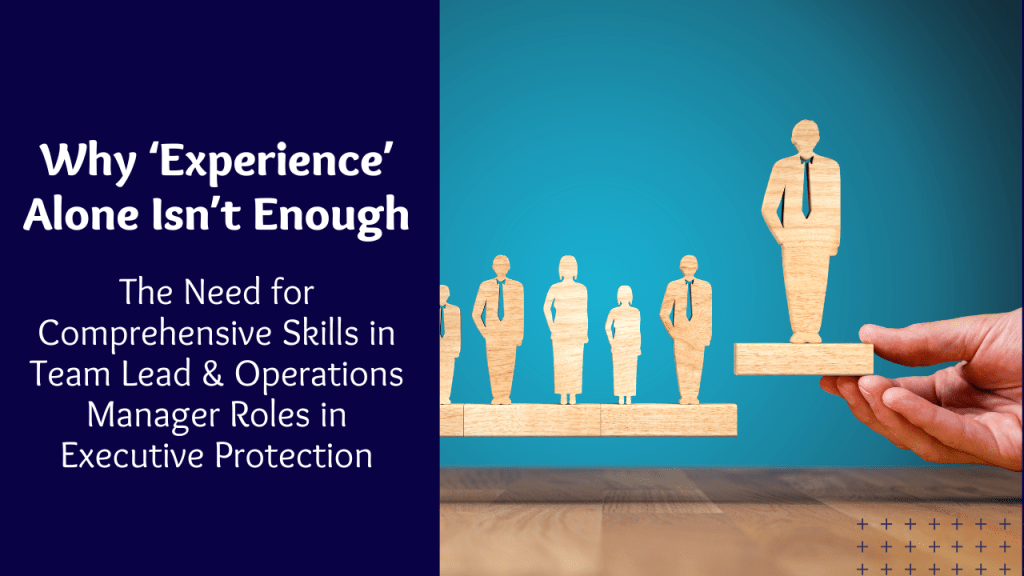
Why ‘Experience’ Alone Isn’t Enough

The Need for Comprehensive Skills in Team Lead & Operations Manager Roles in Executive Protection

We see a lot of articles and posts that address the issues with executive protection agents or what skills are needed and how one should perform as a member of the team. But we rarely see an article that clearly addresses the issues concerning those in positions such as a team leader, security manager or operational director. While its always easy to blame the boots on the ground, it’s important to see and address the issues concerning those who are managing them.

Primarily, we see leadership positions held by people who have just left (Yes, that’s correct, just left) the employ of the ‘Three-letter’ agencies, military, or in some cases, people who have been heavily involved in the industry as EP agents for a number of years. As you can understand, there’s every reason why the first group are, quite often, the best choice for such roles. So today we will discuss the second group, and why the EP industry today, demands more from its leaders than just experience in the field.

We all know that positions like Team Leaders (TLs), Security Managers, or Operations Managers play an important role in ensuring the success of protection teams and client satisfaction, and why holding  one of these positions is not just about having a “higher role” (and payrate). However, a recurring issue in the industry is that many individuals ascend to these roles solely based on time served as EP agents, security guards, military service, law enforcement, or other security-related positions. While such backgrounds may seem at first to provide a strong foundation, they are insufficient on their own to support the multifaceted challenges a leadership position entails. Being a good soldier, having a great arrest record as a police officer or K9 handler, or having been an EP agent for ‘X’  amount of time, doesn’t automatically translate that you are a great fit for a leadership position.

Leadership roles have critical needs that go beyond their past experience, and they require additional skills and training in diverse domains. The consequences of neglecting professional growth in these areas can result in complications such as poor hiring decisions, misaligned role assignments, and inadequate team management. You will be amazed to realize how many times a failure wasn’t so much the fault of the lowly agent, but primarily due to the people in those leadership positions above them.

The Problem with Experience-Only Leadership

Experience in the military, law enforcement or other security related roles, often instill discipline, situational awareness, and tactical skills, qualities that are valuable in executive protection. However, these experiences (or the time you spent in the career) may not translate to effective leadership or operational management in a corporate or private security setting. Here’s why:

  • Inability to Define the Right Candidate for the Job

Many TLs, Security Managers, and Operations Managers lack the skills to create detailed job profiles for hiring. Instead of matching the best candidate to the job’s requirements, they often try to tailor the job to fit the skills of candidates they personally favor. They often default to selecting individuals with similar backgrounds as theirs or their generalized security experience. They overlook key factors such as soft skills, specialized training, and the ability to adapt to the diverse requirements that the client needs or wants. And even more detrimental, there are many cases of managers and detail leaders who find the resume or background of a highly qualified candidate to be intimidating and/or feel challenged by their respective experience and remove them from the list of qualified applicants. While the industry seems to always be complaining about the “quality” of agents, no one appears to be complaining about who did or didn’t hire them for the client in the first place! The best ‘fit’ for the task is not always on the task…

  • Challenges in Role Assignment

Even after hiring, many leaders fail to continue to assess their team members’ individual strengths and weaknesses. Each agent brings specific skills to the table, yet instead of assigning them to roles that align with their expertise, such as surveillance detection, client interactions, or working with children, they often assign tasks indiscriminately. This approach leads to inefficiency, mistakes and decreased team morale. While it can sometimes be challenging to identify the best role for an individual, leaders should be open to reassigning team members. If a placement doesn’t work, avoid forcing it and instead, reassign them to a different position. Leaders must be willing to experiment and refine roles until each team member is in a position that maximizes their value within the team. Try to maintain a long-term mindset. Role assignments are not static; they should evolve as agents grow in their careers and as team needs change.

It is also important to create a culture where team members feel comfortable discussing their strengths, preferences, and areas where they excel. This insight can be invaluable when deciding role assignments. In addition, when assigning roles, think beyond individual skills and consider how team members will interact. The right mix of personalities and expertise can significantly enhance overall team effectiveness…And the wrong combination can be its downfall.

  • Lack of Professional Empathy

Good and effective leaders must be able to balance operational demands with the well-being of their team. Unfortunately, history has shown us that 9 out of 10 in leadership positions don’t particularly care about their team. This can come about  because they are not aware of what it takes to be the agent on the ground, or because of their own past experiences in very much different environments. They expect their agents to work overtime (mostly without being paid for it) or handle unreasonable workloads without considering the impact on their wellbeing and operational performance. It still baffles us that many do not seem to grasp the fact that if you overwork your agents, their attention to detail and their reaction time to incidents will suffer significantly. And we all know how important these two areas are for a protective detail!

Some will even go to extra lengths to ask the agents to do duties that are outside their scope of work, because they do not want to “inconvenience” their clients by making proper demands. And we have found out, instead of standing up for their teams, they are terrified to speak to their clients. They allow their ‘Boots on the Ground’ (who are the most important part of any security detail) to be abused and mistreated, instead of doing what their job calls for, which is to be the go-between and make sure the team has what is needed and that they are all being taken care of.

And for those reasons, this is the type of additional training, skills, and mindset critical for such roles:

Leadership and Management Training: Leadership courses can teach skills like conflict resolution, team building, and emotional intelligence. Leaders who can inspire trust and foster a positive team culture are more likely to achieve long-term success.

-Human Resource Management: Training in hiring practices and personnel management is crucial for selecting the right candidates and building a well-rounded team. Leaders should learn how to conduct behavioral interviews, assess qualifications, and identify red flags during the recruitment process.

-Operational Planning and Logistics: Advanced training in operational planning can help leaders create efficient schedules, optimize resources, and assign roles based on individual expertise. This ensures that every team member contributes their best to the mission.

-Empathy and Emotional Intelligence: Leaders must cultivate professional empathy—understanding their team’s needs, limitations, and aspirations. This includes setting reasonable work hours, recognizing accomplishments, and providing support during challenging assignments.

When TLs and Operations Managers possess well-rounded skill sets, the entire team and client benefits.

A leader with HR skills can build a diverse and competent team, ensuring that each member contributes unique strengths to the operation. By aligning team members with tasks that match their expertise, leaders can enhance efficiency and job satisfaction.

A leader who shows empathy and prioritizes work-life balance, fosters loyalty and motivation, leading to better performance and lower turnover. When the team operates seamlessly under skilled leadership, clients receive a higher level of service, strengthening the organization’s reputation.

The roles of TLs, Security Managers, and Operations Managers in executive protection are too critical to be entrusted to someone whose value is solely based on some specific skillset unrelated to the role. While some backgrounds can be valuable, they must be complemented by additional training and skills in leadership, human resources, operational planning, and empathy. Only then can these leaders effectively hire, manage, and deploy their teams, ensuring operational success and client satisfaction.

For the EP industry to continue evolving, it’s time to prioritize comprehensive development for those in leadership positions. This is not just a recommendation—it’s a necessity for the future of executive protection.

#ExecutiveProtection #LeadershipDevelopment #SecurityManagement #SecurityOperations #RiskManagement #TeamLeadership #CorporateSecurity #SecurityTraining #TeamLeader #ProtectionSpecialist #CrisisManagement

Keeping C-Suite Executives Safe

There have been many reported incidents surrounding violence towards C-suite executives, with the most well-known case, the murder of the tech executive Bob Lee, founder of Cash App in San Francisco, last year and the death of Vivek Taneja, who was assaulted in downtown D.C. on February 2nd and succumbed to his injuries a day later. These incidents, along with many others, bring again to light the ongoing issue with crime rates in specific areas and the potential dangers that corporate leaders may face. We can all agree that in today’s world, the safety and security of high-profile individuals, particularly C-Suite executives, has become paramount. Targeted attacks, opportunistic attacks, kidnappings, thefts, workplace violence, cyber threats, natural disasters, and active shootings are some of the frequent risks that can pose a threat to their safety.

Photo by Christina Morillo on Pexels.com

The Reality for Many Executives

One thing that the public does not know is that, unlike high-profile politicians or celebrities who often have round-the-clock security details, many C-Suite executives operate day-to-day without the constant presence of protective teams. Whether they are traveling for business, attending business meetings and conferences, or simply going about their daily routines, these individuals may find themselves exposed to various threats without the support of a security entourage. Often, the cost of their safety is not considered to be within their company’s budget, and many of them are fairly resistant to having a team of protectors consistently around them.

Opportunistic and Targeted Threats

  • Pava LaPere, a 26-year-old tech entrepreneur, was found dead on the roof of her building, half-naked, strangled, and brutally beaten with a brick. She was killed by Jason Billingsley who, having been under police surveillance for another woman’s sexual abuse, was allowed to enter the building by LaPere herself.
  • 51-year-old Forrest Hayes, the former senior director of Apple’s worldwide operations, was killed by a high-priced prostitute who injected him with a lethal dose of heroin and then left him to die on his luxury yacht.
  • In 2019, Tushar Atre was kidnapped from his own home early in the morning hours and later on found dead. He was stabbed and shot multiple times.
  • In 2022, Artemis Seaford, a high-level executive at Meta and dual US. – Greek national, was found to be surveilled by surveillance-for-hire software for around one year. Seaford was another victim of the “Greek Watergate,” for which the Greek government has been accused of spying on a number of its own citizens, including politicians, journalists, activists, and business owners.

As we know and can clearly see from multiple cases, threats can come from any direction and at any given opportunity. Those of wealth or stature in society find themselves to becoming a target or being “condemned” by groups who feel that they somehow deserve more and that their goal to achieve is best obtained through violence of some sort. We all saw how executives and personnel from pharmaceutical companies were targeted during the Covid lockdowns and how specific minorities (Asian) have been singled out for harassment recently due to the tedious stories surrounding the supposed origins of Covid as well as the tedious political arena of U.S/Chinese relations. Russian businessmen/women have become victims of various crimes against themselves, their families, assets, and companies.

Photo by Rebrand Cities on Pexels.com

How many Americans are targeted while overseas during their business or leisure trips, and how many executives are regularly targeted during company layoffs as well? While the first thing that comes to mind is the importance of preserving human lives, organizations have to also realize that any harm done to their executives and employees will have a tremendous impact on their business. The loss of the leaders in their business (the brains behind their products), the loss of their intellectual property, and the disturbance of their daily operations will cause the employees and customers to lose faith in them and they won’t feel safe within their facilities anymore.

Keeping Executives Safe

One may ask, how then can executives be safe and protected against natural disasters or physical and cyber security threats if they cannot be provided with a security team? The different attacks, the threat level, the fast social-political-geopolitical changes, and incidents that have already taken place, underscores the critical need for C-Suite executives to be better prepared and equipped with basic safety procedures and skills to ensure their well-being in the absence of dedicated protection.

Corporations have a responsibility to invest in the education and training of their executives to mitigate risks and safeguard their well-being. By providing specially designed safety training programs, companies can empower their leaders with the tools and knowledge necessary to protect themselves and make informed decisions in challenging circumstances. Not only will a safety training program benefit the individuals and organizations by saving lives, but it will also help with mitigating legal and financial risks, protecting intellectual property, protecting daily operations, improving productivity and morale, demonstrate corporate social responsibility, and enhance company’s reputation. We know that not all organizations have physical security teams for their executives. Some may not have the budget for it, and some, though the evidence is quite clear, do not see the necessity for it. However, there is a way for all businesses, big and small, to make their people safer.

Safety Educational Programs for Executives

Our team at LeMareschal has had the pleasure of conducting private classes for C-Suite executives and tech companies’ employees in the past. From our experience, we found out that many approach the training with an open mind and realize early on how much they need it, and some even say “I wish I would have done this earlier”. When you decide to provide these type of training options to this specific target group, you should consider who these people are and which environments they exist, create, and travel within.  The purpose of these training programs is to provide them with the situational awareness that is required to navigate in the society that we live and travel in, and the knowledge and skills needed to protect themselves and their employees from potential safety risks. In today’s world, personal safety is increasingly important for everyone!

Considering the fact that many of these executives and employees are very busy individuals, there is a time restriction issue that you will always have to compete with. The training has to be long enough to give them a solid understanding of included topics, but also short enough to make it possible for them to attend. Sometimes people and organizations may be interested, but the timeframe required doesn’t allow them to give it any serious consideration.


What Topics Should an Executive Be Trained in?

As we’re sure there are quite of number of opinions on this subject, we have listed below some of the topics that we have found to be most helpful.

Situational Awareness – How to be aware of their surroundings and identify potential threats. This includes identifying dangerous areas, suspicious individuals, and potential safety hazards.

Body Language and pre-attack indicators – How to identify suspicious individuals according to their body language and facial expressions. This will also teach them how to identify deceit.

Basic Threat Assessment – How to assess potential threats to their safety, including identifying potential risks in their work environment, while traveling, and even in their homes.

Cybersecurity Awareness – Executives must be taught the importance of cybersecurity and how to protect their personal and professional devices and their confidential information from online threats.

Travel Safety – How to stay safe while traveling, including how to navigate unfamiliar locations, how to use public transportation safely, how to avoid common travel scams, how to be safe in regards to hotels, how to identify and estimate risks while travelling, how to plan for a safe trip and what to consider when preparing in advance.

Cultural Etiquette – How to avoid risk and embarrassment and how to draw less attention by adapting to local cultural behaviors.

Emergency Preparedness – Executives will gain the knowledge and skills needed to respond to emergencies, including natural disasters, medical emergencies, and active shooter situations.

Active Shooters – How to respond in the case of an active shooting situation. What steps to take to protect themselves and others.

Security Measures – How to secure their homes, offices, and personal belongings to reduce the risk of theft and burglary and how to use personal protective equipment and apps.

Stalking and Harassment – How to identify stalking signs, how to report it, and how to deal with it before it escalates.

Conflict Management – How to identify different categories of conflict, how to manage it properly, and how to de-escalate situations as they arise.

First Aid – This will help executives learn the basic first aid skills in case they have to respond to medical emergencies and injuries until professional help arrives.


In an era where threats to personal safety are ever-present, investing in the education and training of executives is not just a prudent business decision, but a wise preventative strategy. By equipping the ‘’brains’’ of your organization with the necessary skills and knowledge to protect themselves, your corporation can mitigate risks, protect your most valuable assets, and demonstrate a commitment to the well-being of your leadership team.

LeMareschal’s subject matter instructors are ready to come alongside and instruct your organization on how to be safe, more aware, and thus highly productive.

Any further questions? Give us a call for a free consultation.

The Importance of Effective Communication Between Protectee and The Executive Protection Team

The last few days have produced a video of the meeting between Vladimir Putin and Justin Trudeau and has been making the news within the executive protection industry circles as it shows the great communication levels between Putin and his EP agents. This is highlighting once again the importance of communication between the protective team and the principal. Although it is a subject rarely mentioned in EP training schools, communication is vital, especially in an industry where safety is the prime objective and split-second decisions can make all the difference, sometimes even between life and death.

Photo by August de Richelieu on Pexels.com

Long gone are the days of an EP agent being considered just a body or a gun for hire. The industry has changed, and with that has changed what the definition of an EP agent is and what responsibilities fall under their roles. Being able to communicate effectively with your team members, your client, and anyone else around the client is vital for a successful operation. Consider the scenario where you are on a detail and you have to communicate with your client in a covert way, because something changed, and you have to move. Or your client is meeting with fans or has a personal meeting and someone is making him feel threatened, scared, or insulted. You need to be able to know when to act and your client must be able to understand your directions and most importantly be able to follow them up.

Now, the simplest definition of communication is defined as a process that involves sending and receiving messages through the verbal and non-verbal methods. And as with many other forms of communication, it needs two sides to function properly. For the sender, and the receiver, when we talk about communication between an EP agent and the protectee, it is important to have both sides invested in effective communication, otherwise it won’t work effectively. In high-pressure situations, split-second decisions can mean the difference between safety and peril. Effective communication enables the protection team to relay vital information promptly, allowing them  to make informed decisions in the blink of an eye. Whether it’s identifying an exit strategy, assessing the credibility of a potential threat, or removing themselves from a potential dangerous or embarrassing situation, clear and concise communication between EP teams and their clients is paramount.

Mutual Understanding Between Protectee and EP agent

Mutual understanding is important for effective communication and goes beyond mere verbal exchanges; it includes a deep comprehension of the protectee’s habits, preferences, emotional state, body language, current situation/environment, and potential vulnerabilities. It also means that the protectee has a good understanding of what his/her protective team can do and trusts their abilities, judgment, and they themselves as professionals.

Building Effective Communication

Many will tell you that clients have to go through training classes with them. The reality is, it is very rare, if not impossible, for a client to be willing to attend a class with his EP agents, they feel it is our job, they have much more important things to attend to. In our 56 years of combined experience, we only saw one client, ONE, who took a four-day class with his protective team. And the reason he did it was because the client himself was quite interested in anything “tactical”. The majority of your clients either hate guns, value their time more, or do not have the slightest interest to learn anything about safety, “Better things to do”. Don’t forget, that is what they hired YOU for…

However, there are ways to build effective communication with your clients.  

  1. Learn your client well. This is probably one of the most important steps for building effective communication. Take your time to learn about the people you will be protecting, know if they have any physical or psychological issues (it can affect how they express themselves). Learn how to “read” their body language, like when they feel discomfort, are scared, embarrassed, angry, and even what they like or dislike. Although this is hard when you are hired for short gigs, because you don’t have the luxury of time, try to learn some information from their PA’s or previous EP agents who may have worked before you.
  2. Be situationally aware. In our industry, real-time awareness and dynamic risk assessment are non-negotiable. Make sure that you know well what is going around your client and how specific people or behaviors make them feel, as well as be aware of any potential suspicious people or threats toward them.
  3. “Read the room”. ‘Reading the room’ involves grasping the nuances of the environment, the people present, and the emotions prevailing within the space. It requires constant vigilance and adaptability to ensure proper communication, positive cooperation with the client, and everyone else surrounding them, as well as the client’s safety and well-being at all times. “Reading the room” helps executive protection agents detect emotions and adapt their approach, conversational tone, or, in many cases, just remain quiet. By closely observing body language, facial expressions, and interactions among attendees, staff, corporate members, and even family members, agents can identify not only “moods” but also individuals who may pose a risk to the client’s safety.
  4. Act accordingly. Many colleagues fail to act accordingly to the threat/situation/environment because they are so programmed to ‘’impress’’ the protectee, leading them to over abuse their roles and their use of power/authority and ending up either embarrassing the client or disrupting their moment/meeting. If you overreact once or twice the client will stop following your directions when there is actually a need and time to do so. Bottom line: Don’t over react unless there is a reason to.
  5. Keep Protectee Informed.  Consider making sure that the protectee remains informed about any potential threats or changes in the security environment. Whether it’s a BOLO on a specific person, shift in the itinerary, a sudden change in the protectee’s schedule, or an unexpected development, open lines of communication empower both parties to respond proactively, mitigating risks and ensuring a seamless flow of operations. It also helps with building trust with the person you protect. They feel involved, valued and understood, and they are more likely to follow-up with your directions in the case of an emergency. By actively listening to your protectee’s concerns, addressing their needs, and keeping them informed every step of the way, you can create a sense of mutual trust that forms the cornerstone of an effective protective operation. Something to consider though, do not overdo it! Use simple language (avoid professional terminology) and keep it simple and to the point.

Effective communication, as in the example of the video with Putin and his EP agent, may seem impressive. It is, but what you should know is that there is a lot of time invested by both parties to reach that level. As you become able to read your clients, they will also begin to read you as well. If you have a good relationship, they will be able to read into your body language as well and know what is coming so they can prepare themselves and follow your directions quickly. A protective detail is like a good watch mechanism. Everyone involved is a piece of it and plays a big part in making it work…Like a clock…

Operational Communication for Close Protection Operations

In the world of security operations, one of the most critical areas is communication, which involves constant cooperation and vital information sharing between top-level executives, their respective EA/P/A, the GSOC team, company employees, vendors, and agents working on the ground. Now, if you have been working for any reasonable amount of time in our industry, we are sure that the majority of you have experienced situations where the operation and security of everyone involved has been negatively affected by poor communication, inconsistent communication, or even the complete lack of communication. How information is being shared, what kind of information is being shared, and how/when it is documented is a skill one will quite often learn more readily outside the traditional ‘’EP Schools’’. Considering the fact that many security operations involve a huge number of people and different companies/vendors creating a hierarchy level, coupled with the fact that many companies have a tendency to be highly secretive with the information regarding the operation, you begin to understand how failing to communicate properly will not only create more risks but also will create day to day complications that don’t allow for a smooth operation. This is something that will not only be experienced by anyone secondarily involved, but also by the very protectees themselves. Keep in mind that your clients need peace of mind as well, and they shouldn’t be bothered or have their daily schedule negatively affected by your lack of communication skills or the resulting issues that ensue.

Communication tools

There is a common misbelief (Hollywood and action entertainment are all too often to blame for this) that all EP operations have agents using radios and other high-tech gadgets. In all actuality, the majority of EP agents are required to appear either low profile or not given a radio based on client proximity so they must rely upon and use their cellphones for a majority of their detail communication needs. Using your cellphone may seem like an easy tool and really quite convenient, but there is a downside, and it should also come with specific warnings regarding the pitfalls that come with its use.

Currently, for your operational needs, in order to communicate, you will need some form of a publicly available chat app. Some of the most utilized and popular platforms are Signal, Telegram, Wickr Pro, and Threema, to name a few. The majority of our colleagues have used and are still using WhatsApp, even though the app has been reported for multiple data breaches and leaks, as well as ‘’system shutdowns’’, leaving many colleagues panicked and scrambling to rapidly find an alternative communication system. But no matter how serious the issues that it presents, WhatsApp seems to be yet another example of the phenomenon where people get so accustomed to a product and do not want to change because change means you have to learn to use something new from the ground up and start again. We have had serious resistance from other companies we provided services to, as well as our clients themselves when we asked to use a different and more secure platform. In the end, we and our agents agreed to use WhatsApp as per our clients’ request for them; however, we were utilizing other platforms privately between our own agents. When you are using a third-party App such as WhatsApp, Telegram, Signal, etc., keep in mind that you will never be in control of the safety of the information you are sharing. Never. None of these apps are or ever will be entirely safe. So, when you are deciding, choose carefully based on who has fewer privacy issues, who is the creator (country), who your client is in relation to the creator (can the creators of this app be targeting your client?), what are your operational needs and always make sure you stay on top of the latest changes (social-political, geopolitical as well as company changes) that may affect the risk to your client. There are also paid work chat apps or business apps created for the workplace and personal messaging that promise a safer environment but again, one must take into consideration the fees and accessibility. (Who is paying when there is /more than one company involved and who IS involved, i.e. contractors, employees, 2nd parties, etc.).

Photo by MOHI SYED on Pexels.com

And the available functions and capabilities of each platform need to be vetted thoroughly as well. What are your needs or requirements? Will you be using large group chats? Will you and any size group be able to utilize voice texting? Will you be able to send small packets of information through the groups that you set up? (Pics of critical POIs, BOLO vehicles, onsite venue pics for inbound teams or advances, etc.) These are just a few of the features that operational teams use all the time and finding the right platform for your team’s needs and unique requirements is very important. No one operational has any desire to have any more apps or sites open at once on their personal devices than is absolutely necessary in an effort to try to manage a detail. Less “moving parts” is always better, if possible.

Information flow

During a protective operation, there is information that is crucial and must be passed among the parties involved (as per their responsibilities) and the agents on the ground. For numerous reasons, some individuals who are assigned as an operation manager or contract manager seem to be apprehensive about asking the necessary questions of the client or the people assigned to act on behalf of the client. This apprehension, quite often, is caused by their own insecurity in what they want to ask, fear of a negative response to their request, or the simple fact that they do not know what to ask. Insecurity in what to ask is a skill acquired by time in grade. As we spend time in our Craft, it’s almost impossible not to learn what the correct questions or inquiries would be. Fear of a negative response can be associated with the desire for acceptance or to have the client like them. We all know that what is best for the client’s safety and family security may not exactly be what THEY want…Be prepared to patiently and thoroughly explain the reasoning behind the questions and the resulting decisions. And for those who don’t know what to ask, stay tuned we will share a template one can use as one sees fit for his/her own needs.

When you receive a request to provide protective services, you must ensure that any/all specific information that is necessary for that detail’s success is obtained from the client right away and is passed along immediately to the agents on the ground. How many of us have found ourselves working on short gigs and know nothing or very little about the client? Sometimes even the very basic information that pertains to the gig itself? While we all know that clients can change their minds about what they want from second to second, there is specific information that still must be passed to the agents. This is an inherent need to set your team up for success. Period. Being able to plan ahead, run successful advances, and lower the risk levels, or even eliminate them altogether, means you must have as much information as you can and communicate it properly.

Now, the information flow definitely has two sides. Because the agents on the ground are reacting in real-time during any situation, they are actively aware of new information that must be passed on to the GSOC or the assigned person in charge. It must be done on a consistent basis. This is critical for operational effectiveness. But we all know “that” agent who will put every, little, minute bit of information that he/she may think it is relevant to the task. Always keep this in the back of your mind…While you are communicating with your fellow team members or passing vital information to your GSOC, keep it brief. Short and to the point. Only the facts. K.I.S.S. is the acronym that suits this best…

Photo by Lukas on Pexels.com

Briefings and De-briefings

I don’t believe that we can accurately highlight enough how important briefings and de-briefings are in our line of work. It seems that more and more, only a handful of companies or team leaders are utilizing them properly or using them at all. This lack comes from basic laziness in people who want to merely save time (Even though you can keep them short if you keep them on point and factual) and/or the absence of needed information. If you have nothing to pass on to your agents, why have one, right? Wrong. You, as a team lead, are not the only one who may have information that needs to be brought to the group. Allow team members to speak and ask questions so that later issues are avoided.

Photo by Christina Morillo on Pexels.com

Communication Briefings are designed to provide necessary information about a client, the detail, events or occurrences and how they all interact, in a quick and effective way. They can also inform your agents about the SOPs, how to carry on specific instructions or corrections/encouragements to how they are performing or changes required to perform their duties. Everyone involved will hear about current risks and key threats in the areas they will be operating and will all be on the same page.

De-briefings are equally important as it gives the team the opportunity to again share any information they gained through the day, identify any issue, discuss risks, possible POIs, improve communication between the team members and provide any additional support or guidance depending on the situation. It may also include discussions about changing tactics for the next day of operations as required due to new informational input gathered. And if there is truly nothing to report at the end of any time period, take the opportunity to boost morale and congratulate the team on a job well done. Remember, while we work very hard to stay out of sight and not draw attention to ourselves, this in no way means that we don’t need encouragement from time to time.

Documentation

After being in this industry for a combined 54 years, we can both tell you how important documentation is (And it will save your position [And your posterior] one day!). If you are an EP agent and part of the team, it doesn’t matter if you have been sending your information and communicating with your fellow team members, your TL, or GSOC during the day. At the end of each shift, or the end of the operational day, you MUST keep a daily report. Your own daily report. In simple words, your own ‘’diary’’. As much as we have been discussing communication during this article, this is the most important form of communication that you can possibly use. It literally is your communication with the future. We know that sounds a bit “out there”, but hear us out. At any one point in the future, you may be called upon to recount a day, event, or occurrence that is critical and it could very well be the difference between safety or an unsafe condition…contract or no contract….Employment or unemployment…Some little detail that will be the deciding factor between simplicity and severity.  And the very fact that you kept an intricate record of your daily operations will be the one factor that makes all the difference in the world. The reason is, the information you (or that has been circulated by others during the shift) may or may not have reported or documented, or the incidents or special client’s requests of that day that may or may not have been registered will be absolutely dependent on the accurate reporting and documentation that you and your team kept. As part of our job is preparing and preventing the worst, keeping your own diary/documentation means you are protecting yourself and the decisions you or your team made at work if you ever are questioned or called in for explanations. It will help you to tell your side of what happened and why you made the decisions you made, what were client’s requests or TL requests, and how you responded. The easiest way to do this is by sending yourself an email at the end of your shift. Besides the information you would obviously include, you will have (because of the e-mail) the time and date also registered.

Ever since there was ever more than one of us in proximity to one another, there is one undeniable fact…To survive, we MUST communicate. Every deciding moment in history has been built around communication. Banners, signs, signal fires, telegraph messages, the Pony Express, Morse code, Enigma, emails, burst satellite…All based on the need for and the understanding of communication. In our Craft, we must be the true professionals, and with this requirement comes the critical need to convey what we know, what we’ve seen, where we’ve been…The list goes on. Now, we know that this article only covers the basics when it comes to the subject of communication, and we realize that. But for those of us in our Craft, these points that we have made in this article are several of the “little things” that come up all too often in any detail AND they are the most frequently abused, ignored, and neglected aspects of what we consider to be a crucial part of any successful operation in close protection. How we communicate. For once we can smoothly, eloquently, accurately, safely, and quickly disseminate information properly, all the other aspects of our task will fall into place.

The Grows

Denida & Chris Grow bring a combined 54 years of international experience in the Protective and Intelligence services. They are based in Seattle, WA, and run their companies LeMareschalAthena Worldwide and Nannyguards

The importance of educating Security Personnel and Intelligence Analysts about biases

Bias is a topic that many industries like to avoid, and the security and intelligence industries are no exception. However, there is a profound need to discuss biases in regard to the security industry and when educating security practitioners and intelligence analysts. When the subject of biases has been raised in the past, the majority of commentators cannot seem to agree, in fact, they will often argue against the existence of biases and/or why there is a need to discuss them in the first place. In this article, we would like to address the topic of bias – what bias is, who has biases, whether are biases wrong, and what types of biases there are. Then, we will highlight WHY it is important for security professionals and intelligence analysts to be able to identify their biases and address them, and, then, we will share HOW one can identify his/her biases.

Now before we start, there is one thing on which we can all agree: As a security professional, you don’t only make assessments about incidents or places, but also about people. Keep this in mind as we proceed further, we will come back to it.

What is bias?

To answer this, we will use the definition according to the American Psychological Association

1. partiality: an inclination or predisposition for or against something. See also prejudice.

2. any tendency or preference, such as a response bias or test bias.

3. systematic error arising during sampling, data collection, or data analysis. See biased estimatorbiased sampling.

4. any deviation of a measured or calculated quantity from its actual (true) value, such that the measurement or calculation is unrepresentative of the item of interest. —biased adj.

There are a few keywords from the definition — predisposition, against, tendency, preference”. Keep those words in mind when thinking about how they affect the threat assessment of a security professional. While you do that, think of a scenario when a security guard has to assess, either by observation or by interviews, any visitors in the area for which he/she is responsible. That security guard believes that women are less likely to commit a crime (bias) and, during his/her threat assessment, he/she misses the fine details that a woman is, in all actuality, a terrorist. You think perhaps this couldn’t occur? Well, it has actually happened. In July 2017 in Mosul, a female suicide bomber, holding her child in her arms, managed to walk by security guards and detonate her bomb.

The security guards, instead of being observant and watching her hands (in which she was holding the detonator), just saw a mother with her child. Many people see women as weak and incapable of committing acts of terror, especially one who is carrying her own child. This is not the only incident when the ‘’miscalculation of threat or of threat actors’’ was catastrophic.

(A woman suicide bomber walks past soldiers, the trigger in her right hand (Al-Mawsleya TV)

Photo by fauxels on Pexels.com

Do all people have biases?

Before we answer that, ask yourself, “Are there people, things, or ideas you like better than others? Are there places/events where you feel more comfortable than others?” We are sure your answer to these questions is “yes” and that is because all humans have biases. Some biases are passed to us through evolution and some are learned through socialization and/or direct experience. One must understand that biases serve a purpose. Simply put, because the human brain has the tendency to categorize information, people, events, experiences, etc. during his/her learning and development process, the brain will connect the new information and people to past experiences. Once that is done, the brain will respond to it in the same way it does to other things belonging to that same category. So, by putting people with similar traits into a specific category, one believes that everyone else in that category must be the same. Biases are not limited to race, gender, ethnicity, religion, social or political groups but many characteristics may be subjected to one’s biases such as physical appearance, sexual orientation, educational level, profession, etc.

Are biases wrong and racist?

When discussed, the majority of people tend to disregard biases, believing that even acknowledging those biases will label them as racists. The first mistake when talking about biases is when someone considers someone else good or bad based on his/her biases.

According to Matt Grawitch, PhD ‘’Biases make decision-making easier by giving us a starting point, an initial prediction, or a “leaning of the mind” regarding which choice to make. We anchor our original judgment in the biased conclusion and then adjust it based on supplemental information.’’

Having biases is not necessarily bad, wrong, or racist. In fact, we’ve discussed that biases improve the decision-making process and help the human brain to categorize new information. We could say that since biases help us simplify information processing, they basically function as rules of thumb that help us make sense of what is happening around us and make faster decisions.

However, biases can become bad and even dangerous when we treat or judge someone unfairly or when the accuracy of the decision is of the utmost importance, such as behaviour or threat assessment. In addition, what can make a bias shift from ok to “bad” is when an individual allows their biases to influence their decision-making process in such a way that they allow those biases to affect someone else in a negative fashion by either being unfair or causing a miscalculation in the threat level.

Not being able to recognize and address our biases can lead to neglecting or discounting information that would be valuable for our job functions. Information that we process and use to make decisions can directly affect a risk/threat and vulnerability assessment, an interview with a suspect, the analysis of intelligence and data, or the use of link analysis in putting together an intelligence report. In these situations, biases can become a systematic thinking error that can cloud our judgment, and, as a result, impact our decisions, thus rendering our final product limited or even useless. 

What types of biases do people have?

People can have conscious biases (biased attitudes toward specific ideologies, events, groups of people, etc. that we are aware of) or unconscious biases (biases we are not aware of, cannot control, are difficult to access, and can quite often influence our actions more than conscious biases).

In one of her articles, Kendra Cherry mentions that ‘’some of our cognitive biases are related to memory. The way you remember an event may be biased for a number of reasons and, that in turn, can lead to biased thinking and decision-making. Other cognitive biases might be related to problems with attention. Since attention is a limited resource, people have to be selective about what they pay attention to in the world around them.’’

If you are aware of a biased attitude, it is more likely and consciously possible for you to be able to address it during your decision-making process. However, unconscious biases are the most ‘’dangerous” ones since it often takes specific training and study of yourself to be able to identify that you have them. Here, Carly Hallman is listing 50 types of unconscious biases. Have a look and see how one or more of them can affect your decision-making process.

  1. Fundamental Attribution Error: We judge others on their personality or fundamental character, but we judge ourselves on the situation.
  2. Self-Serving Bias: Our failures are situational, but our successes are our responsibility.
  3. In-Group Favoritism: We favor people who are in our in-group as opposed to an out-group.
  4. Bandwagon Effect: Ideas, fads, and beliefs grow as more people adopt them.
  5. Groupthink: Due to a desire for conformity and harmony in the group, we make irrational decisions, often to minimize conflict.
  6. Halo Effect: If you see a person as having a positive trait, that positive impression will spill over into their other traits. (This also works for negative traits.)
  7. Moral Luck: Better moral standing happens due to a positive outcome; worse moral standing happens due to a negative outcome.
  8. False Consensus: We believe more people agree with us than is actually the case.
  9. Curse of Knowledge: Once we know something, we assume everyone else knows it, too.
  10. Spotlight Effect: We overestimate how much people are paying attention to our behavior and appearance.
  11. Availability Heuristic: We rely on immediate examples that come to mind while making judgments.
  12. Defensive Attribution: As a witness who secretly fears being vulnerable to a serious mishap, we will blame the victim less if we relate to the victim.
  13. Just-World Hypothesis: We tend to believe the world is just; therefore, we assume acts of injustice are deserved.
  14. Naïve Realism: We believe that we observe objective reality and that other people are irrational, uninformed, or biased.
  15. Naïve Cynicism: We believe that we observe objective reality and that other people have a higher egocentric bias than they actually do in their intentions/actions.
  16. Forer Effect (aka Barnum Effect): We easily attribute our personalities to vague statements, even if they can apply to a wide range of people.
  17. Dunning-Kruger Effect: The less you know, the more confident you are. The more you know, the less confident you are.
  18. Anchoring: We rely heavily on the first piece of information introduced when making decisions.
  19. Automation Bias: We rely on automated systems, sometimes trusting too much in the automated correction of actually correct decisions.
  20. Google Effect (aka Digital Amnesia): We tend to forget information that’s easily looked up in search engines.
  21. Reactance: We do the opposite of what we’re told, especially when we perceive threats to personal freedoms.
  22. Confirmation Bias: We tend to find and remember information that confirms our perceptions.
  23. Backfire Effect: Disproving evidence sometimes has the unwarranted effect of confirming our beliefs.
  24. Third-Person Effect: We believe that others are more affected by mass media consumption than we ourselves are.
  25. Belief Bias: We judge an argument’s strength not by how strongly it supports the conclusion but how plausible the conclusion is in our own minds.
  26. Availability Cascade: Tied to our need for social acceptance, collective beliefs gain more plausibility through public repetition.
  27. Declinism: We tend to romanticize the past and view the future negatively, believing that societies/institutions are by and large in decline.
  28. Status Quo Bias: We tend to prefer things to stay the same; changes from the baseline are considered to be a loss.
  29. Sunk Cost Fallacy (aka Escalation of Commitment): We invest more in things that have cost us something rather than altering our investments, even if we face negative outcomes.
  30. Gambler’s Fallacy: We think future possibilities are affected by past events.
  31. Zero-Risk Bias: We prefer to reduce small risks to zero, even if we can reduce more risk overall with another option.
  32. Framing Effect: We often draw different conclusions from the same information depending on how it’s presented.
  33. Stereotyping: We adopt generalized beliefs that members of a group will have certain characteristics, despite not having information about the individual.
  34. Outgroup Homogeneity Bias: We perceive out-group members as homogeneous and our own in-groups as more diverse.
  35. Authority Bias: We trust and are more often influenced by the opinions of authority figures.
  36. Placebo Effect: If we believe a treatment will work, it often will have a small physiological effect.
  37. Survivorship Bias: We tend to focus on those things that survived a process and overlook ones that failed.
  38. Tachypsychia: Our perceptions of time shift depending on trauma, drug use, and physical exertion.
  39. Law of Triviality (aka “Bike-Shedding”): We give disproportionate weight to trivial issues, often while avoiding more complex issues.
  40. Zeigarnik Effect: We remember incomplete tasks more than completed ones.
  41. IKEA Effect: We place higher value on things we partially created ourselves.
  42. Ben Franklin Effect: We like doing favors; we are more likely to do another favor for someone if we’ve already done a favor for them than if we had received a favor from that person.
  43. Bystander Effect: The more other people are around, the less likely we are to help a victim.
  44. Suggestibility: We, especially children, sometimes mistake ideas suggested by a questioner for memories.
  45. False Memory: We mistake imagination for real memories.
  46. Cryptomnesia: We mistake real memories for imagination.
  47. Clustering Illusion: We find patterns and “clusters” in random data.
  48. Pessimism Bias: We sometimes overestimate the likelihood of bad outcomes.
  49. Optimism Bias: We sometimes are over-optimistic about good outcomes.
  50. Blind Spot Bias: We don’t think we have bias, and we see it on others more than ourselves.

WHY must security professionals and intelligence analysts address bias training?

As a security professional or intelligence analyst, seeing what biases are and how they can significantly affect us, do you see how important it is to recognize and address them during the decision-making process? Do you see how biases can affect your risk and threat assessment, information gathering and analysis as well as behavioral assessment while you are conducting a first interview with a visitor, suspicious person, etc.?

We will give you an example. During the Manchester arena attack investigation, one of the security guards claimed that he did feel something was “off” with one of the terrorists but he was uncertain of how to approach and ask questions (first interview of a suspect) because he was afraid he was going to be labeled a “racist’’.

Being trained in how to recognize and address your biases will not only help you to make a better decision but will also give you peace of mind and confidence knowing that you are approaching and properly interviewing a person whose presence seems to be unjustified and/or suspicious. You will be able to clearly gather more information and assess the risk without feeling that you are merely racially profiling that person. You will also build more awareness of the subjects with which you hold biases and that awareness will lead to more choices. More choices will lead to a more ‘’open mind’’ and allow you to seek further information before you make a decision.

In connection to why biases and the training on them are important and related to the security industry, we must mention here Richard Gasaway, Ph.D, the creator of the Center for the Advancement of Situational Awareness and Decision making, has highlighted the fact that ‘’Confirmation bias is particularly challenging to situational awareness because it can prohibit the uptake of critical clues and cues that can foretell impending doom.’’

Now that we have discussed the many aspects of biases, what they are, and how they can affect your decision-making process do you want to test yourself and find out what biases you have? You can use one of the many online tests available, the Implicit Association Test (IAT) created by Harvard.

This will help you assess and better identify all that biases you or your staff may have that can affect risk and threat assessments as well as intelligence gathering and analysis. In addition, your staff’s performance and how they interact with others to make sure their decision-making will be as accurate as can be ascertained from the information provided and not just from their own personal biases.

If you are an individual interested in receiving training in biases or you represent an organization looking to train your employees in this very much needed and important topic, please reach out to us.

Chris Grow

AUS Global Special Services Travel Team

Managing Partner LeMareschal LLC

Denida Zinxhiria Grow

Founder & CEO

Athena Worldwide & Nannyguards

Managing Partner LeMareschal LLC

Providing EP services for Clients with Physical Disabilities and Mental Health Disorders

One of the biggest misconceptions for new Executive Protection practitioners is that they have an innocent and naive belief that they will land the best client, the one who is aware about what Executive Protection is, the one who is very active and physically trained, the one who will be following up with security directions, the one who will care about his/her agents’ wellbeing and the one who will be easy going and friendly.

Yes, the perfect client does exist, but it may take you quite some time in your career to get one, if at all. Considering clients have their own character traits, let’s talk about those clients who, day to day, are facing a physical disability such as paralysis, Parkinson’s, Multiple Sclerosis, or even a semi-permanent injury. And remember, being simply advanced in years may have a substantial affect on their movements and therefore create some unique challenges in providing protective services for them.

The German Politician Wolfgang Schäuble has been bound to a wheelchair since 1990 after an assassination attempt, actor Michael J. Fox has been fighting with Parkinson’s disease for decades and actress Selma Blair has been living with multiple sclerosis since 2018. What all these famous people have in common is also a protective detail and Executive Protection Agents providing services for them. So have you ever wondered what an EP agent must take into consideration when he/she is hired to provide services for an individual with physical limitations or disabilities? While the primary goal remains the same, ‘’Protect the Principal’’, the way in which you are achieving it may be a little bit different in these types of situations.

  • First of all, do your due diligence and get informed on the specific circumstances that surround your prospective client. There are a number of crucial items you should know. Medical condition, abilities/inabilities, current medications, private physician info, etc. The more you know, the better you will be when providing services for them.
  • At your first meeting, ask them about their needs and if they have particular expectations from you. Ask about any specific instructions for their care day to day.
  • Consider how much time it takes for them to go from point A to B and plan/design scenarios around having to evacuate them (with or without the wheelchair or any walking aids).
  • Learn all about their specific wheelchair functions and movement (Or any walking aids).
  • Always ask permission before jumping to help, especially when in public or in the company of other people. Don’t assume that they may always want or need your help. At this point in their lives, they can feel that an enormous amount of their personal freedom has been stripped away.
  • Always keep in mind, people with disabilities are still people and they still have a great many things they like or want.
  • Be patient and polite when offering any help. Don’t try to rush them. What for you may seem easy, for them may be hard, painful or even seem impossible.
  • Recognize and respect their personal space and time.  Yes, even a person who needs assistance to move around and depends on you will still have need of his/her own personal space or time.
  • Don’t ‘’over-do it’’, let them breathe from time to time. You do NOT have to be in the room every waking second.
  • Always be prepared to make adjustments or accommodations to make their life easier and look for ways to develop methods to better assist them.
  • Always take into consideration their special needs (physical and medical) when you have to visit venues, attend events, travel into other countries, book a hotel room, make dinner reservations etc. Have in mind, not many countries are as progressive as we are when it comes to customers with physical disabilities. Having a highly-skilled advance agent who can plan these details accordingly is a great advantage in these cases.
  • Ensure that someone from the team is ahead of you, taking care to be sure there is a clear path for your client to enter or exit with the wheelchair or walking aid, wherever you may have to go.
  • If there is no threat, give them their time and have patience while moving to discourage pressured or awkward moments.
  • In the event of an imminent moment of threat or danger, have you planned ahead and are you, or a group of you, capable of lifting that person up properly and assisting in a quick and safe evacuation?
  • Be quite careful of your language both while in the presence or in the absence of your client. While many professionals are aware which words can be offensive for a person who has a disability, some may accidentally offend someone without meaning to. When you work for people with disabilities you want them to feel respected and empowered. In order to accomplish that, simply place emphasis on someone as the person first, by name, and then, only if needed, mention the disability if logistics would require it to avoid embarrassment or frustration

Now let’s talk about clients who are dealing with mental health disorders, which are the most common issues an Executive Protection agent may have to deal with and can be hard to detect unless you are told or you are quick to recognize.

Most common reported names and examples (as per their public confessions):

  1. Elon Musk – Asperger’s Syndrome
  2. Chrissy Teigen – Postpartum Depression
  3. Demi Lovato – Bipolar Disorder
  4. Steve Young – Social Anxiety Disorder
  5. Donny Osmond – Social Anxiety Disorder
  6. Michael Phelps – ADHD
  7. Dan Reynolds – Clinical Depression
  8. Leonardo DiCaprio – Obsessive-Compulsive Disorder
  9. Daniel Radcliffe – Obsessive-Compulsive Disorder
  10. Lady Gaga – PTSD
  11. Adele – Postpartum Depression
  12. Prince Harry – Severe Anxiety during royal events
  13. Chris Evans – Social Anxiety
  14. Jim Carrey – Depression

      Why it is important to be aware of your client’s mental health disorders? Because what they are dealing with affects the way they see life, you, threats, others etc. Just by simply being aware, you enable yourself to make the necessary adjustments in how you approach them, interact with them and how you provide services to them. Imagine the client who goes into a full panic attack when walking through and dealing with crowds or the client who suffers from dementia and you have to introduce yourself for the 100th time.

     Although we highly emphasize the importance of creating and maintaining a medical profile for your client and keeping the involved agents apprised of this information, not many companies practice this. Until you are informed about a disorder or medical malady by your supervisor, predecessor or the client himself, it may take you quite some time with dedicated personal observation and study to discover what you are dealing with. Again, do your due diligence to find out what the condition is or may be. If you can consult with a therapist, do so while always maintaining the utmost discretion and confidentiality. In a case where this may not be possible, an easy way to find more information is by using the Diagnostic and Statistical Manual of Mental Disorders (DSM), the handbook used by health care professionals as a guide to the diagnosis of mental disorders. The book contains descriptions, symptoms, and other criteria for diagnosing mental disorders. However, as with “Googling” your symptoms on the internet, one must be very careful of how to use this handbook and the information it contains.

    How you approach your clients who may suffer from mental health disorders is very important and can help by creating a healthy relationship and a positive protective detail while avoiding conflicts and awkward or embarrassing events.

These are some key points to have in mind:

  • During a crisis moment, pause, stand back and assess the situation before approaching. What you see on initial approach may not be as it appears.
  • Be careful with your tone, speak slowly and in a calm manner. You, your tone and your body language have an enormous effect on the situational outcome.
  • If need be, introduce yourself again, explain why you are there and ask how you can be of assistance.
  • If they appear disoriented, reassure them, remaining calm yourself. This will have a drastic effect on their mental status as well.
  • Listen to what they would like and respect their wishes if possible.
  • Do not rush them, create space and give them their time.
  • Make sure you are providing a quiet and discreet place for them, if needed, kindly request that all other people present exit to allow them a few minutes of quiet.
  • Remain calm and have patience. Listen, don’t speak…Sometimes a willing ear is all that is required to assist in a peaceful outcome.
  • Try to identify the cause of their respective triggers and reduce any noise levels and confusion.
  • Keeping their triggers in mind, always take appropriate measures while travelling or attending events to eliminate awkward moments or embarrassing circumstances.
  • Know your limits and recognize the difference between what you feel comfortable handling and when it is time to ask for a professional intervention.
  • Never forget, you are NOT their therapist but their Executive Protection agent, concerned about their wellbeing.
  • If you are interested to learn more and being more prepared, there are many Psychological First Aid or Intervention to Crisis classes available online.

     Dealing with someone who has physical disabilities or mental health disorders is no easy task, no matter how well prepared you are, and especially when you are facing it from the aspect of an Executive Protection agent. However, when you have done your due diligence, sharpened your client awareness skills and made all the required and necessary preparations, you can achieve calmer details with very few calamities and avoid unneeded conflicts and give your client security, confidence and peace of mind.

Understanding that the people you interact with, provide assistance to or the very person you are directly protecting, is in pain, stressed, fearful, angry or extremely confused, etc and being able to recognize these moments and have a plan of how to deal with it properly, will help soothing these anxious and difficult behaviors at the earliest possible stage providing a stable, professional platform from which to provide services.

Chris Grow

AUS Global Special Services Travel Team

Managing Partner LeMareschal LLC

Denida Zinxhiria Grow

Founder & CEO

Athena Worldwide & Nannyguards

Managing Partner LeMareschal LLC

Executive Protection Agents in a Rare Interview with a Retired Paparazzi

It’s not very often when we have the ability to interview and learn from our adversaries. While most efforts are seemingly focused only on physical attacks, they do not give enough emphasis to the paparazzi, media, and all that this facet of protection entails. But we’ve got you covered. This is an interview we have been wanting to do for the last 5 years. What we learned from a retired British paparazzi is that pointing a flashlight toward them won’t work, neither you are safe if you block the tail number from your private jet. We also learned how they find information about your clients, who are willing to pay a lot of money to buy your pictures (no, it is not only the media outlets), to what length they will go to distract you and get that picture and why you will be not able to buy their silence.

*Disclaimer: During this interview, you may encounter offensive language content within the realm of your site.*

** For permission to use this video please contact info@lemareschal.com**

***Copyright @Athena Worldwide, a LeMareschal LLC company. Any illegal reproduction of this content will result in immediate legal action.***

The challenges for protecting Public Figures- The Macron Incident

The latest incident with French President Emmanuel Macron being slapped by someone in the crowd has once again fired up the keyboard warriors who take any incident (video or picture) such as this and claim how improperly the Executive Protection team functioned and what would they have done differently and, of course, be more successful. As a Greek proverb says ‘’Whoever is outside the dance (floor), can sing many songs’’ Meaning: It is easy to talk about something when you are not the one involved in it. 

As security practitioners, we must be very careful what we say online, keeping in mind, whatever you post online stays online even if you delete it minutes later. We should not criticize security details and/or the people involved because we do not know all the facts, details, limitations and the full story. When you post a comment on a 10-second video, you may not have the full story. You do not know what happened before or after the incident. What you see in a photo may not be the full picture. It doesn’t make you any more ‘’professional’’ when you try to spot the wrong moves in an incident where you weren’t involved and you do not know all the parameters: you are just assuming.

In this case, we heard many opinions:

‘’Why didn’t they keep standard formation?’’- How can you keep standard formation when your principal is anticipating close interaction with a member of the crowd? Greeting lines are extremely tedious and are one of the most difficult situations to read and provide protection.

‘’The reaction time was slow.’’- The reaction time always seems to be slower when you see an incident on a video over and over again rather than being involved with it in real-time in the field.

‘’They were lucky he wasn’t holding a knife.’’ – Actually someone did their job well and made sure he (or anyone else in the crowd) wasn’t holding a weapon. What most fail to understand is that these crowds are previously checked for anything that can be used as a weapon.

‘’Why didn’t they saw that coming?’’ – They don’t teach ESP at Executive Protection schools…

‘’Why didn’t someone teach Macron?’’ – Most protectees won’t sit down and learn from you about protection, they want you to protect them. It’s not their job to know how to do yours…Why do you think you’re employed?

Now let’s address some challenges for protecting public figures and try to make some rational sense of all of this.

Protecting people whose identity depends on the public, such as politicians, in this case, is very much different than protecting a C-Suite executive for example. A politician needs the interaction with public. They shake hands, hug, get pictures with and celebrate with large crowds. Having people like them is what makes people vote for them, and they need to look and act quite approachable to everyone in order to gain votes. If they don’t get the votes, well, then they no longer hold their current political position. They have to attend gatherings and events and most of those functions may be outside of your span of control regarding organizing it. You have to provide services as best as you can with what you have and minimize whatever limitations you can. 

In this case ‘’the unknown crowd’’ is the issue. The ‘’crowd’’ provides a good opportunity for the enemy to blend in, act and even escape in some cases. Also, as most public appearances are preplanned and announced, the enemy has the time to be prepared for the attack. And when we say attack, let’s clarify that “attack on your principal” is not only an assassination or physical harm but also an attack on his/her personality, reputation or by causing embarrassment. 

While most EP training schools focus only on physical attacks, have in mind causing embarrassing situations may be something your principal is particularly vulnerable and endangered by, thus it is something you must be prepared to prevent. Making sure the crowd has been checked for anything that can be used as a weapon doesn’t mean you are safe from an embarrassing situation. Paying attention to people’s hands and what they are carrying doesn’t mean you can be sure about the intention of a handshake. A handshake can become a pat on the shoulder or a slap on the face. How would you know the intentions of the handshake and act within 2 seconds to prevent it? You must be in very close proximity to do that and sometimes you have limitations on how close you can be with your principal, particularly when they are interacting with the public and potential voters. When any public figure decides he/she want to come within close proximity of a voter, you are required to break the standard formations and you cannot have security between the voter and the principal because they need that ‘’personal space’’.

Act too aggressive and they will perceive this position as very unapproachable, something that goes against your principal’s political campaigns. So you have limitations or adaptations to perform your protective job competently. 

Another thing to consider is that some protectees will appear uncooperative with you and your suggestions or directions. They will do the exact opposite of what you have instructed them to do or whatever the plan was because they thought doing something different was ok, safe or was suggested at the last minute by their campaign manager. Some protectees will ask you to protect them no matter what. The fact that they won’t consider changing their lifestyle, and you have to do your best, becomes another facet of the ever-evolving detail.

Have we forgotten the flying shoe incident with President Bush in a press conference in 2008? The red paint thrown at Mary Harney, Ireland’s Health Minister in November 2010? Berlusconi’s nose being broken and two teeth knocked out when a man attending a political rally threw the statuette of Milan’s Duomo gothic cathedral straight in his face in 2009? Eggs being thrown at Bill Clinton in Warsaw, Poland? Nicolas Sarkozy being a victim of a flying pie in 1997? The book thrown at Obama in 2010? The glitter attack on Minnesota Governor Tim Pawlently in 2011? Pope being attacked by a woman who jumped barriers at St Peter’s Basilica and knocked him down in 2009? The famous slap on Dimitra Liani Papandreou, the widow of ex Greek PM at her book signing by a woman who appears to be there to sign her book? Bill Gates’ “Pie-to-the-Face” fiasco? There are so many more similar incidents including paint, body fluids, pies, yoghurt, vegetables, flour and even flashing body parts such as the Femen members who went toplessness in front of the EU-Russia summit, in Brussels, in December 2012.

Can we criticize the EP team members involved in these incidents? Can we say that you would have done better after the incident has taken place? From the moment you have a complete crowd check for weapons, you are in a “secure” space. But what leads you to believe that you have a better understanding regarding the mental status of someone who appears to be a voter or a fan? Can you honestly guess his motives if he/she wants to slap, or spit or in some way embarrass your client?

If you haven’t provided security details for Public Figures, it may seem easy for you to criticize an incident like this, but criticizing what you don’t know and just assuming doesn’t make you right and it very well may show your ignorance. Instead, use this incident as a reminder that people will use anything to harm your client’s reputation and their imagination can be big and quite unpleasant. Keep it as a learning tool for yourself and yet another scenario in your head of what you would or wouldn’t do if…

Denida Grow

Managing Partner

LeMareschal LLC

Founder & CEO

Athena Worldwide

Nannyguards

How do you properly handle your client’s budget?

Photo by Karolina Grabowska on Pexels.com


One of the most serious, and sadly, often abused, of all professional deadly sins in our industry is the overcharging of the client or spending his/her money unreasonably and/or unwisely. We have seen too many companies presenting the “threat” to be much bigger than it truly is so they can cause more fear and create a dependency from the client and assign more bodies on the ground. The more bodies you have on the ground, the more money you can charge. The problem with this is not only the unethical portion but also, at some point, the client or someone from his company who is in charge of the security budget will sit down, evaluate and decide you are ”too much”, cutting down on the number of agents, simply decide to go with another security provider or, worst-case scenario, accuse you of fraud and unnecessary overbilling and take legal action against you.

What most people don’t know is that someone who is going to reach out to you for his/her protection, either needs it or thinks he/she needs it. They want to hire a company and be done with it. Replacing you or searching for another provider is something they want to avoid, if at all possible. Those clients are looking for stability so if they seek to replace you, chances are, your services are lacking something important or there is something wrong with the numbers you are charging. How many of you have started with a team and the number of agents has been reduced to even half after a couple of months? Overcharging can be quite damaging to your contract as it will clearly show you are taking advantage of your client.

Another issue that can make clients go searching elsewhere for services is how you manage their budget. We all know those executive protection agents who will order the most expensive dish on the menu “because the client is paying”, or those agents who will charge for services outside of the clients’ responsibility for their expenses while on duty. Yes, there has been that person who charged the client for that expensive spa treatment, or the massage, or the most expensive wine bottle for room service, or that one who demanded first-class airline tickets…and the list of real-life cases goes on.

Just because a client is taking care of your expenses during your rotation/duty hours, it doesn’t mean in any way that you should take advantage of or abuse his/her budget or money. And like it or not, this expensive lifestyle you are witnessing is THEIR life, not yours. Remember your place and who you are to the client and to the detail. If the client offers something, be grateful but always keep in mind, that was a one-time thing, not a proposition to continue with some type of spending spree on the detail’s part.

These types of protection professionals and their corresponding behavior show the level of how unprofessional they are and how much they disrespect the fact that someone else is kind enough to provide for all their costs while they are in the client’s employ. An executive agent who knows how to properly manage his/her client’s money will always go much further and always be considered and thought of as a real professional.

#closeprotection #ExecutiveProtection #femalebodyguards #securityprofessionals #EthicalSecurity #ClientBudgetManagement #ProfessionalismMatters #ClientTrust #SecurityBilling #TransparentCharges #ClientRelationships #SecurityProvider #EffectiveSecurityService #bodyguards #femalebodyguards #corporatesecurity #bodyguardcompany