Do you want to know how to keep your children safe? Start with these simple steps

Parents! You REALLY need to start paying attention: Children and teenagers should be taught that their safety should be a top priority for them. As they navigate the world, and whether they are at home, school, or out with friends, it’s important to be aware of potential dangers and to take steps to stay safe.

Do you want to keep your children safe? Start with these simple steps:

1. Help your children develop safe habits online: As children and teenagers spend more time online, it’s important for them to develop safe habits on the internet. This includes being cautious when opening unknown websites, never sharing personal information, avoiding strangers online, and being aware of potential online scams. They need to always feel safe to report to you if someone or some organization is contacting them or harassing them online.

2. Teach them how to behave when they are out in public: It is important for them to be aware of their surroundings. You should always know where they are going and advise them to use well-lit public streets. If they feel uncomfortable or threatened, teach them to listen to and trust their gut instincts and remove themselves from the situation as soon and safely as possible. Don’t accept drinks or treats from strangers and never leave their drink unattended.

3. Show them how to seek help: Guide them on procedures for how to seek help when they believe someone is following them or they are in dangerous circumstances. Help them learn what a safe place is and how to locate one.

4. Let them know to be vocal when they feel uncomfortable: We teach our children how to behave and respect others; however, they must be reassured that it is ok for them to be vocal when someone makes them feel uncomfortable or threatened.

5. Warn them to be cautious with strangers: They should always be cautious when approached by strangers, especially if they’re alone and they should never accept rides from strangers or go with someone they don’t know, even if the person states that they know you as their parent and says it’s ok. Unless you, as the parent specifically arranged for this type of meeting and told them about it prior, then you didn’t, and they need to walk away immediately.

6. Talk to them about predators and their behavior: Talk to your children about sex predators and show them pictures of registered offenders in your area. Ask them to inform you if they see any of these individuals, or if they have been attempting to contact them.

7. Have them memorize their emergency contact information: It’s important for them to know emergency contact information such as their parents’ phone numbers and home addresses (including work phone numbers and addresses).

8. Practice different scenarios with them: Children of all ages should learn how to react in different scenarios so that they can protect themselves in dangerous situations.

9. Encourage them to communicate with you and other trusted adults: They should always know to communicate with their parents or other trusted adults when they’re going out or planning activities. This can help ensure that someone knows where they are and can help locate them if they need assistance. They also need to feel comfortable to disclose something unsettling or if someone is making them feel uncomfortable. Maintain open communication with your children and know how to listen to them. Trust them and keep calm. If they feel that you will react angrily or in a negative manner, they will be apprehensive about approaching you.

Tell them to report any suspicious activity to a trusted adult or authority figure. Make them understand that it is ok to ask for help if they need it. Whether it’s a trusted adult, a friend, or even a hotline, there will always be people available to listen and help if they are feeling scared or threatened.

10. Show them how to be safe at home: Teach your children to keep doors and windows locked when they are home alone. Instruct them not to answer the door for anyone they do not know and not to disclose to anyone, on the phone, that they are home alone. Teach them how to use the phone and how to call for help in case of an emergency. Have phone numbers such as police, fire department, and emergency medical services in a safe and easy-to-access place. In many countries, these emergency services have different numbers to reach them.

Parents, you have a vital role in helping your children and teenagers develop safe habits and providing guidance when needed. Want to learn more? Contact Nannyguards today!

#safety#staysafe#safekids#safechildren#familyprotection#childsafety#childprotection#kidsprotection#bodyguardsforkids#nannyguards

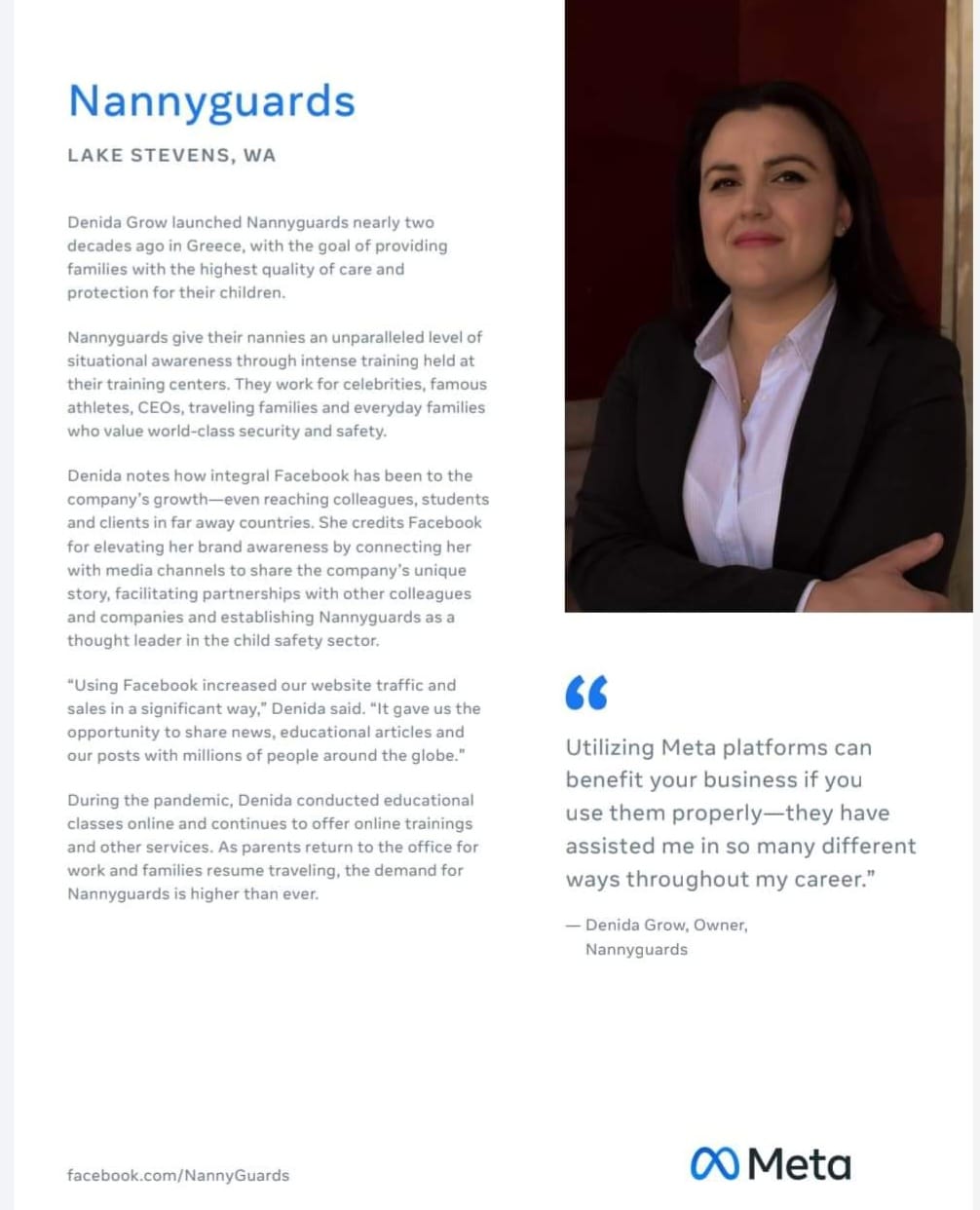
Nannyguards has been selected by the Leaders Network team at Meta

We are very happy and quite proud to announce that Nannyguards has been selected by the Leaders Network team at Meta to showcase our success story. It has been a tough road and many long hours since the very first day Nannyguards was created and we feel extremely blessed to share our work and heartfelt passion with some amazing professionals who have since joined our team. Dr. Mary Beth Wilkas Janke (Psychology), JD Elkin (Cyber Security Awareness), Kelly Sayre (Situational Awareness) and Chris Grow.

Want to learn more about Nannyguards? Visit www.nannyguards.com

‘Wren Eleanor’ TikTok movement inspires moms on social media to remove photos of kids: ‘Sick people’

TikTok sleuths noticed that users were saving videos of 3-year-old Wren Eleanor in concerning numbers

For years, security professionals have been repeatedly sounding the alarm in regards to the extreme danger of parents posting their children’s pictures or videos online. Your child’s adoring pictures or videos can be downloaded, used, and, quite often, photoshopped in horrific circumstances by pedophile rings, child traffickers, and ‘kiddie porn’ websites. What to you is “cute” and “adoring,” or a great way to draw more followers or make money as an influencer account, is for these insidious others “attractive,” “sexually stimulating,” or “erotically arousing”! Evil absolutely DOES exist…Horrible individuals and organizations are very real, and they are preying on your ignorance and hunting your children. Be alert!

According to the Fox News article, “One user, @hashtagfacts, noted that a video of Wren wearing a cropped, orange shirt was saved more than 45,000 times. A video of Wren eating a hotdog was saved nearly 375,000 times. She also highlighted unsettling comments on Wren’s videos and pointed out that popular searches for Wren’s account included phrases like “Wren Eleanor hotdog” or “Wren Eleanor pickle,” meaning users were frequently searching for videos of the three-year-old eating a hotdog or pickle.”…

Click here to read the full article

Social Media Investigations and Monitoring for Risk Mitigation Purposes

The use of social media and the way it affects our lives and businesses have brought a new challenge to the security industry and the protective team’s responsibility. It gives the entire world the ability to look into people’s lives with the mere push of a button. Scandals are created, secrets exposed, and lives ruined. In the case of personal security, social media can be used in the advancement of a protective detail; however, one must know how to utilize it properly. Today, we will talk about Social Media Investigations and Monitoring. For those who are not aware of the term, as we utilize it in protection circles, Social Media Investigation and Monitoring is the process by which you can identify what is being said about your clients, a brand they represent, or the corporations with which they are involved and any threats or dangers that may exist in relation to those aspects.

As we sift through different social media platforms and online channels, we must then determine if what is being said has any significance regarding your clients’ reputation, persona, and safety and if there is the need to mitigate any risks. In other words, it’s like setting up an online, social media “net”. This process then helps you discover everything that is being said, written about, or portrayed on social media and determine its relevance to your clients. You can gather information about the ‘’public opinion’’ surrounding your clients, about people or entities who are angry with them for one reason or the other, people who are obsessed with them, or people who are making online threats. SOCMINT or Social Media Intelligence (not to be confused with OSINT) has seen a huge rise in necessity due to the use of social media and a competent protective detail needs to always be informed and social media investigations and monitoring are a huge part of this process. 

Now, let’s see some examples of how social media investigations and monitoring applies in protective services. Let’s say one of the people you are protecting belongs to a large pharmaceutical company and they decided to raise the price of a specific drug, thus affecting the lives and wellbeing of thousands of people. Perhaps another client is involved in a financial institution that quite suddenly makes a significant decision that affects people’s lifetime savings and pensions. You can imagine that there will be a significant number of people who become very angry, and some may want to harm your client. During the recent pandemic, there were a number of “anti-vaxx” groups that were quite vocal and utilized Facebook as one of their many platforms to accomplish their goals. Another example would be the need to discover if there is someone using your client’s name or company to scam others and commit crimes.

We are sure that many of you today are aware of the infamous ‘’Tinder Swindler’’, Shimon Yehuda Hayut, who legally changed his name to Simon Leviev to pretend to be the son of the billionaire Lev Leviev and used his name and company logos to scam people. Although his actions were known since 2017, it was only after the airing of the Netflix documentary in 2022 that the Leviev family found out and filed a lawsuit against Hayut for falsely portraying himself as the son of Lev Leviev, receiving benefits, and committing crimes.

According to Leviev’s family attorney, Guy Ophir, they will now include anyone who has attempted to make a profit from his scam during the next lawsuit. What we can ask is, as security providers, why didn’t someone from the real Leviev family ever discover this scam artist who was extremely public and active on social media as the ‘’son of Lev Leviev’’? Although the real family members were never part of this fraudulent scheme, and it didn’t appear to affect their safety, it did, however, involve their name/brand in a very public and negative way. In other words, it should have definitely been considered as a threat to their reputation. Other people who were harmed by this scam artist were the businesses who did work with them, and their secondary service providers as well. 

Another interesting case to mention is Elon Musk where he, the actual client, took it upon himself to “solve” the issue and directly contacted the person of interest who had begun posting his private flight details and created the security risk for him and was literally blackmailing him unless the POI was paid. According to media reports “Elon Musk states social-media accounts that track his travel movements are ‘becoming a security issue.” Tail numbers and yacht names of billionaires are increasingly being shared on online platforms and one can track them by having the appropriate app unless significant efforts are made to secure them from the reach of those diligent few. These are some unique specific details that the security team needs to pay close attention to at all times.

Photo by Asad Photo Maldives on Pexels.com

Since Social Media platforms are the way people today communicate with each other, we as security providers must keep in mind that this is not always a positive aspect. Perhaps a person or persons will utilize social media to collectively gather people with their same goal or mission, to get together and plan their next move (Example: protesting outside your client’s house or corporation). In this case, you will want to know what is being said online about the person you protect to determine if there is something of extreme necessity to include in your risk and threat assessment and then take protective measures as well as inform their legal department.

As we have all witnessed too many times, it only takes one well-placed picture or story regarding some alleged activity on the part of your client, and it will go viral quickly, truth or not. Staying one step ahead of this type of “attack” has become a crucial necessity in order to protect your client from embarrassment or exposure. One of the most common issues in recent history is when personnel close to the client i.e., family, staff, vendors, and any other secondary customers post pictures, stories, or opinions and subsequently fail to understand the negative effect these types of communications can and will have on the client’s life, business, and the lives of their loved ones.

Why do you need a Social Media Investigations and Monitoring Strategy when you are a security services provider? To summarize we can say:  

1) To identify new threats. 

2) To discover what information about your client is posted online either by himself, the ones close to him, or his employees and evaluate how these affect his safety. 

3) To evaluate a threat (someone is posting online threats directed at your client).

4) To add to your due diligence.

5) To geolocate a picture or a video, sometimes even audio. 

6) To include any findings in your Risk and Threat Assessment (We can never highlight this enough, social media surveys and investigations are now a critical part of your Risk and Threat Assessments).

7) To find people obsessed with or following your clients (stalkers).

8) To identify hate groups or terrorist organizations that may affect your client.

9) To identify people or businesses your client may or may not want to do business with.

10)To mitigate risks from the information found online about the person you protect (How are the pictures of my client used or tampered with and for what purpose?).

11)To identify if someone is impersonating your client or a family member.

12)To find out if your client’s moves/visits/travels are posted online (Exposing them to others who may be in the same hotel, conference room, restaurant). 

13)To identify workplace violence or insider threat indicators.

14)To find out what is the ‘’public opinion’’ regarding your client (Always keep an eye on what is being said about your client and have a strategy to respond). 

15)To determine if a person or persons are utilizing your client’s name or business name in a malicious or unauthorized manner for their own personal gain. (Claiming associations or partnerships, etc.)

How to perform Social Media Monitoring for security purposes? 

First, let’s clarify one important thing. ‘’Googling it’’ is not enough, nor is it the answer. There are a number of search sites that allow for user input thus watering down or contaminating information and it’s accuracy. For those who are not aware, Social Media Investigations and Monitoring is quite a different department of protective services and quite often falls under Intelligence Analysis and Open-Source Intelligence. It requires unique skills and knowledge. One must clearly understand different social media and research platforms and how to use each one of them (and/or in combination) to obtain information. How you will approach each case is different and certainly depends on who your client is, their business, close relations, and/or their public image. This will directly affect the searches and the resources used and for what purpose. It is vital in our current day and age to include SOCMINT (Social Media Intelligence) in your client’s service proposal, no matter how public the person may or may not be. Hiring ten Executive Protection agents and a Residential Security Team is not enough anymore. SOCMINT services are a vital part of your Risk and Threat Assessments (Dynamic Risk Assessments too) and enable your protective detail to function more efficiently. 

For those who can not provide a certified Social Media Investigator for their clients, follow up with these steps:

1)Understand who your client is, his/her background, the threats, where do they stand in political, social, financial sectors.

2)Be aware of any of the latest changes in your clients’ lifestyle, public opinions, and professional decisions. 

3)Be aware of any of their political and social changes. Watch the news from multiple channels. 

4)Familiarize yourself with all close family, friends, staff, and associates and their respective social media footprints.

5)Set up a social media investigation and monitoring strategy. 

6)Have a good understanding of the Intelligence Cycle (How the intel is being collected, analyzed, disseminated, reviewed, etc.).

7)Have a good understanding of the search tools on different platforms (Facebook, Twitter, Instagram, TikTok, LinkedIn, Tumblr, Reddit, etc.) 

8)Do research on the available search engines and the strengths and limitations each one may have. 

9)Know how to conduct image, video, and audio research and gather intelligence from them.

10)Invest in appropriate platforms for social media investigations and monitoring (Have in mind, NEVER rely on one platform’s result or just platforms’ results. The user/investigator is the main component of a social media investigation). 

11)Download and use appropriate search engine extensions and apps. 

12)Invest time in creating ‘’sock puppets’’ or fake profiles and maintain their persona. Sometimes you may need a profile to have access to different forums or groups without being discovered.

13)Train yourself in link analysis (How to look for connections between people, events, and organizations).

14)Set keyword alerts (In multiple languages in case your client has ties with more than one country).

15)Gather, analyze, evaluate, and report your findings to the appropriate department or leadership.  

Photo by Lisa Fotios on Pexels.com

As the threat landscape changes every day, we as protection providers must be able to adapt and keep ourselves up to date with additional training. Today’s executive protection agent must also be skilled and knowledgeable in investigations, open-source intelligence, protective intelligence, HUMINT, and have an increased understanding of cyber security. Large corporations have already created their own embedded intelligence departments, while others are hiring threat analysts and OSINT investigations from outside security providers. The rise of protective intelligence, and whatever that includes, is here to stay and we are seeing it more and more through the highly increased number of related job postings every day. 

If you are an Executive Protection Agent and want to learn more on how to utilize Social Media Investigations and Monitoring for Risk Mitigation Purposes, reach out to us.

f you are a service provider and want to add Social Media Investigations and Monitoring for Risk Mitigation Purposes on your service list, contact us to learn about our vendor services. 

Chris Grow

AUS Global Special Services Travel Team

Managing Partner LeMareschal LLC

Denida Grow

Founder & CEO

Athena Worldwide 

Nannyguards

Managing Partner LeMareschal LLC

Mentoring Security Professionals

We will be launching a series of educational webinars that are absolutely free to attend. The aim of the webinars won’t be to present people and their past stories, but to have specific guests who will combine their experience and training in the industry in order to teach you something new, to help your professional development and to provide consultation for you. They will share their opinions, the “do and don’ts” of the industry and answer your questions.

And the best part? The content of each webinar will be developed by you! While we are working on our next webinars, let us know either by a comment here or via email at info@lemareschal.com what topics would you be interested in having discussed, answered and/or receive consultation on? This is a webinar created for you, by you!

Executive Protection Agents in a Rare Interview with a Retired Paparazzi

It’s not very often when we have the ability to interview and learn from our adversaries. While most efforts are seemingly focused only on physical attacks, they do not give enough emphasis to the paparazzi, media, and all that this facet of protection entails. But we’ve got you covered. This is an interview we have been wanting to do for the last 5 years. What we learned from a retired British paparazzi is that pointing a flashlight toward them won’t work, neither you are safe if you block the tail number from your private jet. We also learned how they find information about your clients, who are willing to pay a lot of money to buy your pictures (no, it is not only the media outlets), to what length they will go to distract you and get that picture and why you will be not able to buy their silence.

*Disclaimer: During this interview, you may encounter offensive language content within the realm of your site.*

** For permission to use this video please contact info@lemareschal.com**

***Copyright @Athena Worldwide, a LeMareschal LLC company. Any illegal reproduction of this content will result in immediate legal action.***

The challenges for protecting Public Figures- The Macron Incident

The latest incident with French President Emmanuel Macron being slapped by someone in the crowd has once again fired up the keyboard warriors who take any incident (video or picture) such as this and claim how improperly the Executive Protection team functioned and what would they have done differently and, of course, be more successful. As a Greek proverb says ‘’Whoever is outside the dance (floor), can sing many songs’’ Meaning: It is easy to talk about something when you are not the one involved in it. 

As security practitioners, we must be very careful what we say online, keeping in mind, whatever you post online stays online even if you delete it minutes later. We should not criticize security details and/or the people involved because we do not know all the facts, details, limitations and the full story. When you post a comment on a 10-second video, you may not have the full story. You do not know what happened before or after the incident. What you see in a photo may not be the full picture. It doesn’t make you any more ‘’professional’’ when you try to spot the wrong moves in an incident where you weren’t involved and you do not know all the parameters: you are just assuming.

In this case, we heard many opinions:

‘’Why didn’t they keep standard formation?’’- How can you keep standard formation when your principal is anticipating close interaction with a member of the crowd? Greeting lines are extremely tedious and are one of the most difficult situations to read and provide protection.

‘’The reaction time was slow.’’- The reaction time always seems to be slower when you see an incident on a video over and over again rather than being involved with it in real-time in the field.

‘’They were lucky he wasn’t holding a knife.’’ – Actually someone did their job well and made sure he (or anyone else in the crowd) wasn’t holding a weapon. What most fail to understand is that these crowds are previously checked for anything that can be used as a weapon.

‘’Why didn’t they saw that coming?’’ – They don’t teach ESP at Executive Protection schools…

‘’Why didn’t someone teach Macron?’’ – Most protectees won’t sit down and learn from you about protection, they want you to protect them. It’s not their job to know how to do yours…Why do you think you’re employed?

Now let’s address some challenges for protecting public figures and try to make some rational sense of all of this.

Protecting people whose identity depends on the public, such as politicians, in this case, is very much different than protecting a C-Suite executive for example. A politician needs the interaction with public. They shake hands, hug, get pictures with and celebrate with large crowds. Having people like them is what makes people vote for them, and they need to look and act quite approachable to everyone in order to gain votes. If they don’t get the votes, well, then they no longer hold their current political position. They have to attend gatherings and events and most of those functions may be outside of your span of control regarding organizing it. You have to provide services as best as you can with what you have and minimize whatever limitations you can. 

In this case ‘’the unknown crowd’’ is the issue. The ‘’crowd’’ provides a good opportunity for the enemy to blend in, act and even escape in some cases. Also, as most public appearances are preplanned and announced, the enemy has the time to be prepared for the attack. And when we say attack, let’s clarify that “attack on your principal” is not only an assassination or physical harm but also an attack on his/her personality, reputation or by causing embarrassment. 

While most EP training schools focus only on physical attacks, have in mind causing embarrassing situations may be something your principal is particularly vulnerable and endangered by, thus it is something you must be prepared to prevent. Making sure the crowd has been checked for anything that can be used as a weapon doesn’t mean you are safe from an embarrassing situation. Paying attention to people’s hands and what they are carrying doesn’t mean you can be sure about the intention of a handshake. A handshake can become a pat on the shoulder or a slap on the face. How would you know the intentions of the handshake and act within 2 seconds to prevent it? You must be in very close proximity to do that and sometimes you have limitations on how close you can be with your principal, particularly when they are interacting with the public and potential voters. When any public figure decides he/she want to come within close proximity of a voter, you are required to break the standard formations and you cannot have security between the voter and the principal because they need that ‘’personal space’’.

Act too aggressive and they will perceive this position as very unapproachable, something that goes against your principal’s political campaigns. So you have limitations or adaptations to perform your protective job competently. 

Another thing to consider is that some protectees will appear uncooperative with you and your suggestions or directions. They will do the exact opposite of what you have instructed them to do or whatever the plan was because they thought doing something different was ok, safe or was suggested at the last minute by their campaign manager. Some protectees will ask you to protect them no matter what. The fact that they won’t consider changing their lifestyle, and you have to do your best, becomes another facet of the ever-evolving detail.

Have we forgotten the flying shoe incident with President Bush in a press conference in 2008? The red paint thrown at Mary Harney, Ireland’s Health Minister in November 2010? Berlusconi’s nose being broken and two teeth knocked out when a man attending a political rally threw the statuette of Milan’s Duomo gothic cathedral straight in his face in 2009? Eggs being thrown at Bill Clinton in Warsaw, Poland? Nicolas Sarkozy being a victim of a flying pie in 1997? The book thrown at Obama in 2010? The glitter attack on Minnesota Governor Tim Pawlently in 2011? Pope being attacked by a woman who jumped barriers at St Peter’s Basilica and knocked him down in 2009? The famous slap on Dimitra Liani Papandreou, the widow of ex Greek PM at her book signing by a woman who appears to be there to sign her book? Bill Gates’ “Pie-to-the-Face” fiasco? There are so many more similar incidents including paint, body fluids, pies, yoghurt, vegetables, flour and even flashing body parts such as the Femen members who went toplessness in front of the EU-Russia summit, in Brussels, in December 2012.

Can we criticize the EP team members involved in these incidents? Can we say that you would have done better after the incident has taken place? From the moment you have a complete crowd check for weapons, you are in a “secure” space. But what leads you to believe that you have a better understanding regarding the mental status of someone who appears to be a voter or a fan? Can you honestly guess his motives if he/she wants to slap, or spit or in some way embarrass your client?

If you haven’t provided security details for Public Figures, it may seem easy for you to criticize an incident like this, but criticizing what you don’t know and just assuming doesn’t make you right and it very well may show your ignorance. Instead, use this incident as a reminder that people will use anything to harm your client’s reputation and their imagination can be big and quite unpleasant. Keep it as a learning tool for yourself and yet another scenario in your head of what you would or wouldn’t do if…

Denida Grow

Managing Partner

LeMareschal LLC

Founder & CEO

Athena Worldwide

Nannyguards

Things to consider before you hire an Executive Protection team aka Bodyguards

 To all CEOs, celebrities, VIPs and high value individuals…

At some point in your careers, you will most likely find the need to retain, or at the very least, inquire about close protection services for yourselves, your loved ones and possibly for those you employ closest to you.
      Now, the list of companies and corporations that provide these type of services is quite lengthy and, while at first they all appear very impressive, you need to be thorough as you take a deep look at them and the ideals and morals they represent. Again, you are searching for the perfect fit that best protects yourselves, your families, employees and all things that you need secured and confidential.
      A quite disturbing trend as of late has been the repeated posting of pics with you as the client, at your locations and in front of your vehicles, private planes, residences, etc. while boasting about the details of who you might be, what was happening or other items of a secure nature. Now, this is entirely unacceptable no matter what the terms or conditions of their employment may be with you. You, and all that that may encompass, are to be secure, confidential and invisible for all intents and purposes. Period.
      Social media has become the source of all communications amongst a great number of these entities and this in turn has led to a trend of exposing enormous amounts of confidential client information when it is not only unnecessary but highly unprofessional and, frankly, childish. At times, it has even been portrayed as “marketing” when, in it’s true form, it’s nothing more than schoolyard bragging.
      So, when researching a prospective organization that you perceive may be the one you will choose, a thorough search of all related social media should be performed. The company’s sites, the reviews and even the social media sites of any/all possible employees that you might hire from their corporation. If they are willing to expose their previous clients with seemingly reckless abandon, you will most likely be the next celebrity/VIP pic that hits the Facebook/Instagram/LinkedIn circuit and that is, I’m quite sure, not your desire at all.
      Many companies will show an endless supply of “tactical” pictures, extreme condition photos, worst case scenario snapshots, etc. Please understand that most of the organizations are composed of a large number of former military members, former LEO/SWAT members and private security contractors who have “been there & done that”. But it is always wise to remember that while these skills are highly advantageous should everything go tragically wrong in your day, these type of days should never happen if the proper planning is performed which is completely above and beyond the “hard skills” as they are often referred to.
      Another highly recommended item is a detailed NDA and total social media blackout for all involved. Leave nothing to chance and be very clear regarding the seriousness that this represents to you and the severity of disciplinary action should it be violated. Again, you and all you hold most dear are to be secure, confidential and private and definitely NOT on the front page of a local newspaper, tabloid, media page or out to the highest bidder.
      Always remember this…You came looking to us with your concerns and fears, placing your overall well-being in our capable hands. With that in mind, you should always feel protected, safe and secure from anyone or anything that might wish to harm you. And that harm should NEVER be at the hands of the very people whom you have so willingly trusted to provide the very best security, protection and peace of mind.

Denida Zinxhiria Grow

Founder & CEO

Athena Worldwide

Athena Academy

Nannyguards

At Athena Worldwide we are industry leaders in promoting, training, and staffing female bodyguards internationally. With our affiliate offices, we can provide worldwide close protection and executive protection services for entertainment professionals, politicians, CEOs, Royal Families, journalists, clergy, and corporate personnel. Want to find out more about female bodyguards? visit www.athenaworldwide.com

Who is guarding Prince Harry and Meghan Markle’s baby?

Lately, many news agencies have tried to write about the protection detail of Prince Harry and Meghan Markle’s baby, based on ”insiders” and revealing names of companies and protectors assigned for little Archie’s security. Now, before you believe any story, have in mind that most of the time those ”insiders” are the company owners who want to draw attention to their companies. It doesn’t mean that those insiders are saying the truth and should be believed.
Prince Harry comes from the most powerful Royal Family in the world, their family members are trained and educated on how to select people that will work for them. They give a huge emphasis on confidentiality, work ethics, and discretion. So you will never know the names of the people who work to protect them, not even the companies.
Ask yourself if the public is aware of the names of the people who protect Bill Gates, Jeff Bezo’s, or other Royal Families. They don’t. Because it is very important for those Close Protection Operatives/ Bodyguards to be unidentified. You will never see them posting pictures with their clients or naming their clients on social media or in interviews. Only an amateur or an unprofessional protector would do so.
Close Protection Operatives/Bodyguards have been hired in the past to protect children of HNW families, celebrities, Royal families, etc. It is not a new ”trend”, so let’s see what it means to offer close protection services to minors.
Some may think it is the ‘’easy job’’ but when you get hired to protect a client’s most valuable asset, his child,  you will find out that providing security details for minors is actually harder and more challenging than protecting adults. Consider as well, the immense amount of trust a client has to put in your ability before they offer you the opportunity and then not be overconfident in your performance. Kids are the fastest way to end a career, don’t underestimate the challenge they present or the rewards that service to them offers.
Today more and more celebrities, dignitaries, politicians, and the corporate elite are hiring female bodyguards that are assigned specifically to protect their children.
The traditional huge thick-necked bodyguard accompanying a child to the zoo is giving way to the ‘’child-friendly image’’ of a well-dressed athlete with an I.Q. of 130+, caring for that child as if it was their own. Male and female bodyguards that can blend in with and adapt to the environment of parents and children are more likely to gain employment over the classic muscleman.
If you are in charge of protecting young children, you will either be their sole caretaker in public or be in charge of both them and their caretakers. Either way, you have challenges. If you are the sole caretaker, you will be as preoccupied with meals, diapers, tempers, and entertainment as with their security. If you are watching over the child while in the company of a nanny or parents, your job is immensely easier but also exponentially harder with the addition of each person added to the party.
Conditions are easier if the child is younger and cannot communicate because you don’t have to carry on a conversation, but harder because you also may have to carry them, thus occupying your hands. Easier if they can talk but harder when they can talk back or argue.  Easier when they are older and can listen for and follow directions but harder when they want their own way.
The difficulty really comes when you are dealing with teenagers. An exceptionally high number of security details for teenagers has to be done covertly. This is to say that the kids just won’t want you around or cooperate with you if you are “in their space”. So forget about walking formations, suits, and stiff postures. Be prepared to dress casual and blend in. That includes both your physical appearance and behavior. One wrong move that embarrasses your young client and you are done, and with a negative review of your conduct reaching the parents, done for good.
Here are some hints to consider when protecting children:
If you can work with a caretaker or parent and allow them to care for the child, this is ideal. The adult would go through training with you to learn to understand verbal instructions and non-verbal instructions and you would not deal directly with the child or ever be alone with them. You must also consider your age and athletic ability when compared with the nanny or the parent(s). Could you pass for a spouse or parent or Aunt or Uncle?
When you interview a client prior to accepting an assignment, ask them about your limitations or role regarding their child’s protection. Typically, the client will not allow you to admonish or punish a child for misbehavior. You will be spending a lot of time with a child that may be developing his/her character. This is a very vulnerable period. Not many parents are willing and open to allow another person to correct their child’s behavior. So be sure to clarify your limitations in writing.
Also, remember that attraction is a natural function in life and children learn to trust and become attracted to adults at an early age.  This process averages about 6 months which is why it is recommended that you limit your contracts to that amount of time. If you are going to stay longer, you must obtain additional training as the emotional stress on you can be overwhelming over longer periods of time. Some may ask you to just act as a bodyguard and protect their child’s physical well-being and some will ask you to also educate them and correct bad behavior.
When it comes to children’s or teenagers’ protection, clients tend to hire bodyguards that will be assigned to the family and the child for many years. As one might understand, it can be difficult to place different bodyguards on a child’s or teenager’s protection during short time periods. In this case, they are looking for someone skilled and mature enough both professionally and ethically to protect but also work as a mentor for their child.
Mentoring and teaching could include academia as well as self-protection skillsets. Make sure your need for income doesn’t overwhelm your ability to teach.
As with any client, there are roughly 50 mandatory questions that should be asked and answered, and an additional 100 that could be asked. Many of these should be asked of the parents but many should be asked of the child while the parents are present. As soon as you get assigned to a child protection detail you must ask about their habits, his/her medical record ( blood type, if he/she is allergic to anything, etc), preferable places they like to spend time, and of course who their friends are.
Background checks should be conducted on every adult around the child, including the parents of friends. Include school staff such as teachers, coaches, bus drivers, school nurses, and cafeteria staff.
Have a conversation with the child. Explain to them why you are there and what your job is. Usually, they see you as a new person intruding in their life and someone who is there to spy on them and report anything they do to their parents. This initial bonding is critical to you keeping your job.
Deal with older children as adults. Have a conversation with them. Children are not stupid and like to be dealt with as adults. Respect their opinion and explain your position. Make sure they understand that your only duty is to keep them safe.
An additional concern is reporting. Whether asked to report back to the child’s parents or not, you should keep very accurate notes and be prepared to deliver an accurate report to them. This may ruin trust so be very careful with this.
Allow the child some time to feel comfortable with you and trust you. Depending on the child and your approach, it may take them up to 3 months to start feeling comfortable and trust you. Don’t rush the process. Be approachable and let them decide when they can come closer to you. Again remember that this is dependent on your planned length of the assignment.
Children by nature are very reactive and they tend to do the opposite of what they have been told. For the child, we are another ‘’intruder’’ in his personal life. It takes a great deal of patience and discipline to earn trust. Study this process and seek out a professional counselor if needed. Your client should retain one for you.
In the beginning, (with an older child), you will have to deal with a child who will be asking you to stay further away, don’t look at them, don’t open the car doors for them, don’t accompany them for shopping or to the movie theater. Of course, as you do your job, you will have to disregard or ignore their requests and although some in our profession may say it doesn’t matter what the child wants the fact is that at some point it does matter. At the end of the day, you don’t want to deal with a kid who will play hide and seek with you and see you as an enemy, but a child that will be cooperative with you and seek you out and trust you when danger threatens their safety or security.
Educate the child on security awareness topics. Children love learning new stuff and they will understand why you can’t stay back out of reaction range, How you can see them but not watch, how you can be close enough to hear them but not listen, why she/he can’t sit on the passenger’s seat next to the driver, why you have to open the door for them etc…
Since much of teenager protection is done undercover, set some signals or codes with the child. Let her/him know what signs you can use for cases such as ‘’stay there’’, ‘’go’’, ‘’come close to me’’ etc. AND Practice these every day.
Consider the child’s friends. Your presence around them can affect how your client acts or reacts. Avoid addressing the friends and never correct the child in front of them.
Another important issue to discuss with the child you are protecting is their online behavior. You may have to teach and explain why it is important for him/her to be very cautious about what information and pictures they post or share with friends. Many times, parents neglect these matters. You will become all things to these children. Take the influence you have over them seriously. You are not just protecting them, you are influencing them too. Children will learn to manipulate both parents and protectors. Parents may become jealous or resent that you spend all your time with their kids or that you are “too close”. Address this issue early on. It will save your career.
You need a female bodyguard to protect your child? Contact us today
Denida Zinxhiria Grow
Founder & CEO
Athena Worldwide
Athena Academy
Nannyguards
At Athena Worldwide we are industry leaders for promoting, training and staffing female bodyguards internationally. With our affiliate offices, we can provide world-wide close protection and executive protection services for entertainment professionals, politicians, CEOs, Royal Families, journalists, clergy and corporate personnel.
Want to find out more about female bodyguards? visit www.athenaworldwide.com Prince Harry and Meghan Markle’s baby bodyguard, who is protecting Prince Harry baby, Bodyguards for Archie

Confidentiality: Personal Choice or Professional code of conduct?

Recently, a young lady, new to the industry, raised a question on a social platform questioning the practice of, or if it is acceptable for, people in our industry to be dropping clients’ names in public or publicly posting pictures with their clients. Surprisingly, many people who took part in the thread commented saying that they didn’t find anything wrong with it. Some of them even named their own old clients. Some were trying to justify it by saying they don’t work for that specific client anymore, they didn’t reveal anything personal about the client, they have the client’s approval to post that picture or name the client, their client is super famous and paparazzi are always getting pictures of them together so why hide it, etc., etc. Essentially, the overall consensus was that they are “good guys” and how dare we criticize people we don’t know. These were quite a number of comments from individuals who either work in the security industry as operatives or own companies themselves and hire contractors to represent them.

Now, we all know that confidentiality has been a hot topic that raises many debates every time it’s laid on the table. And we see the ever-increasing need to have discussions about it nowadays, more than ever, due to the internet and the influence of social media. Merely saying that it is wrong to post a picture or name your client in public does not remotely infer that we are jealous of the clientele you have, it is certainly not because we want to talk bad about you or because we want to look better. The primary reason for it being discussed as an action that is wrong to do goes all the way back to the very basics of risk assessment and dynamic risk assessment. Those who haven’t had the opportunity to be taught these topics in one of their EP schools should truly seek continuing education on it and those who fail to remember their training on how it can drastically affect the client’s safety, need to go back and re-study. This is EP 101….

For a moment, let’s talk about risk factors and who may be after your client: Media representatives (journalists, paparazzi), stalkers, unhappy former employees, former wives, girlfriends, business associates, business antagonists, people he owes money to, kidnappers, and while the list can go endlessly on forever, for brevity’s sake, let’s say anyone who may want to harm him/her in any way, shape or form. That being stated, the person who is standing directly between that client and all these risk factors is you, and anyone who works in the security detail. By linking your name or putting an ID on the person who is standing next to that client in the picture frame is a risk by itself. How so? We will explain later.

Now, let’s address some of the individuals who have stated that these are acceptable practices. Confidentiality is always associated with the less than-desirable actions or events that may occur during a detail, “What happens on the detail, stays on the detail” sort of thing. We have a tendency to become complacent with many other aspects of the more pleasant, day-to-day occurrences, not feeling that they are of any importance in the overall aspect of security. You could not be more mistaken. Confidentiality is about ANYTHING that involves your client and their life, and whoever was involved or interacted with the security detail. It entails the complete protection of any/all kinds of information that someone might gain access to, who may want to harm him in some way, obtain something to use against him, or even harm his reputation.

How long must I maintain this confidentiality? Well, just because you worked for someone in the past doesn’t mean you can or should discuss any details about them or the fact you worked for them formerly. Having worked for someone means you now know critical information regarding their security detail, estate security, what kind of vehicles are used, how many people work for them, what are the skill sets of the current agents (basically how good they are), if they have any issues or weaknesses (divorces, custody battles, use of drugs and alcohol, illegal affairs …), etc. You also know where the client likes to “hang out”, where his good friends live, his close family resides, and most importantly, you are aware of all the security ‘’gaps’’ and security protocols…. And these tiny gaps? We write about them in our reports and address them to our supervisors and most of the time no one cares to take them into consideration because of the budget, or because they don’t want to ‘’bother’’ the client’s routine or bring inconvenience to their daily life. So, the complacent prefer not to change anything, and most of us have walked into security details where protocols (even radio call signs) haven’t been changed for years. So, having worked for someone in the past, even if you are no longer employed there now, doesn’t make it acceptable to talk about it, because you are in possession of important information that may harm or put anyone who worked for that client in a position to be blackmailed or harmed.

“I have the client’s approval to get a picture with him and even post it”. Let’s admit it, there is nothing more satisfying in our profession than to have a happy client who is OK with having a picture together. Yes, you can take that picture of the two of you, but for your own personal photo album, if you like to keep one of those…Never to post in public. The client may be OK with it, but remember, the client hired YOU to protect THEM. They don’t know about security procedures and risk factors, and if you ask for a picture, they may think it is safe. You, however, as the security professional, the trained and educated one, must think and breathe ‘’security’’. You alone are the one whose acts must always take into consideration the client’s and team’s safety.

Many inexperienced agents are misled to believe that since paparazzi are after their clients, their face is all over the media so why not post a picture? Well, the simple answer is, that your face may be in those pictures, but you are just a face. A face doesn’t give an ID to that person standing next to your client, however, posting anywhere on the internet or in any type of social media platform absolutely does. So again, you’re putting a name to the face of the person who guards that client and thus presenting another possible access point to the client or their lives.

And to those who say we shouldn’t criticize someone we don’t know in person, please understand that you are critiqued for everything that potentially shows your professional attitude and performance. “Perception is reality” is more critical than you think. And for something like this, it only takes a misspoken statement in an interview or your personal opinion on social media. You are not necessarily judged if you are a good family person or a good friend. Someone must know you personally to have an opinion on those matters. But when it surrounds work, please remember that what you post, how you comment, and your professional behavior will be criticized and this fact spares no one.

In our line of work, we are the ones who must think and prepare for all threats and take needed measures to prevent worst-case scenarios. Depending on who your client is (or was) talking about them doesn’t necessarily cause life-threatening harm, but it can do damage in many other forms, which you as their security (past and present) must always protect them from, keeping them safe at all times. It may also harm anyone who worked along with you. Just think for a moment…If someone wants access to your client, is it not feasible that they would begin threatening your child, blackmailing you, or threatening someone you love? And under those types of stressful circumstances, would you still be able to remain quiet, hold the information, and not reveal what you know about that client? The secondary blackmail, extortion, and kidnappings are a useful tool to get access to the primary target, which is your client. Predators will go after the ‘’weak’’ link as they seek to harm a target. Exposing that there are any weaknesses, you included, will present an opportunity, and your client is likely to suffer for your misdoings.

An important aspect to consider is why some people are in so much need to stroke their ego. Why is it so important for them to be congratulated, to be told ‘’good job’’, or why their ego matters more than confidentiality and operational security? Do you really think a person who is in such dire need for validation is a safe choice as an executive protection agent? What information will that person disclose to anyone who is willing to pay him just right or threatens him just enough? Think about it for a second.

The companies that have the biggest clients are not known to most of us and they most certainly don’t go by any “tacti-cool” logos or brand names. These companies use strict NDAs and they are critical of how you carry yourself on social media platforms and some will even forbid you from having any significant social media presence. NDAs are there for a good reason, mostly to protect any/all the information you will gain while working for the client. There are many of our colleagues who work for HNW and UHNW individuals and you will never know their names. For example, you’ll never see anyone from some of Forbes’s Top 100 security teams ever mention where they work or for whom they provide protection services.

Where you work, or who you have worked for doesn’t say who you are as a professional, or how proficient you are. We have seen excellent professionals working for great clients and less-than-deserving individuals working for them as well. The name of your client or his social/celebrity status is not related to the level of your success by any means. Each detail has its own unique aspects. Consider the actual threat levels, the intricate advances required, the planning, and real-time decisions that must be constantly made on the move. It’s NOT about you…Never was, never will be. It’s all about the client and the operational professionalism you and your team provide.

Most of the confidentiality issues come from people who have done celebrity protection. Rarely, do we see it with anyone who runs corporate security details, or works for foreign dignitaries or politicians. We all probably know a bad professional who said yes to a low-paying job just to get that chance and get pictured next to a celebrity, but at the end of the day, you should measure your success by the fact you are still working as an EPO full time, it is your main income, you bring enough money home to your family and you are keeping your client and your team happy and safe.

It is up to us, the trained and educated security professionals, to identify a possible risk and minimize the threat level. Name-dropping our clients or unneeded selfies won’t make it any easier, and quite often, it adds more risks. There are many colleagues who think it is not a big thing naming or talking about your clients, but that becomes a liability and you yourself then become a liability as well. Tomorrow your work application may be rejected because someone saw how quickly you talk about your clients. You will find yourself passed over for another applicant who can remain quiet over the simple fact that you can’t keep your ego in check. And you will always wonder why they didn’t hire someone like you who has more work experience and more tactical skills. The truth is, there are many companies who do truly care about confidentiality, and they not only see it as an ethical threat but as a very strict part of their professional code of conduct.

Think twice before you name your clients or post that picture to the public… it may very well leave you out of the loop!