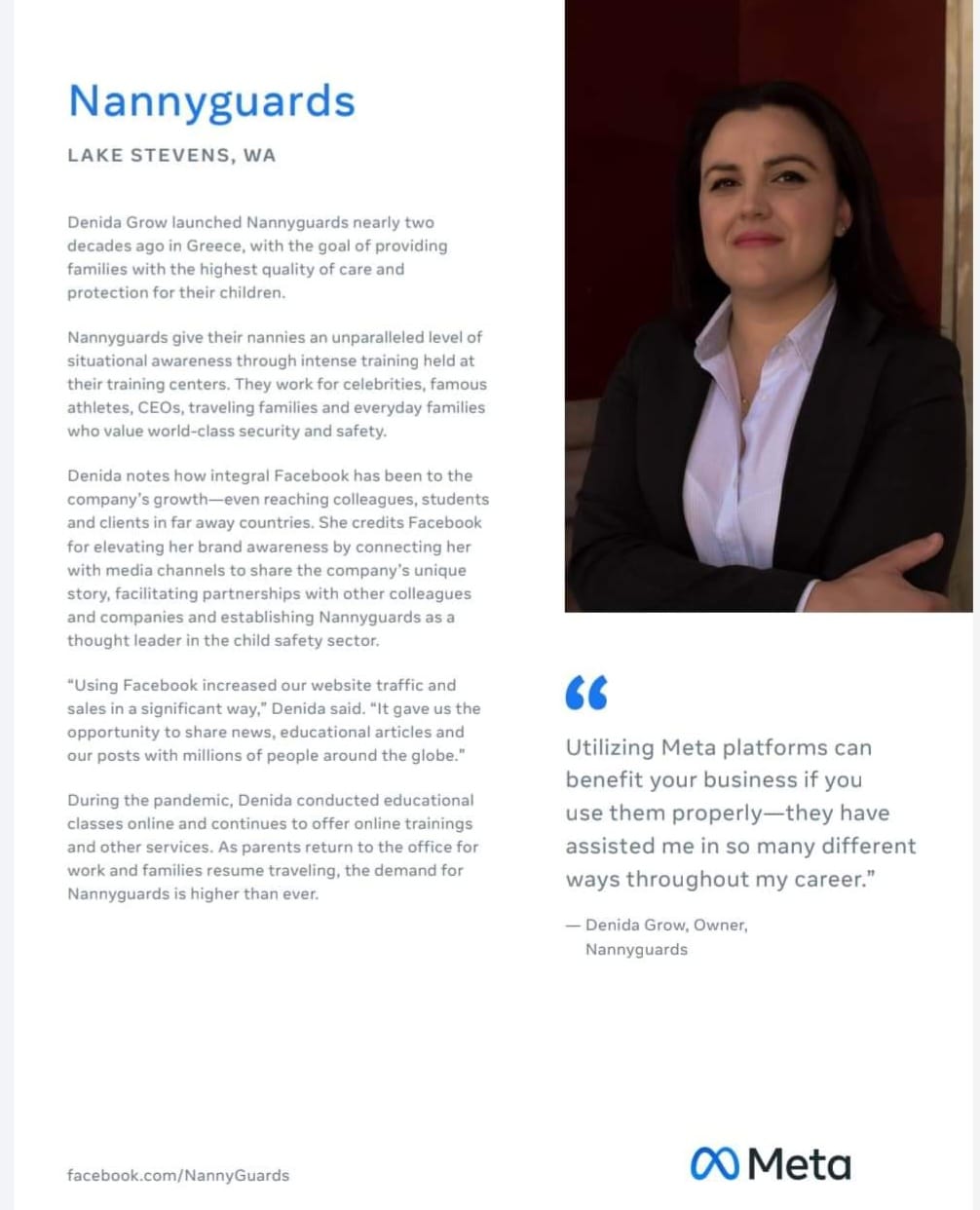
We are very happy and quite proud to announce that Nannyguards has been selected by the Leaders Network team at Meta to showcase our success story. It has been a tough road and many long hours since the very first day Nannyguards was created and we feel extremely blessed to share our work and heartfelt passion with some amazing professionals who have since joined our team. Dr. Mary Beth Wilkas Janke (Psychology), JD Elkin (Cyber Security Awareness), Kelly Sayre (Situational Awareness) and Chris Grow.
The use of social media and the way it affects our lives and businesses have brought a new challenge to the security industry and the protective team’s responsibility. It gives the entire world the ability to look into people’s lives with the mere push of a button. Scandals are created, secrets exposed, and lives ruined. In the case of personal security, social media can be used in the advancement of a protective detail; however, one must know how to utilize it properly. Today, we will talk about Social Media Investigations and Monitoring. For those who are not aware of the term, as we utilize it in protection circles, Social Media Investigation and Monitoring is the process by which you can identify what is being said about your clients, a brand they represent, or the corporations with which they are involved and any threats or dangers that may exist in relation to those aspects.
As we sift through different social media platforms and online channels, we must then determine if what is being said has any significance regarding your clients’ reputation, persona, and safety and if there is the need to mitigate any risks. In other words, it’s like setting up an online, social media “net”. This process then helps you discover everything that is being said, written about, or portrayed on social media and determine its relevance to your clients. You can gather information about the ‘’public opinion’’ surrounding your clients, about people or entities who are angry with them for one reason or the other, people who are obsessed with them, or people who are making online threats. SOCMINT or Social Media Intelligence (not to be confused with OSINT) has seen a huge rise in necessity due to the use of social media and a competent protective detail needs to always be informed and social media investigations and monitoring are a huge part of this process.
Now, let’s see some examples of how social media investigations and monitoring applies in protective services. Let’s say one of the people you are protecting belongs to a large pharmaceutical company and they decided to raise the price of a specific drug, thus affecting the lives and wellbeing of thousands of people. Perhaps another client is involved in a financial institution that quite suddenly makes a significant decision that affects people’s lifetime savings and pensions. You can imagine that there will be a significant number of people who become very angry, and some may want to harm your client. During the recent pandemic, there were a number of “anti-vaxx” groups that were quite vocal and utilized Facebook as one of their many platforms to accomplish their goals. Another example would be the need to discover if there is someone using your client’s name or company to scam others and commit crimes.
We are sure that many of you today are aware of the infamous ‘’Tinder Swindler’’, Shimon Yehuda Hayut, who legally changed his name to Simon Leviev to pretend to be the son of the billionaire Lev Leviev and used his name and company logos to scam people. Although his actions were known since 2017, it was only after the airing of the Netflix documentary in 2022 that the Leviev family found out and filed a lawsuit against Hayut for falsely portraying himself as the son of Lev Leviev, receiving benefits, and committing crimes.
According to Leviev’s family attorney, Guy Ophir, they will now include anyone who has attempted to make a profit from his scam during the next lawsuit. What we can ask is, as security providers, why didn’t someone from the real Leviev family ever discover this scam artist who was extremely public and active on social media as the ‘’son of Lev Leviev’’? Although the real family members were never part of this fraudulent scheme, and it didn’t appear to affect their safety, it did, however, involve their name/brand in a very public and negative way. In other words, it should have definitely been considered as a threat to their reputation. Other people who were harmed by this scam artist were the businesses who did work with them, and their secondary service providers as well.
Another interesting case to mention is Elon Musk where he, the actual client, took it upon himself to “solve” the issue and directly contacted the person of interest who had begun posting his private flight details and created the security risk for him and was literally blackmailing him unless the POI was paid. According to media reports “Elon Musk states social-media accounts that track his travel movements are ‘becoming a security issue.” Tail numbers and yacht names of billionaires are increasingly being shared on online platforms and one can track them by having the appropriate app unless significant efforts are made to secure them from the reach of those diligent few. These are some unique specific details that the security team needs to pay close attention to at all times.
Since Social Media platforms are the way people today communicate with each other, we as security providers must keep in mind that this is not always a positive aspect. Perhaps a person or persons will utilize social media to collectively gather people with their same goal or mission, to get together and plan their next move (Example: protesting outside your client’s house or corporation). In this case, you will want to know what is being said online about the person you protect to determine if there is something of extreme necessity to include in your risk and threat assessment and then take protective measures as well as inform their legal department.
As we have all witnessed too many times, it only takes one well-placed picture or story regarding some alleged activity on the part of your client, and it will go viral quickly, truth or not. Staying one step ahead of this type of “attack” has become a crucial necessity in order to protect your client from embarrassment or exposure. One of the most common issues in recent history is when personnel close to the client i.e., family, staff, vendors, and any other secondary customers post pictures, stories, or opinions and subsequently fail to understand the negative effect these types of communications can and will have on the client’s life, business, and the lives of their loved ones.
2) To discover what information about your client is posted online either by himself, the ones close to him, or his employees and evaluate how these affect his safety.
3) To evaluate a threat (someone is posting online threats directed at your client).
4) To add to your due diligence.
5) To geolocate a picture or a video, sometimes even audio.
6) To include any findings in your Risk and Threat Assessment (We can never highlight this enough, social media surveys and investigations are now a critical part of your Risk and Threat Assessments).
7) To find people obsessed with or following your clients (stalkers).
8) To identify hate groups or terrorist organizations that may affect your client.
9) To identify people or businesses your client may or may not want to do business with.
10)To mitigate risks from the information found online about the person you protect (How are the pictures of my client used or tampered with and for what purpose?).
11)To identify if someone is impersonating your client or a family member.
12)To find out if your client’s moves/visits/travels are posted online (Exposing them to others who may be in the same hotel, conference room, restaurant).
13)To identify workplace violence or insider threat indicators.
14)To find out what is the ‘’public opinion’’ regarding your client (Always keep an eye on what is being said about your client and have a strategy to respond).
15)To determine if a person or persons are utilizing your client’s name or business name in a malicious or unauthorized manner for their own personal gain. (Claiming associations or partnerships, etc.)
How to perform Social Media Monitoring for security purposes?
First, let’s clarify one important thing. ‘’Googling it’’ is not enough, nor is it the answer. There are a number of search sites that allow for user input thus watering down or contaminating information and it’s accuracy. For those who are not aware, Social Media Investigations and Monitoring is quite a different department of protective services and quite often falls under Intelligence Analysis and Open-Source Intelligence. It requires unique skills and knowledge. One must clearly understand different social media and research platforms and how to use each one of them (and/or in combination) to obtain information. How you will approach each case is different and certainly depends on who your client is, their business, close relations, and/or their public image. This will directly affect the searches and the resources used and for what purpose. It is vital in our current day and age to include SOCMINT (Social Media Intelligence) in your client’s service proposal, no matter how public the person may or may not be. Hiring ten Executive Protection agents and a Residential Security Team is not enough anymore. SOCMINT services are a vital part of your Risk and Threat Assessments (Dynamic Risk Assessments too) and enable your protective detail to function more efficiently.
For those who can not provide a certified Social Media Investigator for their clients, follow up with these steps:
1)Understand who your client is, his/her background, the threats, where do they stand in political, social, financial sectors.
2)Be aware of any of the latest changes in your clients’ lifestyle, public opinions, and professional decisions.
3)Be aware of any of their political and social changes. Watch the news from multiple channels.
4)Familiarize yourself with all close family, friends, staff, and associates and their respective social media footprints.
5)Set up a social media investigation and monitoring strategy.
6)Have a good understanding of the Intelligence Cycle (How the intel is being collected, analyzed, disseminated, reviewed, etc.).
7)Have a good understanding of the search tools on different platforms (Facebook, Twitter, Instagram, TikTok, LinkedIn, Tumblr, Reddit, etc.)
8)Do research on the available search engines and the strengths and limitations each one may have.
9)Know how to conduct image, video, and audio research and gather intelligence from them.
10)Invest in appropriate platforms for social media investigations and monitoring (Have in mind, NEVER rely on one platform’s result or just platforms’ results. The user/investigator is the main component of a social media investigation).
11)Download and use appropriate search engine extensions and apps.
12)Invest time in creating ‘’sock puppets’’ or fake profiles and maintain their persona. Sometimes you may need a profile to have access to different forums or groups without being discovered.
13)Train yourself in link analysis (How to look for connections between people, events, and organizations).
14)Set keyword alerts (In multiple languages in case your client has ties with more than one country).
15)Gather, analyze, evaluate, and report your findings to the appropriate department or leadership.
As the threat landscape changes every day, we as protection providers must be able to adapt and keep ourselves up to date with additional training. Today’s executive protection agent must also be skilled and knowledgeable in investigations, open-source intelligence, protective intelligence, HUMINT, and have an increased understanding of cyber security. Large corporations have already created their own embedded intelligence departments, while others are hiring threat analysts and OSINT investigations from outside security providers. The rise of protective intelligence, and whatever that includes, is here to stay and we are seeing it more and more through the highly increased number of related job postings every day.
If you are an Executive Protection Agent and want to learn more on how to utilize Social Media Investigations and Monitoring for Risk Mitigation Purposes, reach out to us.
f you are a service provider and want to add Social Media Investigations and Monitoring for Risk Mitigation Purposes on your service list, contact us to learn about our vendor services.
We will be launching a series of educational webinars that are absolutely free to attend. The aim of the webinars won’t be to present people and their past stories, but to have specific guests who will combine their experience and training in the industry in order to teach you something new, to help your professional development and to provide consultation for you. They will share their opinions, the “do and don’ts” of the industry and answer your questions.
And the best part? The content of each webinar will be developed by you! While we are working on our next webinars, let us know either by a comment here or via email at info@lemareschal.com what topics would you be interested in having discussed, answered and/or receive consultation on? This is a webinar created for you, by you!
Recently, a young lady, new to the industry, raised a question on a social platform questioning the practice of, or if it is acceptable for, people in our industry to be dropping clients’ names in public or publicly posting pictures with their clients. Surprisingly, many people who took part in the thread commented saying that they didn’t find anything wrong with it. Some of them even named their own old clients. Some were trying to justify it by saying they don’t work for that specific client anymore, they didn’t reveal anything personal about the client, they have the client’s approval to post that picture or name the client, their client is super famous and paparazzi are always getting pictures of them together so why hide it, etc., etc. Essentially, the overall consensus was that they are “good guys” and how dare we criticize people we don’t know. These were quite a number of comments from individuals who either work in the security industry as operatives or own companies themselves and hire contractors to represent them.
Now, we all know that confidentiality has been a hot topic that raises many debates every time it’s laid on the table. And we see the ever-increasing need to have discussions about it nowadays, more than ever, due to the internet and the influence of social media. Merely saying that it is wrong to post a picture or name your client in public does not remotely infer that we are jealous of the clientele you have, it is certainly not because we want to talk bad about you or because we want to look better. The primary reason for it being discussed as an action that is wrong to do goes all the way back to the very basics of risk assessment and dynamic risk assessment. Those who haven’t had the opportunity to be taught these topics in one of their EP schools should truly seek continuing education on it and those who fail to remember their training on how it can drastically affect the client’s safety, need to go back and re-study. This is EP 101….
For a moment, let’s talk about risk factors and who may be after your client: Media representatives (journalists, paparazzi), stalkers, unhappy former employees, former wives, girlfriends, business associates, business antagonists, people he owes money to, kidnappers, and while the list can go endlessly on forever, for brevity’s sake, let’s say anyone who may want to harm him/her in any way, shape or form. That being stated, the person who is standing directly between that client and all these risk factors is you, and anyone who works in the security detail. By linking your name or putting an ID on the person who is standing next to that client in the picture frame is a risk by itself. How so? We will explain later.
Now, let’s address some of the individuals who have stated that these are acceptable practices. Confidentiality is always associated with the less than-desirable actions or events that may occur during a detail, “What happens on the detail, stays on the detail” sort of thing. We have a tendency to become complacent with many other aspects of the more pleasant, day-to-day occurrences, not feeling that they are of any importance in the overall aspect of security. You could not be more mistaken. Confidentiality is about ANYTHING that involves your client and their life, and whoever was involved or interacted with the security detail. It entails the complete protection of any/all kinds of information that someone might gain access to, who may want to harm him in some way, obtain something to use against him, or even harm his reputation.
How long must I maintain this confidentiality? Well, just because you worked for someone in the past doesn’t mean you can or should discuss any details about them or the fact you worked for them formerly. Having worked for someone means you now know critical information regarding their security detail, estate security, what kind of vehicles are used, how many people work for them, what are the skill sets of the current agents (basically how good they are), if they have any issues or weaknesses (divorces, custody battles, use of drugs and alcohol, illegal affairs …), etc. You also know where the client likes to “hang out”, where his good friends live, his close family resides, and most importantly, you are aware of all the security ‘’gaps’’ and security protocols…. And these tiny gaps? We write about them in our reports and address them to our supervisors and most of the time no one cares to take them into consideration because of the budget, or because they don’t want to ‘’bother’’ the client’s routine or bring inconvenience to their daily life. So, the complacent prefer not to change anything, and most of us have walked into security details where protocols (even radio call signs) haven’t been changed for years. So, having worked for someone in the past, even if you are no longer employed there now, doesn’t make it acceptable to talk about it, because you are in possession of important information that may harm or put anyone who worked for that client in a position to be blackmailed or harmed.
“I have the client’s approval to get a picture with him and even post it”. Let’s admit it, there is nothing more satisfying in our profession than to have a happy client who is OK with having a picture together. Yes, you can take that picture of the two of you, but for your own personal photo album, if you like to keep one of those…Never to post in public. The client may be OK with it, but remember, the client hired YOU to protect THEM. They don’t know about security procedures and risk factors, and if you ask for a picture, they may think it is safe. You, however, as the security professional, the trained and educated one, must think and breathe ‘’security’’. You alone are the one whose acts must always take into consideration the client’s and team’s safety.
Many inexperienced agents are misled to believe that since paparazzi are after their clients, their face is all over the media so why not post a picture? Well, the simple answer is, that your face may be in those pictures, but you are just a face. A face doesn’t give an ID to that person standing next to your client, however, posting anywhere on the internet or in any type of social media platform absolutely does. So again, you’re putting a name to the face of the person who guards that client and thus presenting another possible access point to the client or their lives.
And to those who say we shouldn’t criticize someone we don’t know in person, please understand that you are critiqued for everything that potentially shows your professional attitude and performance. “Perception is reality” is more critical than you think. And for something like this, it only takes a misspoken statement in an interview or your personal opinion on social media. You are not necessarily judged if you are a good family person or a good friend. Someone must know you personally to have an opinion on those matters. But when it surrounds work, please remember that what you post, how you comment, and your professional behavior will be criticized and this fact spares no one.
In our line of work, we are the ones who must think and prepare for all threats and take needed measures to prevent worst-case scenarios. Depending on who your client is (or was) talking about them doesn’t necessarily cause life-threatening harm, but it can do damage in many other forms, which you as their security (past and present) must always protect them from, keeping them safe at all times. It may also harm anyone who worked along with you. Just think for a moment…If someone wants access to your client, is it not feasible that they would begin threatening your child, blackmailing you, or threatening someone you love? And under those types of stressful circumstances, would you still be able to remain quiet, hold the information, and not reveal what you know about that client? The secondary blackmail, extortion, and kidnappings are a useful tool to get access to the primary target, which is your client. Predators will go after the ‘’weak’’ link as they seek to harm a target. Exposing that there are any weaknesses, you included, will present an opportunity, and your client is likely to suffer for your misdoings.
An important aspect to consider is why some people are in so much need to stroke their ego. Why is it so important for them to be congratulated, to be told ‘’good job’’, or why their ego matters more than confidentiality and operational security? Do you really think a person who is in such dire need for validation is a safe choice as an executive protection agent? What information will that person disclose to anyone who is willing to pay him just right or threatens him just enough? Think about it for a second.
The companies that have the biggest clients are not known to most of us and they most certainly don’t go by any “tacti-cool” logos or brand names. These companies use strict NDAs and they are critical of how you carry yourself on social media platforms and some will even forbid you from having any significant social media presence. NDAs are there for a good reason, mostly to protect any/all the information you will gain while working for the client. There are many of our colleagues who work for HNW and UHNW individuals and you will never know their names. For example, you’ll never see anyone from some of Forbes’s Top 100 security teams ever mention where they work or for whom they provide protection services.
Where you work, or who you have worked for doesn’t say who you are as a professional, or how proficient you are. We have seen excellent professionals working for great clients and less-than-deserving individuals working for them as well. The name of your client or his social/celebrity status is not related to the level of your success by any means. Each detail has its own unique aspects. Consider the actual threat levels, the intricate advances required, the planning, and real-time decisions that must be constantly made on the move. It’s NOT about you…Never was, never will be. It’s all about the client and the operational professionalism you and your team provide.
Most of the confidentiality issues come from people who have done celebrity protection. Rarely, do we see it with anyone who runs corporate security details, or works for foreign dignitaries or politicians. We all probably know a bad professional who said yes to a low-paying job just to get that chance and get pictured next to a celebrity, but at the end of the day, you should measure your success by the fact you are still working as an EPO full time, it is your main income, you bring enough money home to your family and you are keeping your client and your team happy and safe.
It is up to us, the trained and educated security professionals, to identify a possible risk and minimize the threat level. Name-dropping our clients or unneeded selfies won’t make it any easier, and quite often, it adds more risks. There are many colleagues who think it is not a big thing naming or talking about your clients, but that becomes a liability and you yourself then become a liability as well. Tomorrow your work application may be rejected because someone saw how quickly you talk about your clients. You will find yourself passed over for another applicant who can remain quiet over the simple fact that you can’t keep your ego in check. And you will always wonder why they didn’t hire someone like you who has more work experience and more tactical skills. The truth is, there are many companies who do truly care about confidentiality, and they not only see it as an ethical threat but as a very strict part of their professional code of conduct.
Think twice before you name your clients or post that picture to the public… it may very well leave you out of the loop!
Let’s talk about the real world of Executive Protection with all its fantasy myths and all its brutal truths.
Many newcomers in our Craft have a completely different idea of what the profession truly is or what it appears to be, because their view is primarily based on what they have heard, seen in staged pictures, or what Hollywood tells them it is. This lack of honesty will always leave them either very disappointed about the actual day-to-day operations and/or leaves them vulnerable to making some serious mistakes while on duty.
It is common in our industry to see many of our colleagues posting pictures on the internet social media sites of “selfies” taken in first-class airline seats or in the client’s private jet. Some “selfies” show them with their feet up on a suitcase claiming “another classy trip”, or posting from 4 and 5-star hotel rooms, from poolside at an exclusive resort, from the finest restaurants, or next to a limousine parked next to a jet.
However, what is known to all of us who have been in the industry for some time, this type of showboating does a serious injustice to the actuality of the nature of the business. Those “selfies”, pictures, and embellished stories of grandeur don’t do the profession any favors as many practitioners new to the industry, or those contemplating a career change, see a life of luxury and make a judgement call based on smoke and mirrors. And an even more important point to remember is that the client has the extravagant life…You do not! You happen to be present for the sole reason that you must be present to provide protection for the client, not because this life of leisure is yours. Distinguishing the difference is critical.
The reality is- The majority of these pictures are either staged or were taken while not actually working a security detail. We have seen colleagues ask, or even offer to pay, to stand next to a private jet. They put on their best 100-dollar suit, shiny 30-dollar Timex watch, and 12-dollar dark sunglasses and “pose” next to someone else’s 10-million-dollar jet. And we have seen aircraft tail numbers show up in these photos and, for fun, ran the numbers, located the owners, and even tracked the flights. (Now, because you wanted to look “cool”, you have violated another aspect of security, exposed your client, his possessions, and possibly his/her travel schedule, and leaked information that was to be kept confidential…Remember, OPSEC is always first priority, not your ego or accolades from your buddies!)
The reality is- Anyone can pose anywhere, at any time, and make it look like they are working. Anyone can ask a limo driver to take a picture of them next to that limo. If you feel such a dire need to brag about your job to others that you put your client’s health and safety at risk, who in our industry would ever work with you or recommend you to others? If this is how you see it, this is NOT the career for you. If we could only call out all the people we know who were on vacations with their families, and they post pictures pretending to be on a detail. We even know people who traveled to third-world countries to meet their online “girlfriend” or “boyfriend”, and then they posted pictures as if they were working a detail in those countries!
The reality is- When you work for someone, it is rare to have a first-class airline seat next to them on a 6-hour flight. Most clients, no matter how wealthy they are, will book you an economy seat back in the aircraft somewhere. Yes, there are a scarce few clients who will book first-class for their CPOs, but to qualify to work for these clients, you must already be well-established in the industry and have a plethora of industry history and references. And quite often, the CPO has worked for the client for quite some time and there is a close familiarity between the client and the CPO, not unlike the trust a patient might give to their personal physician.
The reality is- When you work with a busy, well-trained team, you will work on rotations and have a schedule that allows for only two things: keeping the client safe and getting to bed to get enough sleep to be able to do it again tomorrow. Anyone who has the time to “enjoy” taking pictures probably has too much time on their hands, isn’t watching their client closely enough, or maybe isn’t working at all. And if you happen to be working alone, you cannot spare any lapse in focus or attention away from your client for your own personal enjoyment. We have been in rotations where after work, we were so tired that we didn’t have the energy or interest to exercise, call our family members or friends, or even eat! Sleep becomes paramount under circumstances like this. This type of scenario is usually due to working long shifts alone or with very little relief staffing, but that is a situation worth discussing in another article.
The reality is- When your client travels, they may be working or on vacation, but you are ALWAYS working. You will ALWAYS get less sleep than your client. When they finally retire for the evening, you are up another few hours planning and preparing for the next day. When they wake, it might be because you are responsible for waking them, or you have to plan for any/all requests they may have upon waking, which means you are up a couple of hours before them. While working, you have to focus on your client’s needs. Finding time to eat and go to the bathroom is not your client’s responsibility or even on their mind. If you want to eat, you have to find your own way to do it quickly and efficiently. If you need to empty your bladder, you have to leave sight of your client and return quickly. If it is not safe to leave your client, then you choose to either hold it or make other arrangements. This is hard enough as a male, but as a female, it is nearly impossible to improvise. Again, a subject for future articles!
The reality is- You will need to find time to eat, sleep, shower, go to the bathroom, write reports, call your family, pay your bills, clean your clothes, charge your equipment batteries, train, stretch, exercise, and accomplish other normal life tasks and all outside of the client’s view. And you will inevitably find yourself doing things you wouldn’t do in your personal life because you must adapt to your client’s activities. And you will need to be an expert in your client’s extracurricular activities to enable you to not only accompany them, but to identify threats to their safety all while riding elephants or horses, scuba diving, skydiving, hunting, mountain biking, and so many more excursions. And an important point to keep in mind…If you know you are not qualified or skilled in any particular activity, learn when to partner up with someone who is or hire your own replacement for the activity in question.
The reality is- You WILL, at some point in your career, find yourself in the presence of an awkward, heated family conversations and you might be asked to take a side. Now, you know its unprofessional to choose a side and you will have to find a diplomatic answer within seconds. You will see behaviors and listen to conversations that will challenge your own personal and professional ethics. And again, learn when to be present, and when to make yourself scarce…You don’t have the luxury of an opinion…If you think you do, you most certainly find yourself on a plane headed home…Unemployed.
The reality is- You will find yourself in challenging environments too. (I developed asthma working in Mumbai and Chris contracted cholera while working in the Middle East) You may get food or water poisoning, malaria, and even get worms from food. Making sure all your vaccinations are up to date and you have OTC meds with you will be commonplace. You will have to work with people who have little to no training or they have been trained differently than you. Some “professionals” in our industry are great with weapons and driving, but have no concept of controlling body odor! They speak 4 languages, but can’t drive a car. They can cook a 4-course meal out of any cookbook from any resemblance of food they can find, but they can’t provide first-aid on an insect bite or gunshot wound.
The reality is- People who come from different cultures and have different perspectives regarding punctuality, performance of their duties, and the common traits of professionalism, have no clue that every decision they make, from their clothing, to their language skills, to hygiene habits, to interpersonal skills, are all weighed and measured by the clients who would hire them.
The reality is- Unless they have extensively worked in foreign countries or locations, many practitioners claim this type of experience having never operated under these circumstances. There are people who have done nothing more than stayed in a hotel in a country or had a layover in an airport, and then claim to have experience there. Travel with your client will come with time and you will, likely as not, find yourself slowly filling your passport with stamps from many foreign locales. But in the beginning, it will likely be close to home, short trips, and nothing terribly exciting. Patience is the key component in longevity with close protection.
The reality is- True professionals will not let themselves be photographed by others and certainly would never photograph themselves while working. And they will not want to work with those who do. True professionals know the difference between ethics and etiquette and follow the rules of each. Doing anything to compromise your client’s business or personal privacy is not just a mistake, it is a catastrophic attack on our industry and our collective ability to earn a living in it. True professionals will know how to dress for any occasion their clients may invite them into and know how to negotiate with the client to avoid unsafe activities and conditions. True professionals will know how to do one hundred things, while in the active company of their client, that will never be acknowledged or appreciated by the client, and a thousand things near their client that will never even be seen or known…Because it’s NOT about you. Never was, isn’t now, never will be.
The reality is- If you seek personal public recognition in this industry for the delicate function you are being paid to perform, if you are seeking a smooth, cushy job, if you crave personal validation, desperately need the praises of your colleagues, if Hollywood has indelibly imprinted its version of EP on you…Make no mistake…you have picked the wrong career field.
However, if you have a high sense of honor, professionalism, discretion, integrity, and patience, Welcome! If you take a deep personal pride in a job well done, come join us! Centuries of protectors came before us and lived by a strict code. The Samurai, The Roman Praetorian, The Varangian Guard, to name just a few, are examples of those who truly understood and abided by a Code and provided unquestionably stalwart and unwavering protection and safety for those entrusted to them. There is no greater honor than to provide protection, safety, security, and peace of mind to those who depend on us most!
Anyone who has read my articles knows that I base most of them on questions or inquiries from those professionals who either offer good and accurate advice or from those who ask for it.
First, I prefer placing female bodyguards with female clients or their children for the client’s comfort or peace of mind. Some males are easily suited to this task but the client may simply think that a male does not belong in constant close proximity and occasionally in isolated private settings with the kids or a client’s wife. This can be equally true with female bodyguards and male clients but the concern of inappropriate behavior with the children dissolves when a female is placed with them. Remember, it’s always up to the client.
The most active topics to come through my office are all related to females in the Executive Protection industry. As a female bodyguard, as a business owner and as the founder of a successful training academy exclusive to females in the Personal Protection Industry, I will address a few of the more popular statements I am routinely tasked with arguing against.
“A female bodyguard/CPO is better than a male bodyguard/CPO”
Your gender doesn’t make you better in this profession. What allows you to outperform a colleague or be more suited to a specific task is how well you meet or can adapt to a client’s specific security needs. In our case, the security needs that a client may have might be provided by a female, male, canine or even a machine.
“It is very hard for a woman to break into this industry”
Well, it is also difficult for a male to break into this industry. Training, experience, personality, knowledge of how to dress, how to drive and a really well-polished CV mean nothing if you believe that you have some preordained right to be here. Both women and men alike will be passed over equally if they lack humility, charm, manners, couth, education, social polish or real-world experience. Which of these is most important?
“It is hard to find a job”
Keep in mind that the market for female bodyguards has historically been smaller which means you have to compete harder to get the job.
It is worth mentioning that in cases where security is needed for females and kids, many clients are looking for not just female bodyguards but feminine looking females to place next to their wife, sister or daughter so if you are a female with a very harsh or more masculine appearance, you reduce your chances of being hired. And if a male appears too feminine or too “cute” or even too “handsome” he may not be hired either. You see, it is not your gender, it is the appearance you choose to reflect to your client, and it is your client’s perception you must cater to in order to get hired.
Additionally, my records show that a majority of females who want to break into the industry seem to be older than 40 years of age. It seems that many women who are retired Law Enforcement or military are looking to get into the private security industry. The fact is that unless you are applying for a Nanny position, most clients are looking for 25 to 35-year-old female bodyguard with at least 5 years of experience. So at 38 to 40 with no experience, men and women alike stand less of a chance against a younger experienced female bodyguard.
Finally, among those women who complain that they can’t find a job, a vast majority of them do not have what it takes to be hired. Having a large database of female candidates and qualified bodyguards allows me to compare them to each other. Here is what I found out of 400 applications:
Some don’t have a passport. Some don’t have a local State license and can’t drive. Some have no firearms license or experience with anything mechanical.
Some are waiting to apply for licenses as they are interviewed and being hired by a client or a company.
Understand that if you don’t have the licenses or other qualifications, you will never be considered for a position, so act in advance. And if you make a misstatement of facts to get hired, you will get fired and never hired again.
Many female candidates are not willing to relocate due to being married with kids. Although a male bodyguard can leave his wife and kids behind, it is traditionally harder and less socially acceptable for a female bodyguard to do so. Many women in the U.S. left to fight in the Gulf War in 2002. The practice of the Father staying behind became acceptable there and the trend quickly spread to other countries.
Some women practice the outward arrogance associated with a man’s success when they have a couple of good assignments and don’t recognize when this attitude is rejected by the client or colleagues. This is a problem with the men too so again, no difference.
The result is, if you rub the placement company or client the wrong way, your CV goes in the trash. Turn down too many offers due to money or other issues and we will stop calling. If you don’t have a verifiable track record and reputation, you cannot make demands. Fail to answer when we call with an offer, we will not call back……ever.
“Female bodyguards are paid less”
From my experience both personally being an operative and placing female bodyguards with other companies or clients I highly disagree with this. I have always been paid the same as the rest of the team and even more than the rest of the team when my performance or qualifications were measured against theirs.
In closing, we need to clarify and understand four things:
1) If you are making less than your colleagues, male or female, remember that you agreed to the terms of your employment. It was your choice.
2) If you don’t know how to ‘’sell’’ your skillset then you have missed something in your professional training. Go back to the basics and learn how to respond to a contract offer.
3) If you are a beginner, you may have to agree to a lower rate in order to build up your experience and work portfolio. If you do your job, you will progress.
4) Because of the nature of the services needed, some team members may work fewer hours than the rest of the team, therefore they may be paid less. If you are a female bodyguard working with the kids for 6 hours a day, you cannot compare your position with another bodyguard that works for 10 hours driving the car or standing next to the client. If you are doing equal work on equal ground, you should argue for equal pay and equal treatment. If you don’t like the terms, don’t take the job. If you find out after you accept a position that you are paid less, chalk it up to a lesson learned and don’t make the mistake next time.
The demand for female bodyguards has increased steadily over the last decade. If you are not working or not earning what you think you are worth, ask yourself the following:
-What kind of experience do I have?
-What education do I have?
-Does my personality, loyalty, integrity, knowledge, skill, and ability add to the client’s needs or solutions?
-How does my CV measure up against the other candidates interviewing for a position?
If you need a professional assessment of your CV or even your image or need to add to your skillset, go to our website. There is guidance there to help you.
Remember, ladies:
You are equal in your ability to protect a person from the threat of another but the opportunity to perform will be based on a human being assessing your value to the effort. What are you doing to increase your value to the person that needs what you offer?
Over the last 10 years, I have written a few hundred articles and granted interviews related to protective work within our industry. I have almost always addressed topics of interest from the perspective of a Close Protection Operative or directed advice or opinions toward the CPO.
As threats change with the times, the topics of discussion must change and occasionally we have to address an old topic from a fresh perspective. This article is directed to the security company Owner or Manager and addresses a more mundane yet equally important topic: INTEGRITY.
What many company owners and managers will tell you they are looking for when hiring someone to work for them (and represent their companies), is loyalty, dedication, hard-working, punctual, positive attitude, team player, ethical, honest, law-abiding, and professional. It shouldn’t be surprising but many employees are looking for the same qualities in a company’s top leaders.
Most of us as Managers, CEO’s, CFO’s, COO’s, or other Owners fail to remember that when our company is awarded a contract and we hire people to work for us, our organization’s integrity is judged by, and dependent upon our employees. So as important as they are to us, why did they suddenly resign?
Most successful protection organizations are managed by company Owners, Managers, or CEOs who have been operatives at some point in their careers, so it should be hard to understand how they would neglect their employees, but it does happen all the time, and I do understand.
Below I will try to point out some issues that allow for a toxic work environment for both employers and employees which leads to turnover and poor loyalty.
Each company has its own vision and goal. The question is: are you as the creator or guardian of that vision as loyal to it today as you were on day one? Are you loyal to the people who work for you, to what your company represents, to the profession? Or are you ‘’bending’’ your own work ethic or clouding your company’s vision for that monthly check? Great operatives sometimes work for organizations that have cut corners, lagged behind in paying their employees, failed to support their employees, siding instead with the client, and forcing employees to quit before it was time to give them a raise. If you think that your employees won’t quit and inform everyone they know (including your competitors), about your conduct, you are wrong.
Are you on time with your responsibilities toward the people that work for you? Are they getting paid for their working hours/days expenses and benefits on time? “I HAVEN’T BEEN PAID BY THE CLIENT YET” is not an excuse for not paying your operatives on time. Operating a business and hiring people means you have a specific amount of capital you must set aside to insure payroll. Failing to achieve payroll independence probably means you are mismanaging your profits and maybe your company. Do you return phone calls promptly? Do you promise performance raises at 6 months of employment and then wait for the employee to beg you for it at 7 months?
Are you honest regarding employment contracts? There are companies that practice “Shadow Contracting”, which uses two sets of terms: one for the clients and one for the operatives. The difference between the two is the services promised to the client within the terms of service and what the operative believes they are signing up for in pay, working conditions, risk, and support. In most cases, the client is unaware of this.
Additionally, when you hire a CPO, you informed them about the initial threat assessment, so until they get their foot in the door and deal in real-time with the client and his environment and do their own assessment they have to rely on what you know. As we know, in our line of work, the threat level is, in part, what sets the cost for our services. Some organizations will not inform an operative of the real threat level in order to pay the operative less.
Are you a law-abiding professional? Unfortunately, we have seen people with criminal records running security businesses or Managers who don’t mind hiring employees who have prior problems with the law or regulatory authorities, who add them to their company administration or to their CP teams.
These decisions initially affect the CP effort but quickly destroy the trust and loyalty in the organization as a whole and eventually the Client relationship.
Are you a team player? I have heard the phrase “I want you to see our company as your family”, many times. This is a hollow statement because:
They already have a family.
They are usually under a contract with a time limit
They will never feel like family when your family and friends are in all of the key positions or in charge of the operations.
As a business owner, manager, or CEO you have to think ahead and take care of your people. Some contracts require assignments in distant cities or other countries. Those people, who work for you, protect your client, and basically make money for you are away from their homes and families, possibly in a different culture, unfriendly country, or in a domestic environment that tests their patience, fidelity, fitness, and temperament. Are you focusing on what the CP needs to succeed 20 or 30 or 60 or 90 days into their assignment? Are you watching for complacency and prepared to replace or rotate your CPOs if complacency or boredom becomes apparent? Did you remember to add this possibility in the client’s contract and explain that the CPO the client starts with may not be the one they end up with?
Do you regularly check to ensure that your CPOs do not exceed 12 hours a day in service and that they receive proper time for rest or rehabilitation or training or fitness? Did you put these terms into the contract? Did you secure a retainer?
Recently, I was made aware of a female CPO that took an assignment in a country she had not worked in before. She took the assignment with a signed contract which she was awarded because of her experience working with and protecting children. She was promised a weekly bi-weekly paycheck, time off, 10-hour days, food, lodging, travel, and other allowance “reimbursements” and provided needed equipment. Within 30 days, she was behind 2 paychecks, out of personal money due to not being reimbursed, was working 18 hours a day, was being berated daily by the client’s wife, not allowed to discipline or correct a spoiled child, and was not accustomed to the local exotic diet which was her only source of food, resulting in her being sick and undernourished much of the time she was in the country. Additionally, she was not able to leave once she decided to do so and had to work an additional 4 months before finally being paid an adequate amount of money to allow her to “escape”. She has not yet been paid the balance of what is owed her and has no legal means of demanding or recovering her earnings. The company is still in business and continues its practices. It has no loyalty and the internet is now peppered with negative comments about it.
If you see fallacies in your corporate hiring and management practices or are experiencing a high turnover in CPOs or your management staff, spend some money on a private consultant. They can evaluate your practices for far less than what you are losing in lost contracts and overtime or training costs due to employee turnover. Having the right people working for your company and staying with you for a long time is the best investment you can do.
End of the day, while you are running your own security firm take some time to remember where you came from and guard your reputation within the industry.
I wrote this article due to a horrible crime that took place several days ago in Greece. A 34-year-old woman returning home late at night, while unlocking the door of her apartment building, was grabbed and pulled away by a violent criminal. She was raped, beaten, doused with gasoline, and then set on fire while still alive. Despite living in a crowded neighborhood where many people heard her screaming, not a single person went out to see what was happening until it was too late. The most horrible part is that both her father and brother could hear a woman screaming, but they never thought it was their beloved family member…
The criminal, a 27-year-old, who has been accused in the past of sexual attacks by other victims, had been released back into society due to a lack of evidence to convict him. He was described as a male with strange and abusive behavior toward women, and he was stalking the victim for a long time. The blame cannot be solely shouldered by the Greek Justice and Authorities for allowing this man to continue his abusive acts, which ultimately ended the horrible murder of this woman.
I would like to raise the attention to the fact that people in today’s society fail to care about others or act to assist someone in distress. If one of the neighbors, hearing her first screams, had gone outside and yelled at the criminal or made their presence known, might have assisted in stopping the crime, which would have saved the poor woman’s life. Witnesses said they heard a woman screaming, but they were scared to go outside and see what was wrong. Several just didn’t think it was something serious enough to investigate. It must be horrible for the family members and neighbors to know they could have saved this woman’s life if they had acted instead of hiding. This lack of action will most likely haunt the community for a long time.
We are obviously not responsible for the actions of criminals within our community. However, we are accountable for our actions or lack thereof. Being a responsible citizen that cares about their neighbors can save lives. You don’t have to be the hero that will stop the crime by physically engaging the criminal. You can be the hero by just paying attention and reporting suspicious or criminal acts. Let’s think about it, maybe the victim wasn’t our sister or daughter, but if it was, wouldn’t we pray that someone would act if they heard her screams for help and react fast enough to save her? I’m sure we all would pray for that.
Leaving the comfort of your couch and going out to see what’s taking place can save people’s lives. Criminals don’t want to be captured and usually flee if confronted by witnesses. Making criminals aware that someone is watching is a powerful deterrent to their criminal activity and makes for a much safer community
Athena Academy announces NANNYGUARDS a premiere and elite company that not only aids families with placement, through our network of NANNYGUARDS authorized placement agencies but also provides the world’s first Certified Child Protection Specialist training. No other agency in the world meets our stringent training and placement guidelines.
NANNYGUARDS offers a distinct service over traditionally trained nannies. With training in ways to protect your family from stalkers, paparazzi, kidnap attempts, and more. NANNYGUARDS are not acting in the capacity of a bodyguard, but rather a nanny whose training is equivalent to that of a bodyguard but their overall responsibility is the care and keeping of children as dictated historically and in modern times. Not only do Nannyguards have the necessary training to mitigate exposure to negative events, but in the rare event, they are faced with decisions on how to ensure the safety of the children they look after NANNYGUARDS are prepared to do what it takes to ensure children’s safety. With training that is far superior in the management of intentional or unintentional acts of harm, NANNYGUARDS are fulfilling their role as overall caregivers.
Services are provided to families of all types, including celebrity, executive, reality TV, and dignitary families. Additionally, our services are even used for those families that may be traveling often times in hostile parts of the world.
All nannies have a responsibility to carefully look after the direct and indirect actions of the children they are responsible for. This includes supporting the physical, social, emotional, creative, and intellectual development of the children of the family.
NANNYGUARDS company started by a group of security consultants, nannies, bodyguards, and private investigators, is an answer for those that would like more peace of mind when hiring a nanny/manny. Our collective experience in protecting people, working in federal law enforcement, investigating identities and habits of individuals, traveling in foreign countries, training bodyguards, and working with children uniquely qualifies us to help shape the next generation of nannies.
Not only are we keen professionals in background investigating all potential Nannyguards, but we also are very experienced in teaching and training, providing protective services for individuals and families, working in high-risk situations, and more. Although Nannyguards is not a security service provider, we are a security training group that provides nannies with the ability to look at their position from a different point of view.
Nannyguards is borne from the changes occurring in our world today. With strange, unusual, violent, and unforeseen circumstances occurring on a daily basis, Nannyguards is the answer to ensuring quality childcare. Not only do we surpass every nanny agency in “screening” (we investigate) we also bring the future of childcare through the introduction of increased situational awareness.
If all nannies/mannies are experienced and come with good qualifications this makes things equal. However, if the nanny has this background and then goes through Nannyguard certification, all things are no longer equal and we have just raised the bar in childminding services.
Athena Academy offers you the only training in the world that qualifies a NANNYGUARD by completing the Child Protective Specialist course. This unique and certified 4-day course will challenge nannies in ways they may have not thought possible.