Here’s a list of free tools and courses we’ve collected over the years for security professionals, perfect for using your downtime to build skills and stay ahead. Feel free to share, and if you know of other great tools or free training not listed here, drop them in the comments and help someone else grow.
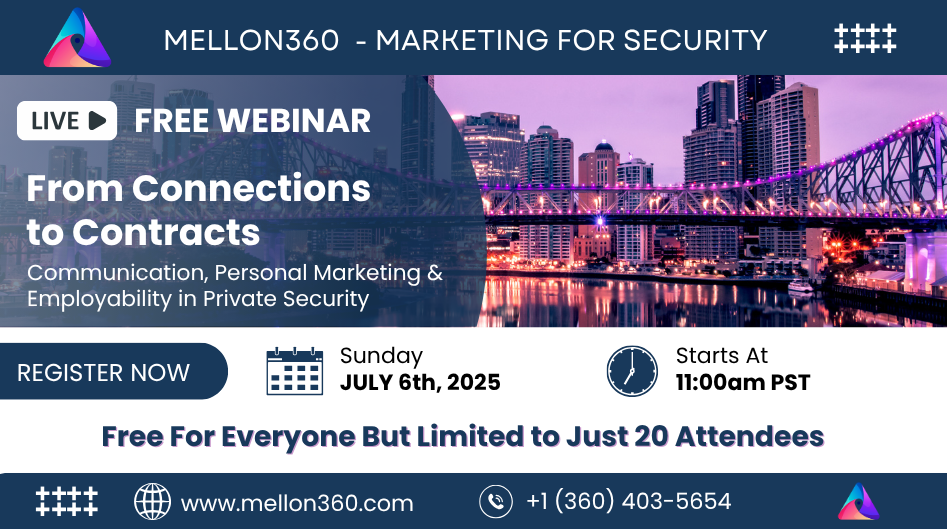
Join us for our first free webinar with Mellon360° Marketing For Security! Do you want to learn how to market yourself properly in the security industry and go from Connections to Contracts? Mellon360° Marketing For Security is hosting a FREE 3-hour webinar on a topic that’s often overlooked—or misused—in our industry:
Marketing for Security Professionals 📅 July 6th, 2025 🕛 11:00 AM PST 💻 Virtual
This session is designed specifically for professionals in physical or cybersecurity, as well as those transitioning from military or law enforcement roles.
At Mellon360° Marketing for Security, we specialize in branding and marketing exclusively for the security industry and we’re committed to helping our fellow professionals grow their careers and businesses.
Course Description: This webinar will help security professionals navigate the fine line between OPSEC, confidentiality, and effective self-promotion without compromising discretion.
We’ll cover the most common marketing and communication mistakes that can damage credibility or cross professional boundaries. You’ll learn how to build a trusted presence (especially on LinkedIn), how to use modern marketing tools in a strategic and ethical way, and gain practical tips on resume writing, event networking, and more to help you attract the right clients, employers, and collaborators.
Whether you’re in executive protection, risk management, intelligence, or cybersecurity, this session will help you communicate your value in a way that’s visible, professional, and aligned with the standards of our industry.
This webinar is free to attend (we don’t want your hard-earned money—buy yourself a coffee and join us!), but space is limited to just 20 participants.
Reserve your spot early! Visit https://mellon360.com/contact/, fill out the contact form, and mention “Marketing Webinar” in the message section.
Those who have been in the business for some time will tell you that executive protection is 90% about preventing threats and only 10% about responding to them. Preparation is key when it comes to protective details, and while physical security measures, highly trained agents, luxury vehicles, and advanced equipment are all critical components of any operation, one often-overlooked asset can mean the difference between proactive protection and reactive response: protective intelligence services.
We can all agree that the world is rapidly changing, and with it, so are the threats, how they materialize, and the individuals behind them. The ways in which hostile actors can reach and harm your clients are constantly evolving. A bodyguard today must consider and prepare for risks and threats that are significantly different from those of 15 or 20 years ago. The digital age has given criminals, stalkers, and hostile actors new tools to track, target, and attack high-profile individuals.
Protective details are often perceived by the public as a purely physical profession, standing guard outside a client’s hotel room, escorting them from point A to point B, and responding to immediate threats. However, in reality, there is far more happening behind the scenes. A successful protective detail involves more than just the agents’ strength or combat skills. A security team that relies solely on reactive methods rather than proactive strategies is doomed to fail. If your protective team lacks the critical foresight needed to anticipate threats, avoid danger, and prepare before a situation escalates, failure is inevitable and failure in this industry can mean human loss, physical harm, asset loss, or reputational damage.
If you ask executive protection (EP) agents how often they have been provided with necessary protective intelligence by the companies that hired them, the majority will likely tell you they haven’t, unless they worked for a major corporation that either invested in its own intelligence division or sourced intelligence from a third party.
The reality is that most security firms neglect to integrate intelligence gathering and analysis into their protective operations, often citing cost concerns or client unwillingness to fund such capabilities. This short-sighted approach leaves agents in the field operating in a vacuum, exposed to a variety of dangers, limiting their ability to anticipate threats, assess risks, and make informed decisions that could prevent an incident before it happens. These security providers fail to recognize that protective intelligence is now a fundamental part of executive protection, just as advances, risk assessments, and threat assessments are (or at least, should be, for those still neglecting these basics). Intelligence should not be provided only if the client requests it; rather, it must be an integral part of every protective detail.
The Role of Protective Intelligence in Executive Protection Settings
Decades ago, intelligence services were primarily associated with government agencies and large corporations. However, today, with advancements in technology and access to open-source information, intelligence can be integrated into organizations of any size, whether small or large.
Consider this scenario: Your protective team has taken all necessary steps to keep your client’s dinner meeting at an A-list restaurant safe and confidential. They even booked the reservation under an alias. However, another customer at the restaurant recognizes your client and tweets on X, “Guess who’s having dinner at our restaurant?” followed by #YourClientsName.
Now, the location of your client’s dinner is public knowledge, rapidly spreading across X and other social media platforms. Meanwhile, your executive protection (EP) team still believes the visit is confidential, unaware that the client’s whereabouts have been exposed. This is critical information they should have in order to take precautions and act accordingly. But without protective intelligence services, they wouldn’t even know the exposure had occurred.
Now, let’s consider another scenario. One of your clients is on a business trip, staying at a hotel. Nearby, a protest is forming and moving closer to the hotel. As a security provider, you would want to advise your client to stay put until the situation stabilizes. But again, without intelligence services monitoring such developments, you wouldn’t have the necessary information to take proactive measures and you would ignorantly move your client into harm’s way.
Why Intelligence Matters in Executive Protection
Executive protection is not just about reacting to threats, it’s about preventing them from occurring in the first place. This is where protective intelligence plays a crucial role. While general intelligence involves gathering and analyzing information across various domains, protective intelligence is a specialized discipline focused on identifying, assessing, and mitigating threats before they materialize into real dangers.
Many executive protection teams rely solely on physical security measures, such as bodyguards, armored vehicles, and surveillance equipment. However, without an intelligence-driven approach, these teams are operating in the dark, reacting to threats as they unfold rather than anticipating, mitigating, avoiding, and/or neutralizing them ahead of time.
The Role of Protective Intelligence
Protective intelligence serves as the foundation of proactive security. It enables security teams to:
–Identify Threats Before They Become a Problem – Protective intelligence involves continuous monitoring of potential threats, including hostile actors, criminal activity, cyber threats, and geopolitical risks. This allows security teams to take preemptive measures rather than relying on last-minute reactions.
–Enhance Situational Awareness – Protective intelligence provides real-time updates on crime trends, civil unrest, and other evolving security threats in locations where clients are traveling or staying. This helps protection teams make informed decisions, adjusting routes and security plans as needed.
–Mitigate Risks Through Social Media Monitoring – We live in a digital world and many threat actors use social media to track, expose, or target high-profile individuals. Protective intelligence includes monitoring online threats, identifying potential leaks of a client’s location, and flagging concerning activity before it escalates into a real-world risk.
–Support Advance Work and Security Planning – Before a client arrives in a city/country location, at a venue, hotel, or meeting location, protective intelligence ensures comprehensive site assessments. Intelligence analysts vet the security of these locations, identifying potential risks and enabling teams to establish backup plans in case of emergencies.
–Provide a Strategic Advantage to Executive Protection Teams – Without protective intelligence, bodyguards and security teams are left to react to threats in real time, often with limited information. With intelligence, they gain a strategic advantage, allowing them to operate proactively and avoid unnecessary risk exposure.
While executive protection agents are considered the last line of defense, intelligence services can extend their protective reach beyond the immediate environment as they can provide:
Location-based and Situation-based risk assessments – Evaluating crime rates, political instability, and recent incidents at destinations.
Live threat alerts – Real-time updates on emerging dangers such as civil unrest, roadblocks, or suspicious individuals.
Pre-mission planning – Conducting advances on venues, hotels, and travel routes to preempt potential risks.
Why Small Firms Avoid Intelligence Services
However, despite its undeniable value, or how many will seek education on the topic, many executive protection firms only integrate protective intelligence when a client specifically requests it, and they can charge for it. This is a highly flawed approach because protective intelligence should not be seen as an optional service to add on, but it must be a core component of every security detail!
A team that operates without intelligence is only providing half of the protection necessary to keep a client safe. In contrast, a security team equipped with protective intelligence is proactive, informed, and always one step ahead of potential threats. The reality is that many small executive protection companies skip intelligence capabilities because they often function on tight budgets and want to prioritize the most visible security measures which are bodyguards, vehicles, and sometimes surveillance equipment without realizing that intelligence is the very foundation upon which these elements should be deployed.
However, waiting for a client to demand intelligence services before integrating them into a security operation is fundamentally flawed. A security company should be advising the client on what is necessary, not the other way around. And when the client does not wish to pay for it, then what? You should have it as part of the services you provide in order to prepare and equip your agents best. The reluctance to invest in intelligence is a classic case of reactive security planning instead of proactive threat mitigation and that comes with a cost.
The cost of ignoring the use of protective intelligence is exposing themselves to unnecessary risk and liability. A single incident, whether it’s an ambush, a targeted attack, an embarrassing situation, or even a travel or meeting disruption, can severely damage a company’s reputation, not to mention endanger lives and assets. On the other hand, an intelligence-driven approach enhances the professionalism of a firm and gives clients a reason to trust in the protective measures they provide.
Again, consider this scenario: A protective team is escorting an executive to a conference in a foreign city. Without intelligence, they are unaware that the hotel is located near an area experiencing political protests. A sudden outbreak of violence places the client and the team at risk. With an intelligence component, this risk would have been identified in advance, and an alternative plan could have been executed.
Making Protective Intelligence a Standard, Not an Option
Security firms must begin treating protective intelligence services as a standard part of their operations, not an add-on that only high-budget clients receive. Even small firms can develop intelligence capabilities by:
Hiring or outsourcing intelligence analysts who can provide actionable insights.
Using open-source intelligence (OSINT) to monitor real-time threats.
Using technology and proper AI-driven tools to track risk factors across different regions.
Training security personnel to integrate intelligence into their daily routines.
Prevention can be more effective than reaction, considering the fact the enemy holds the element of surprise and chooses when, where and how. The primary goal of a protective team is to be able to detect when, where and how and take proactive actions to prevent attacks.
Protective Intelligence services allow for: -Early threat detection – Monitoring and identifying potential threats before they become direct dangers. -Predictive risk analysis – Understanding patterns of criminal activity, protests, or hostile surveillance. -Strategic planning – Knowing the safest routes, venues, and contingency plans in advance.
An intelligence-informed protective team doesn’t just protect, it ensures their client never even faces the threat in the first place. Protective intelligence should not be seen as merely an expense but an investment in the effectiveness and credibility of a security detail. The most successful executive protection teams are those that blend physical security with actionable intelligence, ensuring they stay ahead of threats instead of merely reacting to them. When a protective team has access to protective intelligence, they elevate their role from a “security presence” to a “security strategist.”
It is time for executive protection companies, especially the smaller firms, to rethink their approach. Intelligence is not a luxury; it is an operational necessity that must be built into every protective detail, regardless of client expectations. If the goal is truly to protect, then intelligence must be at the core of every mission.
The recent assassination of UnitedHealthcare CEO Brian Thompson has cast a spotlight on the vulnerabilities faced by many corporate leaders and is a great example of how C-Suite executive’s safety can affect not only their personal wellbeing, but also can drastically affect a company’s reputation and stock. According to News Nation, UnitedHealth Group shares are down more than 14% since Thompson was shot and the company is counting its losses in billions.
While many corporations see security as an unnecessary financial loss and many won’t consider it in their budget, history has shown us that failing to protect their executives can cause an enormous financial loss. As we have seen, there have been many reported incidents surrounding violence towards C-suite executives. Some of the most well-known cases, the kidnappings of the Toronto crypto company CEO who got kidnapped last November and was held for $1M ransom before being released, the murder of the tech executive Bob Lee, founder of Cash App in San Francisco, in 2023, and the death of another tech executive Vivek Taneja, who was assaulted in downtown D.C. on February of the same year and succumbed to his injuries a day later. These incidents, along with many others, bring again to light potential dangers that corporate leaders face today.
While the general public assumes that all high-profile individuals, including celebrities, have security, the reality is that many C-suite executives operate day-to-day without any security presence. Whether they are traveling for business, attending meetings and conferences, or simply going about their daily routines, these individuals often find themselves exposed to various threats without the support of a dedicated security team.
The reasons for this vary. In some cases, the cost of executive protection is not prioritized within the company’s budget. In others, reductions in force (RIF) have affected the security team. Additionally, even when security is provided, many executives resist it, preferring to avoid the perceived inconvenience of having protection around them. One of the biggest challenges when assigning security to specific individuals is their non-compliance, as they believe they will lose their privacy and be forced to change how they live their lives.
Significant Incidents Involving CEOs:
Brian Thompson was the latest victim, but not the only one by far:
51-year-old Forrest Hayes, the former senior director of Apple’s worldwide operations, was killed by a high-priced prostitute who injected him with a lethal dose of heroin and then left him to die on his luxury yacht.
In 2019, Tushar Atre a tech executive and founder of a Santa Cruz-based web design company, was kidnapped from his home on October 1, 2019. He was later found dead in his girlfriend’s BMW SUV. Several suspects, including former employees, were arrested in connection with his death.
In 2022, Artemis Seaford, a high-level executive at Meta and dual U.S. – Greek national, was found to be surveilled by surveillance-for-hire software for around one year.
In 2015, Tadas Kasputis, one of the founders of CoinStruction and the ExMarkets crypto-exchange was kidnapped in his hometown Kaunas city in Lithuania by criminals who wanted to gain access to his crypto wallet.
In 1998, Bill Gates, was hit in the face with a cream pie as he was about to enter a building for a meeting in Brussels.
In 2018, Jeff Bezos had his mobile phone “hacked” after receiving a WhatsApp message.
As we can see from multiple cases, threats towards these individuals can come from any direction and at any given opportunity. Those of wealth or stature in society find themselves becoming a target or being “condemned” by groups who feel that they somehow deserve more and that their goal is best obtained through violence of some sort.
We all saw how executives and personnel from pharmaceutical companies were targeted during the Covid lockdowns and how specific minorities (Asian) have been singled out for harassment recently due to stories surrounding the supposed origins of Covid as well as the tedious political arena of U.S/Chinese relations. Russian businessmen/women have become victims of various crimes against themselves, their families, assets, and companies.
The Need to Protect the Brand
One thing that often escapes the attention of many corporate boards is that CEOs and other high-level C-suite executives are not just leaders of their organizations, they are the face of the company, the human embodiment of the Brand. Protecting these individuals extends far beyond safeguarding their lives; it is also about safeguarding the brand’s reputation, market value, and future stability.
The visibility of executives today has grown exponentially. Shareholders, clients, and the media closely associate a company’s identity and trustworthiness with its leadership team. When a CEO or prominent executive is harmed, whether through assassination, kidnapping or any other physical harm, the ripple effects can be catastrophic for their organizations. Such events can erode stakeholder confidence, shake public perception, and cause financial volatility.
For example, and as we mentioned earlier, following the tragic assassination of UnitedHealthcare CEO Brian Thompson, the company’s stock value reportedly dropped over 14%, resulting in billions of dollars in losses. This kind of damage is not limited to financial metrics alone; it can also impact on employee morale, customer trust, and the company’s ability to attract new business.
The brand-equity connection is further amplified in industries like technology, finance, crypto and healthcare, where executives are often seen as visionaries or cultural icons. Consider figures like Bob Lee, founder of Cash App, whose untimely death not only shocked the tech world, but raised concerns about safety for executives in high-risk urban environments. In these scenarios, the absence of robust protection not only puts lives at risk but also undermines the strength of the brand narrative and leadership continuity.
Corporate boards must understand that executive security is not just some numbers in your budget as an expense, but a proactive and strategic investment in their brand protection. While the first thing that comes to mind is the importance of preserving human lives, organizations have to also realize that any harm done to their executives and employees will have a tremendous impact on their business.
The loss of the leaders in their business (the brains behind their products), the loss of their intellectual property, and the disturbance of their daily operations will cause the employees, customers and investors to lose faith in them. Failing to protect their own executives leaves companies vulnerable, not just to physical threats but to reputational damage that can take years to repair.
One thing that has become increasingly apparent in light of these recent incidents is how surprisingly easy it can be for individuals, often with limited resources, minimal planning, and very little experience, to approach, harm or embarrass high-profile public figures, including CEOs and other C-suite executives. These events expose a concerning vulnerability: corporate leaders, who represent power and authority can still be physically or reputationally damaged with alarming ease.
The very perception of strength that many companies project, be it through financial dominance, market influence, or industry leadership, can quickly crumble when their most visible representatives are attacked or harmed. It reveals the “giant with feet made of clay”: an entity that appears powerful and unstoppable on the surface but, in reality, cannot adequately support or protect its executives, leaving them exposed to danger.
This illusion of invincibility creates a dangerous dichotomy. While corporations may excel at presenting their resilience in business operations, their failure to ensure the security of their leadership undermines their credibility. Each time a CEO or executive is harmed (whether through kidnapping, physical assault, or character assassination) it sends a message to stakeholders, employees, and even competitors that the “giant” is vulnerable. The company’s façade of stability cracks, and the repercussions can be severe:
Financial Fallout: Attacks on executives often trigger stock price drops, erode investor confidence, and cause millions, if not billions, in losses.
Reputational Damage: If a company cannot protect its leadership, what message does that send to clients, employees, and the public?
Operational Disruption: The absence or incapacitation of key executives can destabilize decision-making and hinder long-term strategic goals.
High-profile incidents, like the assassination of UnitedHealthcare CEO Brian Thompson or the kidnapping of crypto executives such as WonderFi’s Dean Skurka, are not anomalies, they are warning signs. They demonstrate that harm can come, not just from organized, well-funded adversaries or criminal organizations, but also from individuals acting alone with limited means. These cases emphasize a critical truth: public figures, especially those in leadership roles, are increasingly accessible targets.
Companies must reassess their priorities and abandon the illusion that their leaders are untouchable simply because they are perceived as powerful. Executive protection for your C-Suite executives is not a luxury or a budget allowance; it is a necessity. A company that fails to shield its most visible assets, its leadership, risks becoming a symbol of fragility rather than strength.
What Comes Tomorrow?
For those closely following the latest incident, the aftermath of UnitedHealthcare CEO Brian Thompson’s assassination reveals troubling insights into public perception and growing hostility toward corporate leaders. Social media platforms quickly became a breeding ground for disturbing reactions. The majority of users were seen mocking or justifying Thompson’s death, with some going so far as to openly encourage similar attacks against other CEOs.
This online vitriol has already inspired real-world consequences. In a concerning copycat case, Briana Boston, a 42-year-old Florida woman, was charged after allegedly making a threatening call to BlueCross BlueShield over a rejected medical claim. While her actions did not escalate to violence, the threat underscores how quickly frustrations directed at executives can boil over into actionable hostility.
The assassination of Brian Thompson has set off a dangerous chain reaction. According to a recent warning issued by the New York Police Department (NYPD), US healthcare executives now face a heightened risk to their safety. Authorities uncovered an online “hitlist” circulating in the wake of Thompson’s death, featuring names, photos, and salaries of numerous other health insurance executives.
This list has amplified the sense of vulnerability. Executives who were once seen as inaccessible are now being publicly targeted. Compounding the issue, “wanted” posters featuring the faces and personal details of healthcare CEOs have appeared throughout Manhattan. These acts, whether meant as intimidation, protest, or a precursor to violence, signal a troubling escalation of hostility toward corporate leadership.
We are dealing with a disturbing growing phenomenon: digital outrage is no longer contained to online spaces. Social media platforms, already rife with grievances about systemic inequities, economic struggles, and corporate distrust, are now amplifying calls for real-world action against executives. Online forums and posts can radicalize individuals, especially those with personal frustrations or grievances, encouraging them to take matters into their own hands.
What comes tomorrow is not limited to healthcare. Brian Thompson’s assassination and its fallout serve as a stark warning to leaders across all industries. CEOs and C-suite executives are increasingly vulnerable, both as visible symbols of power and as targets of systemic frustrations.
Companies that fail to recognize and respond to this evolving threat landscape risk not only the lives of their leaders but also the stability of their operations and the trust of their stakeholders. The time for reactive measures has passed. A proactive, strategic approach to executive protection is now a necessity.
Don’t Be The “Giant With Feet of Clay’’
The evolving threat landscape necessitates a proactive approach to C-Suite executive protection. Companies should start thinking proactively, stop placing security as the first budget cut and must balance the need for security with the personal preferences of their executives, ensuring that protection measures are both effective and minimally intrusive.
Prioritize Executive Security: They should start treating executive protection as an integral part of corporate strategy, not an afterthought.
Adopt Proactive Risk Management: Conduct threat assessments, monitor vulnerabilities, and implement protective measures before incidents occur.
Invest in Discreet and Effective Security Solutions: Develop security protocols that do not disrupt executives’ lives but still provide robust protection.
As we have seen, the message is clear: the world has changed, and so must corporate priorities. CEOs and other C-suite executives are not only the face of their organizations, but they are also vital assets whose safety directly impacts a company’s stability, reputation, and bottom line. Ignoring this reality exposes businesses to unnecessary risks that can have catastrophic consequences.
The “giant with feet made of clay” is no longer a metaphor; it is a warning. Companies must shed the illusion of invincibility and untouchability and take decisive, proactive action to protect their leadership. By prioritizing security, managing risks effectively, and implementing discreet security measures, businesses can protect not only their executives but also their brand, market value, operations, and future success.
In an era where a single incident can bring a giant to its knees, the choice is simple: adapt and fortify, or remain vulnerable and hope you are not next.
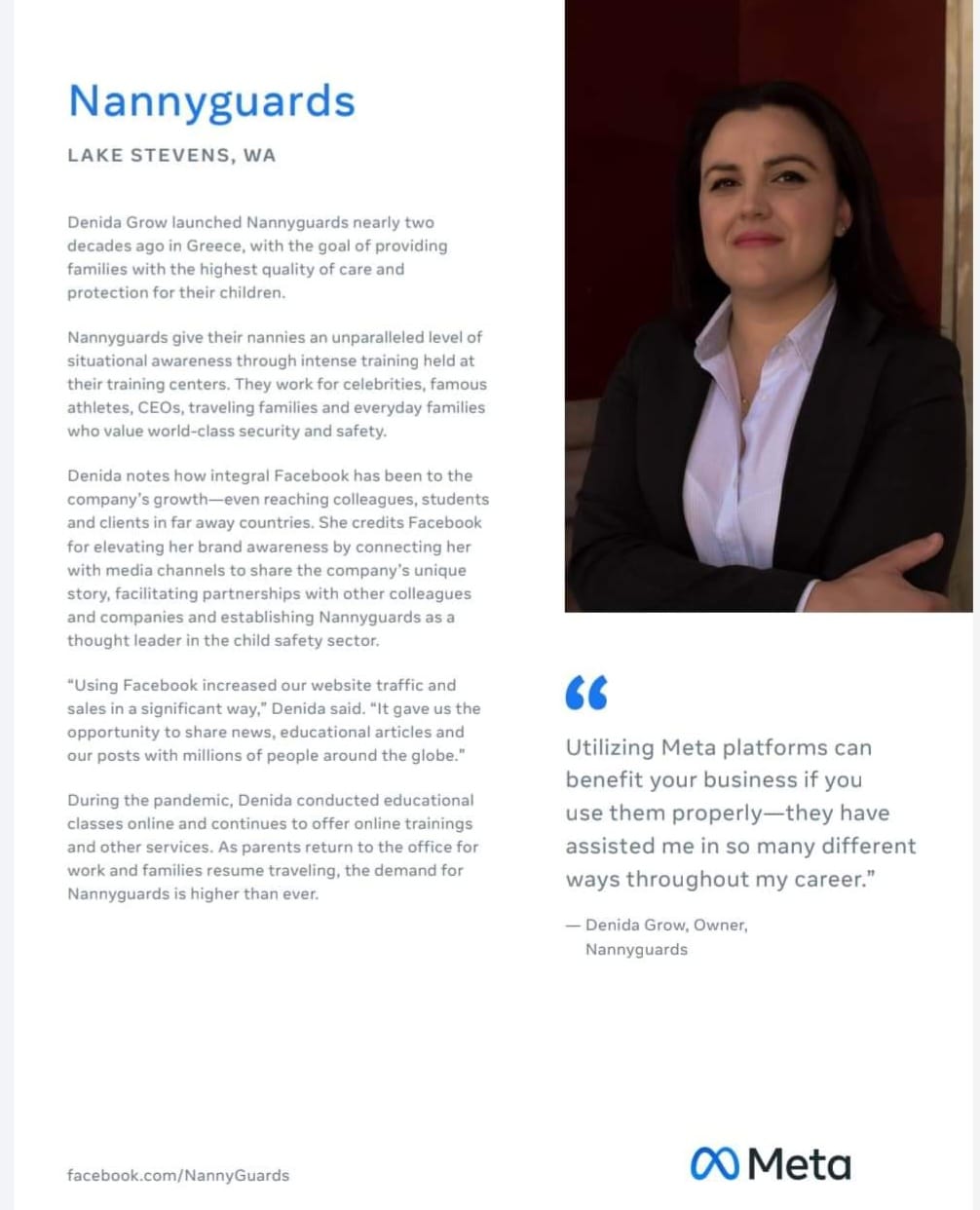
We are very happy and quite proud to announce that Nannyguards has been selected by the Leaders Network team at Meta to showcase our success story. It has been a tough road and many long hours since the very first day Nannyguards was created and we feel extremely blessed to share our work and heartfelt passion with some amazing professionals who have since joined our team. Dr. Mary Beth Wilkas Janke (Psychology), JD Elkin (Cyber Security Awareness), Kelly Sayre (Situational Awareness) and Chris Grow.
Even though I addressed this subject over twelve years ago, the same still rings true. In the world of executive protection/close protection, there are already so many distractions, pitfalls, and misunderstandings that I believe there is a veritable need to, again, address the distinction and perceived necessity surrounding certifications, licenses, and memberships/associations that so many new practitioners fall prey to in their quest to achieve their career goals of becoming a truly professional executive protection or close protection agent. Let’s take a few minutes and see if we can answer a couple of your important questions and get you headed in the right direction…
In our latest interview with expert Nick Barreiro, Chief Forensic Analyst of Principle Forensics, we discussed the security risks from any/all social media platform postings and how someone can obtain critical information from your pictures. If you haven’t watched the interview yet, please find it below
According to Vice’s latest article, authorities have been following Instagram profiles of the women related to, or involved with, Russian oligarchs to obtain information about them, their holdings, accounts, and locate assets to seize/freeze by merely identifying and following the weakest link who posts the most. These women who act like ”influencers” or social media celebrities are looking for publicity, but they now represent a significant threat to the security of the individuals they’re around and expose them to unwanted scrutiny. ”Oligarchs themselves rarely use Instagram to accidentally crack open a window into their high living. Rather, it’s the people partying with them: A stepdaughter, an ex-wife, or in the least one infamous case, an escort.” Read the full article here.
The use of social media and the way it affects our lives and businesses have brought a new challenge to the security industry and the protective team’s responsibility. It gives the entire world the ability to look into people’s lives with the mere push of a button. Scandals are created, secrets exposed, and lives ruined. In the case of personal security, social media can be used in the advancement of a protective detail; however, one must know how to utilize it properly. Today, we will talk about Social Media Investigations and Monitoring. For those who are not aware of the term, as we utilize it in protection circles, Social Media Investigation and Monitoring is the process by which you can identify what is being said about your clients, a brand they represent, or the corporations with which they are involved and any threats or dangers that may exist in relation to those aspects.
As we sift through different social media platforms and online channels, we must then determine if what is being said has any significance regarding your clients’ reputation, persona, and safety and if there is the need to mitigate any risks. In other words, it’s like setting up an online, social media “net”. This process then helps you discover everything that is being said, written about, or portrayed on social media and determine its relevance to your clients. You can gather information about the ‘’public opinion’’ surrounding your clients, about people or entities who are angry with them for one reason or the other, people who are obsessed with them, or people who are making online threats. SOCMINT or Social Media Intelligence (not to be confused with OSINT) has seen a huge rise in necessity due to the use of social media and a competent protective detail needs to always be informed and social media investigations and monitoring are a huge part of this process.
Now, let’s see some examples of how social media investigations and monitoring applies in protective services. Let’s say one of the people you are protecting belongs to a large pharmaceutical company and they decided to raise the price of a specific drug, thus affecting the lives and wellbeing of thousands of people. Perhaps another client is involved in a financial institution that quite suddenly makes a significant decision that affects people’s lifetime savings and pensions. You can imagine that there will be a significant number of people who become very angry, and some may want to harm your client. During the recent pandemic, there were a number of “anti-vaxx” groups that were quite vocal and utilized Facebook as one of their many platforms to accomplish their goals. Another example would be the need to discover if there is someone using your client’s name or company to scam others and commit crimes.
We are sure that many of you today are aware of the infamous ‘’Tinder Swindler’’, Shimon Yehuda Hayut, who legally changed his name to Simon Leviev to pretend to be the son of the billionaire Lev Leviev and used his name and company logos to scam people. Although his actions were known since 2017, it was only after the airing of the Netflix documentary in 2022 that the Leviev family found out and filed a lawsuit against Hayut for falsely portraying himself as the son of Lev Leviev, receiving benefits, and committing crimes.
According to Leviev’s family attorney, Guy Ophir, they will now include anyone who has attempted to make a profit from his scam during the next lawsuit. What we can ask is, as security providers, why didn’t someone from the real Leviev family ever discover this scam artist who was extremely public and active on social media as the ‘’son of Lev Leviev’’? Although the real family members were never part of this fraudulent scheme, and it didn’t appear to affect their safety, it did, however, involve their name/brand in a very public and negative way. In other words, it should have definitely been considered as a threat to their reputation. Other people who were harmed by this scam artist were the businesses who did work with them, and their secondary service providers as well.
Another interesting case to mention is Elon Musk where he, the actual client, took it upon himself to “solve” the issue and directly contacted the person of interest who had begun posting his private flight details and created the security risk for him and was literally blackmailing him unless the POI was paid. According to media reports “Elon Musk states social-media accounts that track his travel movements are ‘becoming a security issue.” Tail numbers and yacht names of billionaires are increasingly being shared on online platforms and one can track them by having the appropriate app unless significant efforts are made to secure them from the reach of those diligent few. These are some unique specific details that the security team needs to pay close attention to at all times.
Since Social Media platforms are the way people today communicate with each other, we as security providers must keep in mind that this is not always a positive aspect. Perhaps a person or persons will utilize social media to collectively gather people with their same goal or mission, to get together and plan their next move (Example: protesting outside your client’s house or corporation). In this case, you will want to know what is being said online about the person you protect to determine if there is something of extreme necessity to include in your risk and threat assessment and then take protective measures as well as inform their legal department.
As we have all witnessed too many times, it only takes one well-placed picture or story regarding some alleged activity on the part of your client, and it will go viral quickly, truth or not. Staying one step ahead of this type of “attack” has become a crucial necessity in order to protect your client from embarrassment or exposure. One of the most common issues in recent history is when personnel close to the client i.e., family, staff, vendors, and any other secondary customers post pictures, stories, or opinions and subsequently fail to understand the negative effect these types of communications can and will have on the client’s life, business, and the lives of their loved ones.
2) To discover what information about your client is posted online either by himself, the ones close to him, or his employees and evaluate how these affect his safety.
3) To evaluate a threat (someone is posting online threats directed at your client).
4) To add to your due diligence.
5) To geolocate a picture or a video, sometimes even audio.
6) To include any findings in your Risk and Threat Assessment (We can never highlight this enough, social media surveys and investigations are now a critical part of your Risk and Threat Assessments).
7) To find people obsessed with or following your clients (stalkers).
8) To identify hate groups or terrorist organizations that may affect your client.
9) To identify people or businesses your client may or may not want to do business with.
10)To mitigate risks from the information found online about the person you protect (How are the pictures of my client used or tampered with and for what purpose?).
11)To identify if someone is impersonating your client or a family member.
12)To find out if your client’s moves/visits/travels are posted online (Exposing them to others who may be in the same hotel, conference room, restaurant).
13)To identify workplace violence or insider threat indicators.
14)To find out what is the ‘’public opinion’’ regarding your client (Always keep an eye on what is being said about your client and have a strategy to respond).
15)To determine if a person or persons are utilizing your client’s name or business name in a malicious or unauthorized manner for their own personal gain. (Claiming associations or partnerships, etc.)
How to perform Social Media Monitoring for security purposes?
First, let’s clarify one important thing. ‘’Googling it’’ is not enough, nor is it the answer. There are a number of search sites that allow for user input thus watering down or contaminating information and it’s accuracy. For those who are not aware, Social Media Investigations and Monitoring is quite a different department of protective services and quite often falls under Intelligence Analysis and Open-Source Intelligence. It requires unique skills and knowledge. One must clearly understand different social media and research platforms and how to use each one of them (and/or in combination) to obtain information. How you will approach each case is different and certainly depends on who your client is, their business, close relations, and/or their public image. This will directly affect the searches and the resources used and for what purpose. It is vital in our current day and age to include SOCMINT (Social Media Intelligence) in your client’s service proposal, no matter how public the person may or may not be. Hiring ten Executive Protection agents and a Residential Security Team is not enough anymore. SOCMINT services are a vital part of your Risk and Threat Assessments (Dynamic Risk Assessments too) and enable your protective detail to function more efficiently.
For those who can not provide a certified Social Media Investigator for their clients, follow up with these steps:
1)Understand who your client is, his/her background, the threats, where do they stand in political, social, financial sectors.
2)Be aware of any of the latest changes in your clients’ lifestyle, public opinions, and professional decisions.
3)Be aware of any of their political and social changes. Watch the news from multiple channels.
4)Familiarize yourself with all close family, friends, staff, and associates and their respective social media footprints.
5)Set up a social media investigation and monitoring strategy.
6)Have a good understanding of the Intelligence Cycle (How the intel is being collected, analyzed, disseminated, reviewed, etc.).
7)Have a good understanding of the search tools on different platforms (Facebook, Twitter, Instagram, TikTok, LinkedIn, Tumblr, Reddit, etc.)
8)Do research on the available search engines and the strengths and limitations each one may have.
9)Know how to conduct image, video, and audio research and gather intelligence from them.
10)Invest in appropriate platforms for social media investigations and monitoring (Have in mind, NEVER rely on one platform’s result or just platforms’ results. The user/investigator is the main component of a social media investigation).
11)Download and use appropriate search engine extensions and apps.
12)Invest time in creating ‘’sock puppets’’ or fake profiles and maintain their persona. Sometimes you may need a profile to have access to different forums or groups without being discovered.
13)Train yourself in link analysis (How to look for connections between people, events, and organizations).
14)Set keyword alerts (In multiple languages in case your client has ties with more than one country).
15)Gather, analyze, evaluate, and report your findings to the appropriate department or leadership.
As the threat landscape changes every day, we as protection providers must be able to adapt and keep ourselves up to date with additional training. Today’s executive protection agent must also be skilled and knowledgeable in investigations, open-source intelligence, protective intelligence, HUMINT, and have an increased understanding of cyber security. Large corporations have already created their own embedded intelligence departments, while others are hiring threat analysts and OSINT investigations from outside security providers. The rise of protective intelligence, and whatever that includes, is here to stay and we are seeing it more and more through the highly increased number of related job postings every day.
If you are an Executive Protection Agent and want to learn more on how to utilize Social Media Investigations and Monitoring for Risk Mitigation Purposes, reach out to us.
f you are a service provider and want to add Social Media Investigations and Monitoring for Risk Mitigation Purposes on your service list, contact us to learn about our vendor services.
One of the biggest challenges that the majority of the security companies will have to deal with is not so much being able to obtain a contract, but to be able to properly maintain that contract once it’s signed and done. We are all quite aware of how many times the intricate contracts for various clients have changed hands over the years. While some might think it is hard to land a good contract, maintaining it professionally and properly while providing what you are being paid for may be very difficult for some companies. According to numerous studies, the average company loses nearly 10% of their clients due to their poor contract management. Why is that? Well, managing contracts (and the corresponding projects) is an overlooked form of corporate leadership and a large part of a company’s operational function and market viability. Project and contract managers must be able to interact frequently with their agents in the field, subcontractors, vendors, stakeholders, family offices and, more often as not, the client himself/herself.
‘’The International Association for Contract & Commercial Management (IACCM) identifies 7 major areas of contract management weakness:
Disagreement regarding contract scope
Weaknesses in contract change management/retention
Performance failures due to over-commitment
Performance issues related to a disagreement/misunderstanding over what was committed or requested
Inappropriate contract structures
Disputes over pricing
Issues with subcontractors’’
Now let’s discuss some of the most common causes that may cost a security provider one of their contracts:
You are charging significantly more than is proper (Faulty Pricing)
At some point we have to admit that quite a number of companies will overcharge a client merely because of who the client is and not particularly what their security needs or threat level may be. You cannot begin to expect one client/contract to change your own wealth status or single handedly build your company’s gross revenue and/or profit. It is neither ethical nor professional for your corporation to make 2 to 3 times more profit than the agents working the detail on the ground. We all have our levels of operational expenses, but don’t pass that bill on to the client or your protective agents. Make a profit, but make one within logical expectations.
2. You are ‘’suffocating’’ your client
Either: A) You have placed more agents than are needed (Again, this comes back around to profit: The more agents on the ground, the more you can charge), B) Your agents are not exercising proper situational awareness and how to be flexible with protection levels versus the client’s perception of asphyxiation, or C) The company holding the contract has not done a proper Risk/Threat/Vulnerability Assessment and/or are not trained, experienced or knowledgeable enough to ascertain proper staffing and logistics. Some companies will ‘’overreact’’ on the threat level to make their services appear quite necessary to the client, while in reality, achieving the opposite result.
3. Not being able to provide services as promised
A protective detail is comprised of many elements and sometimes you have to be able to provide additional services as you go. You must be the one who can foresee what is or will be needed and provide it before the client even asks for it. We have heard of many companies who fail to render even the basics of what they agreed to provide. We have seen details operating with less manpower than what was requested or changing the personnel so often because they fail to keep the professional agents or cannot staff it properly. Have in mind, clients need stability and familiarity and will become unsettled when they see or must become accustomed to new faces.
4. Failure to accommodate clients needs and solve operational issues (Lack of Customer Insight)
We’ve all heard the phrase, “The client is always right”, correct? Well, from the moment you signed that contract, you alone are the one who must do whatever it takes to construct a smooth protective detail and provide peace of mind to the person who hired you. You alone are the one who must be stressed, work long hours and find a way to solve any issue with the security team or the client’s needs, not the client. It must appear as though all is under control and operational.
5. You are not providing services to a level or standard that is expected and required
We can all agree that our prospective clients will want 3 things: A) To be protected, B) To have the best close protection agents, staff and logistics that their finances can obtain (they fully believe they are paying for the best either way) and C) To have peace of mind. If your corporation is hiring unqualified, unprofessional or unethical agents, or utilizing contractors of the same substandard quality because you refuse to pay for the ‘’good ones’’, the client will soon start looking for another company.
6. Your Project or Contract Manager has no vested interest in the contract (Neglected Contracts)
This occurs so many times when the person who is working for an ‘A’ list company, as a Project or Contract manager, simply doesn’t care to deal with the issues, stay intricately involved or maintain the contract for his company. Most fail to have good communication skills, which is one of the key elements when dealing with clients, vendors, staff, stakeholders or agents in the field. How you communicate during common, day to day interactions with people or personalities will be just as valuable, or more in some cases, as to how you react during a crisis situation and the solutions you are expected to provide. Merely having a project or contract manager on your staff isn’t nearly enough. You must have an individual who can be extremely flexible, can develop a strategy out of thin air and be able to solve complex issues, without raising undue alarm, if they arise.
While these are just a few of the common pitfalls that a contract manager may find themselves encumbered with, each client and contract are unique and every company needs their respective contract managers to be creative, innovative, and highly observational so as to catch any of these issues far before they become problematic and present solutions to overcome them. Our task is not just to sell the client on our services and then walk away, but we are expected to, and should without failure, continue to provide the highest level of service and commitment to our clients that they have come to expect. The sale is the easy part…How we treat and care for the client and their contract once we sign on the dotted line will either build our reputation and lead to more success or it will cause a loss of trust and failure that cannot be easily repaired or regained resulting in the loss of the contract.
We will be launching a series of educational webinars that are absolutely free to attend. The aim of the webinars won’t be to present people and their past stories, but to have specific guests who will combine their experience and training in the industry in order to teach you something new, to help your professional development and to provide consultation for you. They will share their opinions, the “do and don’ts” of the industry and answer your questions.
And the best part? The content of each webinar will be developed by you! While we are working on our next webinars, let us know either by a comment here or via email at info@lemareschal.com what topics would you be interested in having discussed, answered and/or receive consultation on? This is a webinar created for you, by you!